
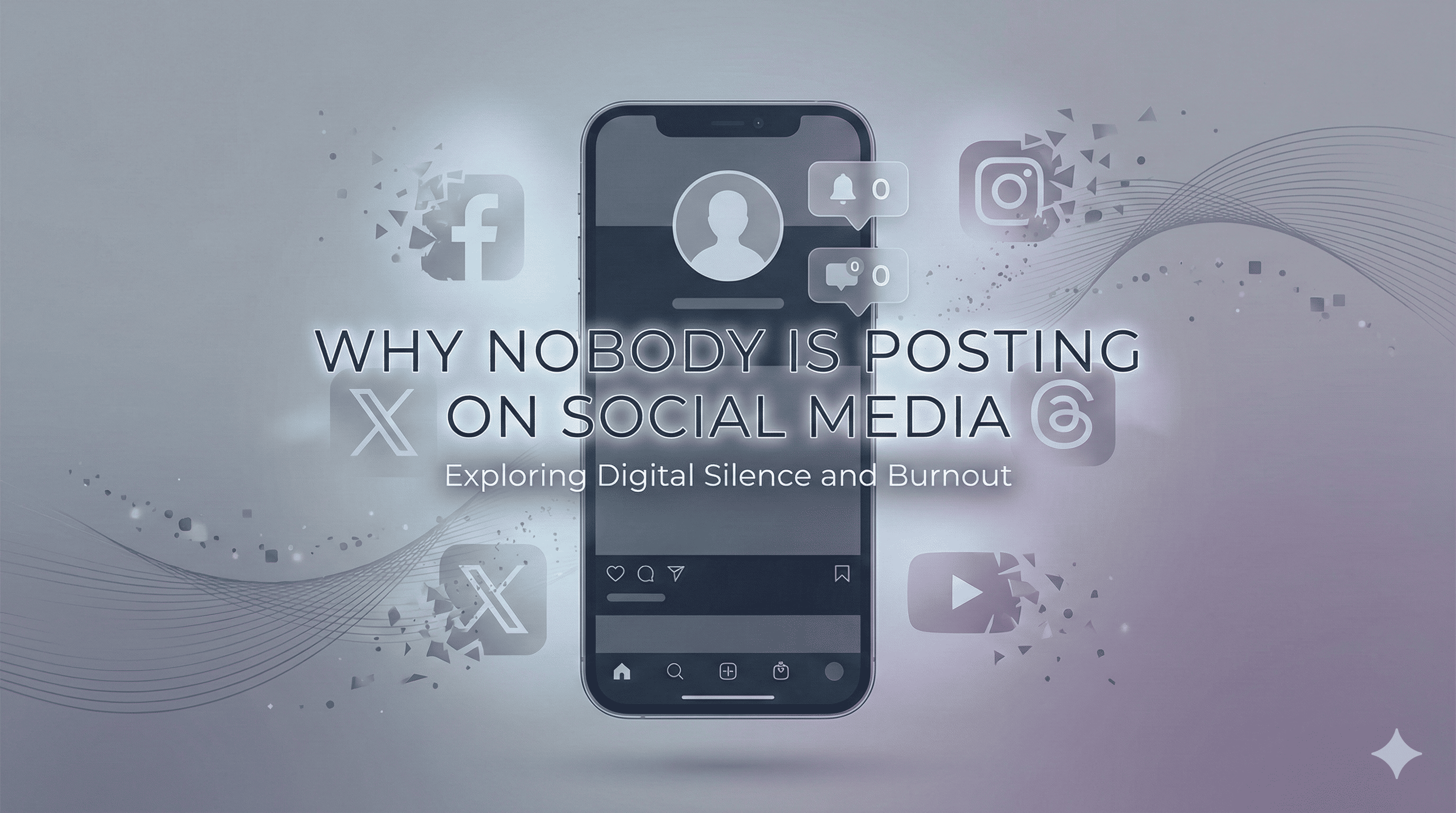
Why Nobody Is Posting on Social Media Anymore (The Rise of “Posting Zero”)
Open any app on your phone and it feels like the volume is stuck on maximum. There are ads, reels, AI slop, viral videos, and the same soundtracks looping over and over. It feels like a constant digital screaming match. Yet, in the middle of all this noise, the people who once filled these platforms with their lives are going quiet.
A new trend explains this silence: “Posting Zero.” People are still online, still scrolling, but they are not sharing like they used to. A major global study backs this up and helps explain why so many users, especially young people, are stepping away from posting.
Here is a closer look at what is going on, why it is happening, and what it would take to bring back a more human internet.
The Internet’s Paradox: Louder Platforms, Quieter People
“It has never felt louder and busier.” That is how today’s internet feels for many users. Open your feed and it is an endless scroll of:
- Ads for skincare or gadgets you never asked for
- Reels you have already watched ten times
- Clips promising to teach you how to make your first million by 24
- AI-generated models that are not even real people
The result is a space that feels less like a community and more like a shopping mall designed by an algorithm. Everything is polished, optimized, targeted. At the same time, the messy, personal, everyday posts that once defined social media are vanishing.
The paradox is simple. The platforms are louder than ever, but the actual people feel quieter than ever.
A Global Study Shows People Are Posting Less
To understand this shift, researchers ran a large study across the world. The results were clear, and a little surprising.
A Massive Sample And A Clear Trend
The study covered 50 countries and included more than 250,000 people. That is a very strong sample size for a look at global behavior.
Here is what it found:
- Social media usage is down by about 10 percent
- The decline is driven mostly by young people
- Gen Z users, who grew up with smartphones, are the most likely to step back
In other words, the people who were once most glued to their phones are now starting to turn away from posting.
This is not about everyone quitting the internet. It is about people changing how they use it.
What “Posting Zero” Really Means
Researchers and commentators have started using a name for this shift: Posting Zero.
It sounds fancy, but it describes something simple. People are still on social media, they are just not posting their own lives anymore.
You can think of it as a move:
- From sharing to watching
- From “Look at my life” to “I will just scroll in silence”
In the early days, timelines were full of:
- Breakfast photos
- Pet pictures
- Gym selfies
- Random life updates no one really needed
It was chaotic and sometimes annoying, but it felt human. People posted without overthinking it.
Now many users prefer to say nothing. They watch others, but keep their own lives off the feed. That is Posting Zero.
So why is it happening?
Reason 1: From Messy Feeds To Polished, AI-Shaped Timelines
The first reason has to do with how platforms have changed over time.
When Social Media Was Messy And Human
When social platforms first took off, they were rough around the edges. People shared whatever they liked, without filters or strategy. A typical feed looked like this:
- A blurry photo of someone’s morning coffee
- A dog trying to jump on a couch
- A mid-workout selfie
- A random thought about a TV show
It was not pretty or polished. It did not feel like a performance. That was exactly why many users loved it. You saw real friends and real moments, not a never-ending stream of content built to sell you something.
A Feed That Looks Like It Was Designed By AI
Compare that to many feeds today. The same user now sees:
- A skincare ad every few posts
- A reel they already watched on another app
- A self-proclaimed guru teaching them how to get rich
- A perfectly styled model who turns out to be AI-generated
Real people start to fade into the background. Friends’ posts get buried under sponsored content and suggested videos. The platforms feel less like places where people hang out and more like malls or TV channels.
There is even a word for this pattern.
The Word That Explains It All: Enshittification
Commentators call this process enshittification. The idea is simple and blunt:
Platforms start off great, then they drown you in ads, then they squeeze everyone dry for profit, and in the end, the whole thing collapses into digital garbage.
In the beginning, platforms focus on users. Later, they focus on advertisers and growth. Over time, feeds become more crowded, more manipulative, and less fun. Users feel less like people and more like data points.
When the experience stops feeling human, many people stop sharing. They might still scroll out of habit, but the urge to post fades.
For more reporting and context on how tech shapes our lives, you can find detailed coverage on the Firstpost website.
Reason 2: Fear, Guilt, And The Silent Scroller
The second reason is more personal. It has to do with how people feel when they think about posting.
Lurking Like Ghosts Behind Glass
Many users have not left social media at all. They still open the apps, still scroll, still watch. They just do it in silence.
They lurk like anonymous ghosts behind one-way glass. They see everything, but say nothing.
Why?
- Fear of perception: One wrong post can stick around forever. A joke can be misunderstood. A casual comment can blow up. The risk feels higher than the reward.
- Feeling invisible: The algorithm often hides posts from actual friends. You share something, but only a tiny fraction of your circle sees it. It starts to feel pointless.
- No desire to be a free influencer: Posting now feels like work. You need the right angle, caption, timing, hashtags. Many people do not want a part-time content job for no pay.
When posting feels like a high-stakes performance, a lot of people choose not to step on stage at all.
A World That Feels Too Heavy For Selfies
There is also a more emotional layer to this silence.
“The world is too heavy for selfies.” That is how many young people feel today. Every week seems to bring a new crisis:
- Wars
- Floods
- Protests
- Tragedies
In that context, posting a beach photo or a happy brunch selfie can feel wrong. Many Gen Z users see it as tone-deaf or insensitive. The gap between what is happening in the world and what appears in their feed is hard to ignore.
Instead of trying to balance serious news and light posts, some people simply stop sharing altogether. They keep their thoughts to group chats or private messages and leave their public profiles quiet.
Reason 3: The Dead Internet Theory And The Rise Of Bots
The third reason is more unsettling. It is linked to something called the Dead Internet Theory.
When Bots Outnumber Humans
The Dead Internet Theory suggests that a large part of online activity no longer comes from real people. Instead, it is driven by automated systems.
By some estimates, automated traffic made up more than half of all internet traffic in 2024. That means bots could be generating more clicks, views, and comments than humans.
These bots show up in many ways:
- Content mills that flood the web with low-quality posts
- AI-generated views that inflate numbers for videos or streams
- Fake accounts that pump out likes, comments, and shares
For users, this raises a simple but unsettling question. If they post something, who is actually seeing it? Real friends, or a crowd of bots and empty accounts?
The more the internet feels filled with fake engagement, the less people want to pour their real lives into it.
There is also a touch of irony here. As Palki Sharma points out, we now have people studying social media the way economists study GDP. Every trend, every like, every silence is tracked, measured, and analyzed.
The Strange New Normal: Studying Our Silence
Imagine telling someone in 2009 that in a few years, researchers would run global surveys to figure out why people are not uploading photos.
That is exactly where we are now. We have:
- Worldwide studies covering hundreds of thousands of people
- Data teams trying to decode posting habits
- Commentators treating a simple “I do not feel like posting” as a sociological event
It is funny at one level, and a bit sad at another. The internet has never been louder, yet the people who built it with their everyday posts have never been quieter.
Louder platforms, quieter people. That is the heart of Posting Zero.
Can We Bring Back A More Human Internet?
So, is there a way back to a kinder, more human social web?
These platforms were built so people could connect. Somewhere along the way, they stopped feeling like that. But the path forward might be simpler than it seems.
What Needs To Change
If platforms want people to post again, a few shifts would help:
-
Let feeds breathe between ads Users need space that is not constantly selling them something. A little quiet between promotions would make feeds feel less like billboards.
-
Show actual friends again People open apps to see what their friends are doing, not just what brands are pushing. If friend posts came first, posting would feel meaningful again.
-
Make posting feel human, not performative The tools and design of apps should reward honest, casual sharing, not only viral, polished content.
-
Bring back the joy of “stupid little moments” The fun internet was full of small, silly posts. A weird sandwich. A pet doing something odd. A bad hair day. Those moments built real connection.
The real internet, the fun internet, was never built by brands and bots. It was built by people, one small post at a time.
To follow how this conversation around tech, society, and culture keeps unfolding, you can watch more episodes of Vantage with Palki Sharma on the Firstpost YouTube channel, or catch updates on the Firstpost website. You can also keep up with their coverage on Instagram, Facebook, X, and the Firstpost WhatsApp channel.
A Final Thought
At the end of the segment, the show shifts from social media to geopolitics with a riddle: “I wore the crown of a revolutionary. I promised to lift my nation. I claimed to fight imperialism. I became the very thing I warned against… Who am I?” It is a reminder that outside our screens, real power and real history still unfold.
The same is true for our lives online. Behind every username is a person who laughs, worries, works, and cares. Posting Zero is not just about a drop in uploads, it is about people quietly choosing where and how they want to exist on the internet.
If you have ever stared at the “Post” button and closed the app instead, you are part of this story. The next move belongs to both users and platforms. Do we accept a noisy internet filled with bots and ads, or do we slowly rebuild a space where simple, honest moments feel welcome again?


 English
 Arabic
 French
 Spanish
 Portuguese
 Deutsch
 Turkish
 Dutch
Dutch
 Italiano
 Russian
 Portuguese (Brazil)