
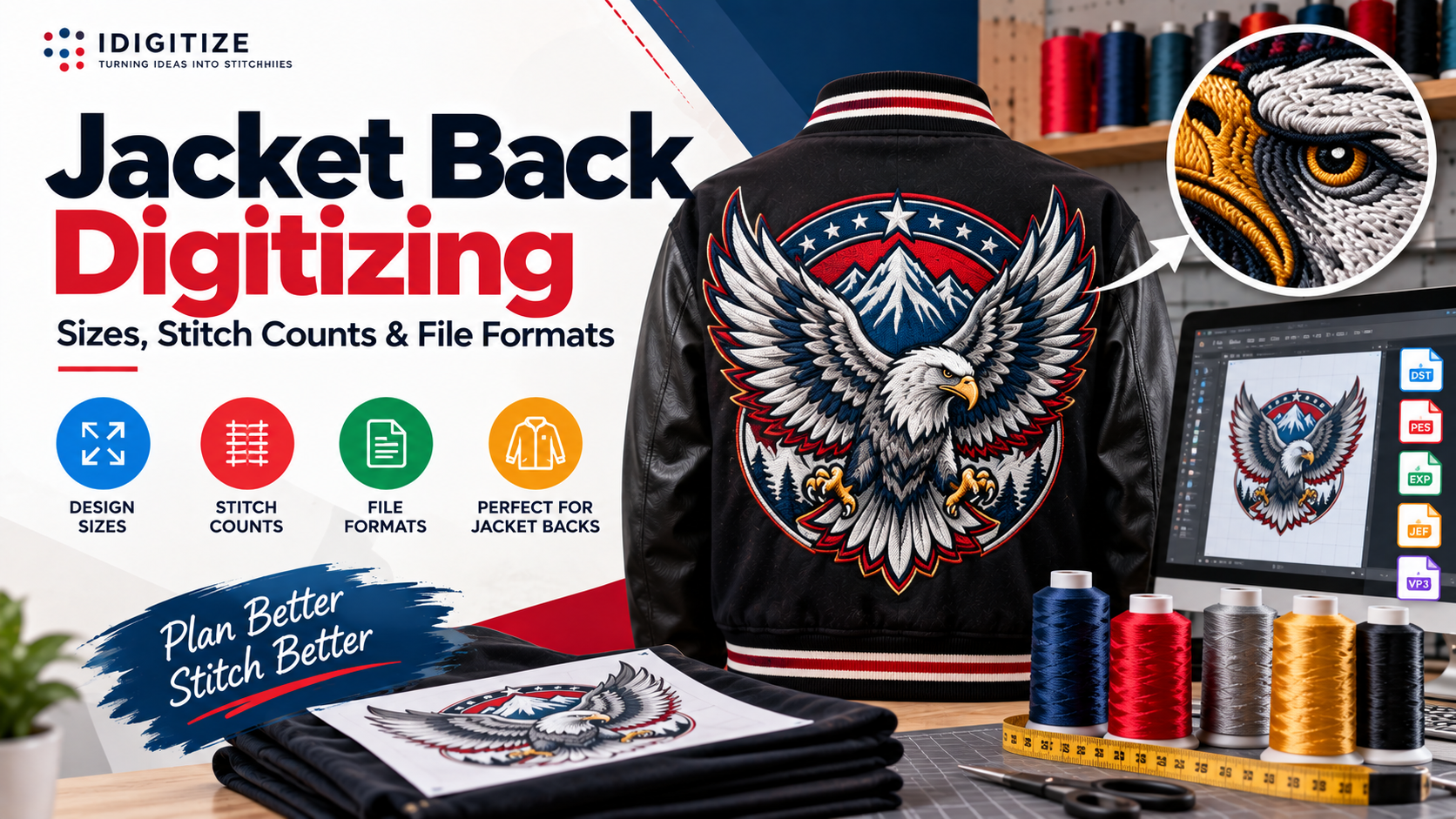
Jacket back digitizing turns a large logo, mascot, or lettering into a stitch file sized for a jacket's back panel. At iDigitize, we provide professional jacket back digitizing services that create machine-ready files for denim, leather, varsity, fleece, and bomber jackets. This guide explains how the process works, which design sizes suit each jacket type, and what to check before you order.
A jacket back is not just a bigger chest logo. It is a specialized branch of embroidery digitizing that demands careful stitch planning. Without that planning, large designs pucker, drift out of alignment, or break thread mid-run.
What Is Jacket Back Digitizing?
Jacket back digitizing is embroidery digitizing built for large back-panel designs. A digitizer converts artwork into stitch data that tells the machine where to sew, in what order, at what density, and with which stitch type.
Back-panel files are heavy. Most contain roughly 30,000 to 80,000 stitches. Highly detailed or full-coverage designs, such as biker club backs, can exceed 100,000. At that volume, every technical decision affects the finished result.
How Back-Panel Files Differ From Standard Logo Files
Three adjustments separate a well-built back design from a rushed one:
-
Push and pull compensation: Extra compensation keeps large shapes aligned and closes gaps between fills and outlines.
-
Stitch sequencing: Center-outward stitching and a deliberate stitch path reduce fabric movement and registration problems.
-
Density control: Density changes with the fabric, which helps prevent thread breaks and puckering.
Best Design Sizes for Each Jacket Type
Design size and style should match the jacket's construction. These are the ranges we work with:
-
Denim jackets: 10" x 12" to 11" x 14". Sturdy denim handles fully filled graphics and large typography.
-
Leather and faux leather: 9" x 11" to 10" x 12". Bold block fonts and clean outlines work best, because heavily filled designs can tear or weaken the material.
-
Varsity and letterman jackets: 11" x 13" to 12" x 15". Heavy construction supports mascots, 3D designs, and bold chenille-style letters.
-
Fleece and Sherpa: 10" x 10" to 11" x 12". Thick borders and high-contrast artwork keep the design from sinking into the pile.
-
Bomber and windbreaker: 9" x 10" to 10" x 12". Lighter, cleaner corporate designs perform best.
How Do You Measure a Jacket Back Before Ordering?
Measure the usable panel in three steps:
-
Measure horizontally across the back, between the shoulder seams.
-
Measure vertically from the base of the collar to the base of the waist.
-
Subtract 1 to 2 inches from both numbers to leave room for the embroidery frame and design clearance.
Send those final dimensions with your artwork so we can digitize the file at the correct size.
Which File Format Does Your Machine Need?
The right format depends on your machine brand. DST (Tajima) and EXP (Melco) are the most common on commercial multi-needle machines. PES (Brother) and JEF (Janome) usually suit single-needle or semi-commercial machines.
We supply DST, PES, EMB, EXP, JEF, VP3, HUS, and XXX files. If your machine uses a different format, tell us when you place your order.
When Does Professional Digitizing Make Sense?
Professional digitizing is worth considering when your design includes fine lettering, mascots, or custom illustrations. It also helps when the design uses appliqué or 3D puff, or when you are sewing onto delicate or thick materials.
Team jackets, club backs, and uniform programs also benefit, because the same file may be sewn many times. A poorly built file repeats its flaws on every jacket.
Common Mistakes to Avoid With Jacket Back Digitizing
-
Reusing one file across fabrics. Leather needs lower density and sharp leather needles. Denim can hold fills and layered underlays.
-
Ignoring thin fabrics. On windbreakers and bombers, open fills at low density, a light mesh underlay, satin outlines instead of solid tatami fills, and a heavy cutaway stabilizer help keep the design flat.
-
Oversizing for the material. A design that suits a varsity jacket may be too heavy for leather.
-
Using low-contrast art on fleece. Fine detail disappears into the pile.
-
Guessing the panel size. Skipping measurements leads to rework.
What to Send Us for Your Order
When you order professional jacket back digitizing services from us, include the following:
-
Your logo or artwork, ideally the highest-resolution version you have
-
Placement and final design size
-
The jacket fabric
-
Your machine's embroidery file format
We digitize each file manually and run a quality check before delivery. Files typically arrive in 4 to 12 hours, and an express option delivers in 1 to 4 hours. Revisions are free. If your artwork is low quality, we also offer vector art services.
Get Your Back Design Sewing Cleanly
The takeaway for jacket back digitizing is that design size, stitch density, and file format must all match the jacket. A design that works on a varsity jacket can fail on leather or a windbreaker. At iDigitize, we build those decisions into the file so your machine operator can focus on production.
Once you have your artwork, measurements, fabric type, and machine format ready, send them to us. We will prepare a file suited to your jacket, and you can reach our support team at any hour with questions.
Frequently Asked Questions
How many stitches does a jacket back design need?
Most jacket back files contain about 30,000 to 80,000 stitches. Highly detailed, full-coverage designs and large biker patches can reach 100,000 or more. The exact count depends on the design's size, detail, and fill types, so we set it during digitizing.
What is the standard size for a jacket back embroidery design?
Standard back-panel designs generally range from 10" x 10" to 12" x 16", depending on the jacket. A common adult size is about 10.5" x 12", which fits denim, varsity, and leather panels. Leather usually takes smaller designs than varsity jackets.
How long does jacket back digitizing take?
Our professional jacket back digitizing services normally deliver files in 4 to 12 hours. An express option delivers in 1 to 4 hours. Include your artwork, placement, size, and fabric details with your order so we can start right away.
Can I use the same digitized file for leather and denim jackets?
No. Leather needs lower stitch density and sharp leather needles to avoid cutting the material. Denim can hold fills and multiple layered underlays. Tell us the fabric when you order so we can set the file correctly.
Which embroidery file format should I request?
Request the format your machine reads. DST and EXP are common on commercial multi-needle machines, while PES and JEF are common on single-needle or semi-commercial machines. If you are unsure, check your machine's manual or tell us the brand and model.

 English
 Arabic
 French
 Portuguese
 Deutsch
 Turkish
 Dutch
Dutch
 Italiano
 Russian
 Romaian
 Portuguese (Brazil)