
Building a technology team in 2026 isn't just about hiring enough developers anymore. Companies need the right skills, faster hiring cycles, flexible structures, and the ability to scale capability up or down as priorities shift.
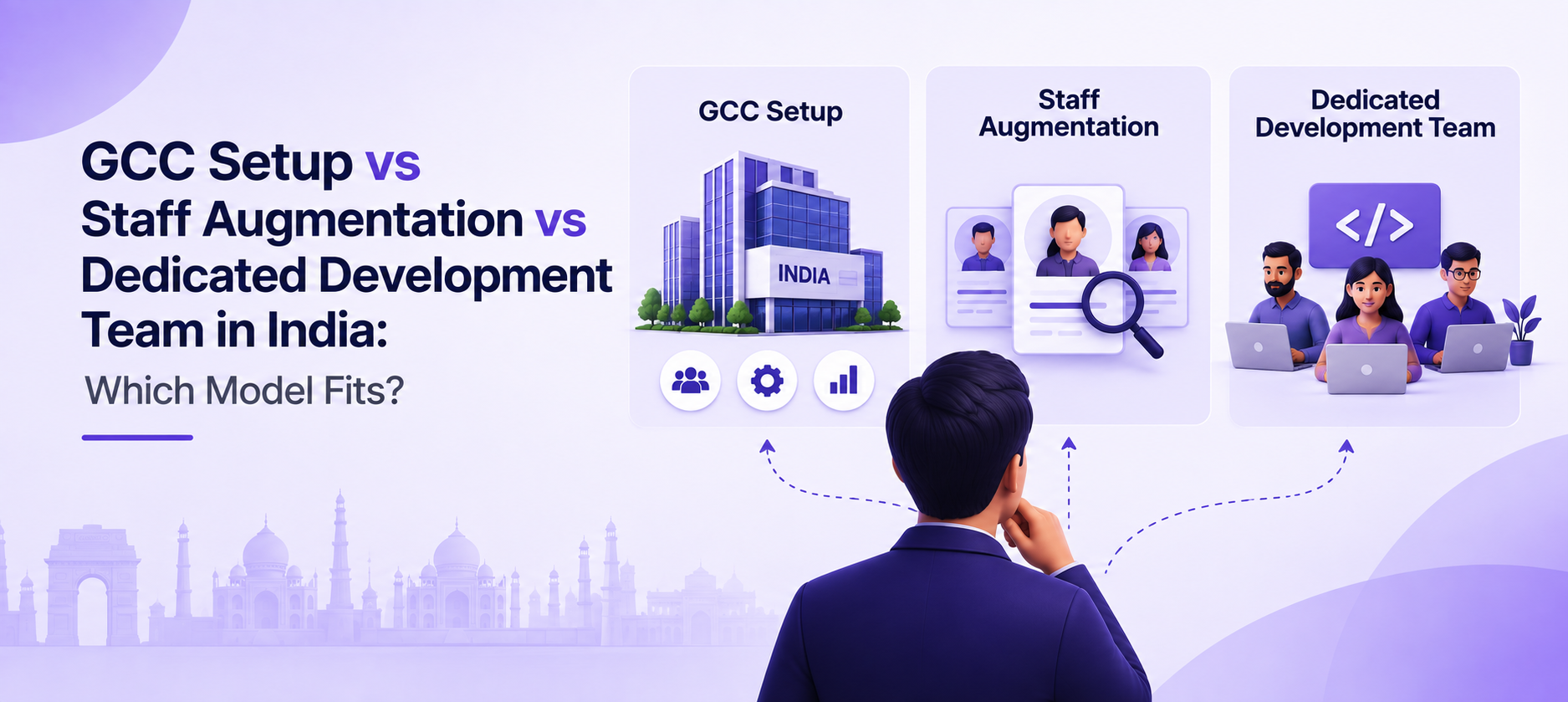
You might need three developers for a short project, a full product engineering team for a new platform, or a long-term technology organisation in India. Each of those calls for a different workforce model, and that's exactly where staff augmentation, dedicated teams, and Global Capability Centers (GCCs) come in. Staff augmentation lets you add skilled professionals to your existing team without committing to permanent hiring straight away. Dedicated teams give you a complete group that works as an extension of your organisation. A GCC is for companies that want to establish and own a long-term capability in another geography. Understanding the differences lets you choose based on your actual requirement rather than the latest hiring trend.
What is staff augmentation?
Staff augmentation is a flexible workforce model where you bring external technology professionals into your existing team for a specific period or requirement. Instead of running a lengthy permanent recruitment process, you access developers, QA engineers, DevOps professionals, designers, data engineers, or other specialists through a staffing partner, and they work within your existing processes, tools, priorities, and delivery structure.
Picture a software company with a 15-person engineering team that suddenly needs a couple of extra React developers and a DevOps engineer for a product release. Rather than starting a months-long hire, it augments the existing team with the specialists it needs, right now. That's what makes the model so useful when technology demand moves faster than permanent headcount planning can keep up. SquadXP frames staff augmentation as a way to add capacity while handling changing workforce requirements, with common triggers like entering a new market, absorbing fluctuating demand, and bridging hiring gaps, the scenarios covered in when to use staff augmentation.
Why companies choose flexible tech talent
Technology projects rarely sit still. You might start out needing backend developers and later require cloud engineers, AI specialists, or cybersecurity professionals. Hiring every one of those capabilities permanently creates overhead you don't need, especially when the demand for a particular skill is temporary.
Flexible tech talent solves that. Companies typically reach for staff augmentation when they hit a sudden spike in workload, struggle to find specialised developers locally, need to accelerate product development, face a temporary skills shortage, expand into a new stack, have a launch with a fixed deadline, need to cover an unavailable specialist, are running a digital transformation, or want to test a new geography before making a long-term commitment. The through-line is flexibility: you add capacity exactly where it's needed without redesigning your whole organisation.
Staff augmentation vs traditional hiring
Traditional hiring means sourcing candidates, interviewing, running background checks, negotiating compensation, and onboarding. It's still the right approach for long-term internal roles, but it takes real time when you need technical capacity immediately. With staff augmentation, you work with a specialised partner to identify candidates who match the required profile far faster.
That speed matters most when you need to hire developers with specific experience, React and Angular, Node.js and Java, Python, .NET, cloud platforms, DevOps, data engineering, AI and machine learning, mobile, or QA automation. The key distinction to hold onto: staff augmentation is primarily about adding capacity and skills to an existing organisation, not handing over a whole function, and it often lands cheaper and faster than people expect once you compare it against the true cost of permanent hiring, as the US-vs-India cost-per-engineer breakdown shows.
What are dedicated teams?
A dedicated team is a group assembled specifically to work on your product, platform, or technology function. Unlike adding one or two specialists to an existing team, it brings multiple roles that work together as a cohesive unit. A typical product engineering team might include software engineers, QA engineers, UI/UX designers, product managers, DevOps engineers, and technical architects, with the exact shape depending on the project.
Dedicated teams fit when you need sustained engineering capacity but don't want to immediately stand up a local entity or build an internal organisation from scratch. SquadXP positions its dedicated-team model as a way to scale engineering capability without taking on the full complexity of establishing a GCC.
When should you choose dedicated teams?
Dedicated teams make sense when the requirement is longer-term. A company launching a new SaaS platform may need a full engineering team for several years, and hiring each role independently could take months, whereas assembling a dedicated team lets you start product development with a coordinated group from day one.
They also give you continuity. Instead of repeatedly hiring different contractors for individual tasks, you build a stable team that develops a genuine understanding of your product, architecture, and business goals. That makes the model especially relevant for product development, SaaS platforms, application modernisation, digital transformation, long-term engineering programs, cloud migration, and data and AI initiatives, where institutional knowledge compounds over time.
Where do AI/ML specialists fit in?
AI has created a whole category of specialist talent, and companies building AI applications may need machine learning engineers, data scientists, AI engineers, MLOps professionals, or generative AI specialists. Hiring AI/ML specialists is genuinely hard, because these roles demand a mix of domain knowledge, software engineering, and specialised AI expertise that's scarce and expensive.
You may not need a large permanent AI team right away. In that situation, specialist hiring or augmentation gives you access to the capabilities you need while you work out your long-term AI strategy, and understanding what it takes to hire AI/ML engineers in India helps you set realistic expectations on cost and availability. For a company planning a larger AI function, those specialists can later become part of a dedicated team or an internal GCC capability, so the workforce model evolves as the business matures.
IT outsourcing vs staff augmentation
Outsourcing and staff augmentation get used interchangeably, but they solve different problems. With traditional IT outsourcing, the external provider takes responsibility for delivering a defined service or outcome. Staff augmentation is about providing people who become part of your existing delivery structure.
In practice: with outsourcing, you hand a vendor responsibility for developing and delivering a specific application. With staff augmentation, you keep responsibility for the application but add five external engineers to your own product team. With a dedicated team, you work with a stable external group that focuses continuously on your product or technology function. The right choice comes down to how much control you want over people, priorities, processes, and delivery.
When does a GCC make sense?
A Global Capability Center is different from both. A GCC setup in India is generally considered when you want to establish a long-term capability that becomes part of your own organisational structure. Over time a GCC can own product engineering, software development, AI and machine learning, data science, cloud engineering, cybersecurity, R&D, finance and business operations, and global technology functions.
The distinction is ownership. A dedicated team provides engineering capacity; a GCC is designed to build an organisational capability you own. SquadXP's current GCC guidance stresses that the decision should start with what the India center needs to accomplish and what it should own, not with a headcount target, which is the core argument of the India GCC guide and the deeper GCC vs outsourcing vs dedicated teams comparison.
Can staff augmentation be the first step toward a GCC?
Yes, and it often is. You don't have to jump from no India presence straight to a large GCC. You can start with a small augmented team, learn the talent market, establish working processes, and evaluate the business case for something bigger. From there you can move to a dedicated team and eventually a GCC once the long-term requirement is clear.
This staged approach is useful when you want to understand local talent availability, salary expectations, time-zone collaboration, team productivity, hiring timelines, technology capabilities, and your genuine long-term needs before committing. SquadXP's GCC guidance specifically describes using dedicated teams as a bridge while a permanent India capability is being built, and the first ten hires for a new GCC shows how that progression takes shape once you commit.
How to choose the right model
There's no universal answer, so work through a few questions. If you need a few specialists quickly and already have an internal team, staff augmentation fits. If you need a complete team for a long-term project but don't want to establish a full local organisation, a dedicated team fits. If you want to build a long-term, company-owned technology capability in India, a GCC fits. If you're testing the Indian market, starting with an augmented or dedicated team gives you practical experience before a larger commitment. And if you need highly specialised skills like AI/ML, cloud, cybersecurity, or data engineering, specialist hiring or augmentation gives you fast access. The model should follow the requirement, not the other way round.
What to look for in the best IT staff augmentation providers
When researching providers, look well past the raw number of developers available. A strong partner understands your technical requirements and finds candidates who fit both the stack and the working environment. Weigh their technical screening (how are professionals evaluated before being presented?), talent availability (do they actually have access to the right people?), speed (how fast can suitable profiles be presented and onboarded?), communication (how do they manage coordination between you and the professionals?), flexibility (can the team scale up or down as requirements change?), specialist capabilities (can they support AI/ML, cloud, DevOps, and data engineering?), and enterprise experience (have they worked with organisations that have complex security and compliance needs?). Those factors tell you far more than a headcount claim, which is the same lens the staff-augmentation red-flags guide applies.
What makes a good IT staff augmentation service?
Judge the complete experience, not just the hiring stage. A reliable service runs from understanding the requirement through onboarding and ongoing coordination: understanding the technical requirement, defining the experience and seniority needed, identifying suitable professionals, conducting technical screening, sharing relevant profiles, interviewing shortlisted candidates, completing onboarding, and managing workforce needs as the project evolves. That approach keeps augmentation from becoming "renting developers", the aim is to add people who contribute meaningfully to your existing team.
IT staff augmentation for enterprises
Enterprises carry extra considerations. Large companies may need dozens or hundreds of professionals across multiple functions, plus security controls, compliance processes, background verification, standardised onboarding, defined reporting structures, technology-specific screening, multiple hiring locations, workforce scalability, and data and IP protection. The provider has to support all of that without compromising quality or process consistency. For an enterprise, the value of augmentation isn't simply hiring more people, it's expanding capacity while holding your existing delivery standards steady.
Understanding IT staffing augmentation services
These services can cover a wide range of roles, frontend, backend, and full-stack developers, mobile developers, QA engineers, DevOps engineers, cloud architects, data engineers, data scientists, AI/ML engineers, UI/UX designers, technical project managers, and cybersecurity specialists. The important point is that the model should adapt to the requirement. One company might start with two developers and expand into a full product team; another might use specialist augmentation for a short AI project and later stand up a permanent AI capability. Flexibility is the whole point.
How SquadXP helps companies build technology teams
SquadXP positions itself as a talent and team-building partner for companies building technology capability in India, across three broad requirements: building a GCC, embedding a dedicated squad, and hiring specialist talent. That lets you treat workforce planning as a progression rather than a one-off decision. In practice, stage one adds specialist talent through augmentation, stage two builds a dedicated team around a long-term product or technology requirement, and stage three establishes a GCC when you're ready to own a larger capability in India. The right path depends on your objectives, timeline, required skills, and how much organisational ownership you want, and it maps cleanly onto building a scalable technology workforce in India.
Final thoughts
Technology hiring in 2026 is about flexibility and capability, not just growing headcount. Staff augmentation adds specific skills or capacity quickly. Dedicated teams provide stable engineering capability for long-term projects. A GCC creates a deeper, company-owned technology organisation in India. So the decision really starts with one question: what capability does the business need to build, and how much of it does it want to own? If the answer is capacity, augmentation fits. If it's a stable product engineering unit, a dedicated team fits. If it's a strategic technology organisation in India, a GCC is the longer-term structure. The best workforce strategy is simply the one that matches your technology roadmap, hiring needs, and long-term operating model.

 Arabic
 French
 Spanish
 Portuguese
 Deutsch
 Turkish
 Dutch
Dutch
 Italiano
 Russian
 Romaian
 Portuguese (Brazil)