
Introduction
Studying can take a lot of time, especially when learners must read long notes and find the most important points. An AI flashcard generator makes this process easier by turning notes, documents, or topics into short question-and-answer cards. These cards help students review key information without reading the same material again and again.
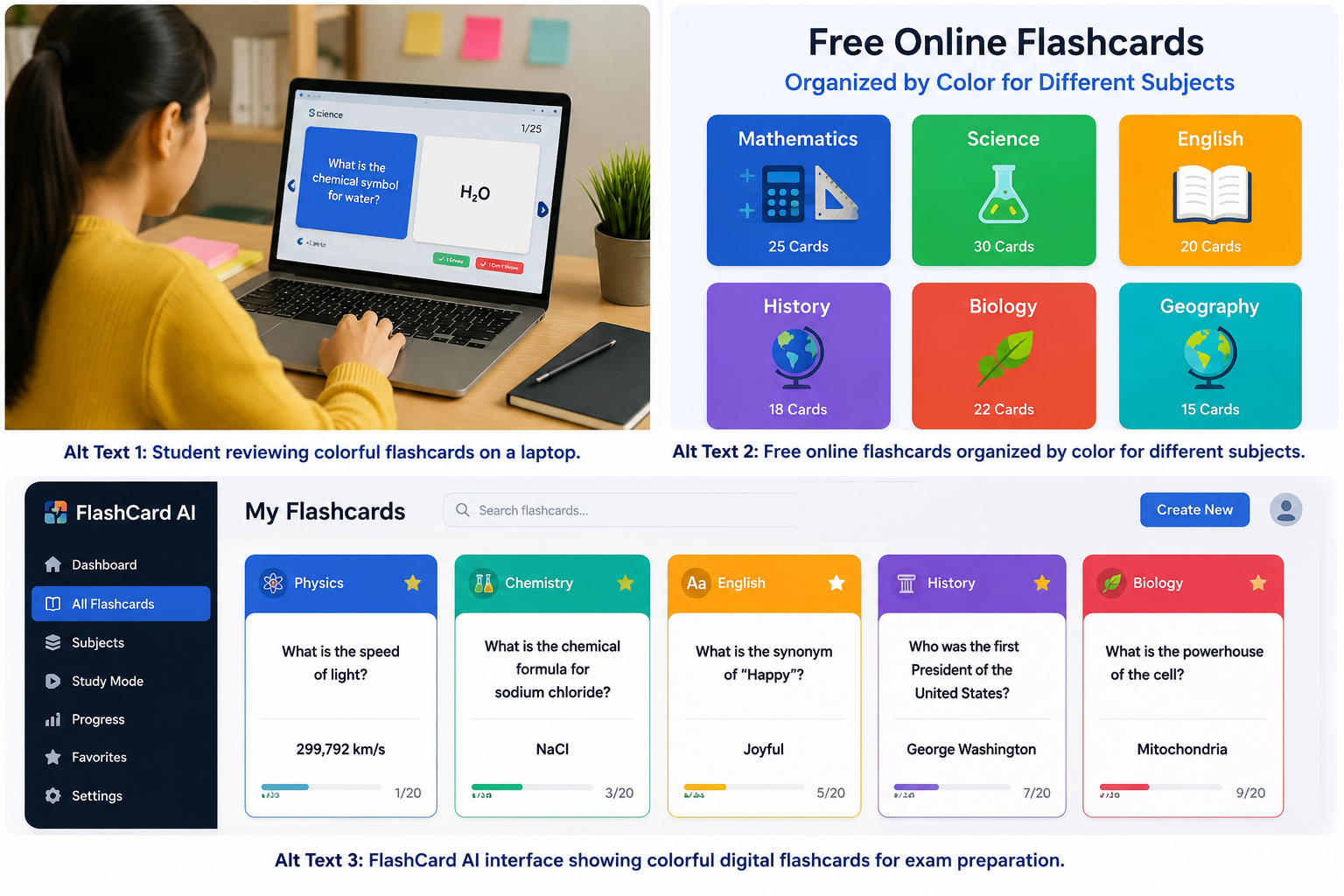
FlashCard AI helps learners create clear digital cards for school, university, language learning, professional training, and personal development. With the right study routine, AI-generated flashcards can save preparation time and make learning more organized.
Quick Answer: What Is an AI Flashcard Generator?
An AI flashcard generator is an online tool that uses artificial intelligence to create study cards from learning material. A user may enter a topic, paste notes, or upload supported content. The tool then finds important ideas and changes them into questions and answers.
A typical process includes:
- Add notes, text, or a topic.
- Ask the tool to generate flashcards.
- Review the suggested questions and answers.
- Edit any unclear or incorrect information.
- Save the cards in a study set.
- Begin reviewing them.
The main goal is to reduce the time spent making cards while keeping learners active in the study process.
How Do AI-Generated Flashcards Work?
AI studies the information provided by the user. It looks for useful details such as:
- Important terms
- Definitions
- Dates and events
- Formulas
- Main ideas
- People and places
- Steps in a process
- Common questions
The system uses these details to create a front and back for each card. The front normally contains a question, while the back gives a short answer.
For example:
- Front: What is photosynthesis?
- Back: It is the process plants use to turn light energy into chemical energy.
The learner should always check generated content. AI tools can misunderstand complex information, miss context, or create an answer that is too general.
1. Save Time When Preparing Study Material
Making cards by hand can be useful, but it may take hours when a subject includes many chapters. An AI tool can produce a first set of cards within a much shorter time.
This gives learners more time to:
- Review important topics
- Complete practice exercises
- Test their knowledge
- Focus on difficult ideas
- Prepare for exams
AI does not remove the need to study. Instead, it reduces repetitive preparation work. Users should spend some of the saved time checking and improving every card.
2. Turn Long Notes Into Short Questions
Long notes are often hard to review. They may contain examples, explanations, facts, and extra details in the same paragraph. Flashcards divide this information into smaller parts.
Good study flashcards usually focus on one idea at a time. This helps learners understand what they know and what they still need to practice.
A long section about the water cycle, for example, could become separate cards about:
- Evaporation
- Condensation
- Precipitation
- Collection
- The role of the sun
Breaking a topic into small questions can make a difficult chapter feel more manageable.
3. Support Active Recall
Active recall means trying to remember information before looking at the answer. It is different from reading notes without testing yourself.
A simple active recall routine is:
- Read the question.
- Hide the answer.
- Think about your response.
- Say or write the answer.
- Check the back of the card.
- Mark the card as easy or difficult.
This method shows whether information can be remembered without help. FlashCard AI can support this process by creating structured questions from a learner’s material.
4. Make Online Learning More Flexible
When users create flashcards online, their study sets may be easier to organize and access. Digital cards can be used during a study session at home, in a library, or while traveling.
Online flashcards may offer practical benefits such as:
- Fast editing
- Simple topic organization
- Less paper use
- Access from supported devices
- Easy removal of old cards
- Quick creation of new sets
- Convenient review during short breaks
This flexibility can help busy students build a regular learning habit. Even a short review session can be useful when it is focused.
5. Create Cards for Different Subjects
AI-generated cards can support many subjects. The question style should be adjusted to suit the type of information being learned.
Languages
Create cards for:
- Words and meanings
- Translations
- Grammar rules
- Common phrases
- Example sentences
Science
Use cards to review:
- Definitions
- Scientific processes
- Parts of a system
- Laws and theories
- Important examples
Mathematics
Cards can cover:
- Formulas
- Symbols
- Rules
- Short calculation steps
- Common mistakes
Flashcards are helpful for remembering formulas, but students should also solve full problems.
History
Create questions about:
- Dates
- Important people
- Major events
- Causes and effects
- Historical terms
Professional Training
Employees and job seekers can review:
- Industry terms
- Safety procedures
- Product details
- Interview questions
- Certification topics
6. Personalize Each Study Set
Not every learner needs the same cards. A beginner may need basic definitions, while an advanced learner may need detailed questions.
Users can personalize AI-generated cards by:
- Changing difficult words
- Shortening long answers
- Adding personal examples
- Including memory clues
- Dividing one complex card into several cards
- Removing facts they already know
- Creating more cards for weak topics
Personalized content is often easier to understand because it matches the learner’s course, knowledge, and goals.
7. Improve Exam Preparation
Flashcards can make exam review more organized. Instead of studying every chapter in the same way, learners can identify weak areas and give them more attention.
For effective exam preparation:
- Create a set for each subject or chapter.
- Begin reviewing before the final week.
- Answer every card before checking it.
- Separate easy and difficult cards.
- Review difficult cards more often.
- Mix the order of questions.
- Combine cards with practice tests.
Flashcards should not be the only exam tool. Essays, calculations, case studies, and long-form questions require additional practice.
8. Use Spaced Repetition
Spaced repetition means reviewing information at increasing time intervals. New or difficult cards are studied often, while familiar cards are reviewed less frequently.
A basic schedule might be:
- First review: the same day
- Second review: the next day
- Third review: after three days
- Fourth review: after one week
- Later reviews: every few weeks
If an answer is forgotten, the learner can return that card to a shorter schedule. This approach helps focus study time on information that needs the most attention.
9. Help Teachers Prepare Learning Activities
Teachers can use FlashCard AI to prepare simple review material for lessons. Cards may support classroom quizzes, group discussions, homework, or exam revision.
Possible classroom uses include:
- Vocabulary review
- Lesson warm-ups
- Quick knowledge checks
- Group competitions
- Topic summaries
- Exit questions
- Revision sets
Teachers should review all AI-generated material before giving it to students. This is important because the information must match the lesson, age group, and course requirements.
How to Create Better AI Flashcards
The quality of the input affects the quality of the output. Clear, accurate source material is more likely to produce useful cards.
Follow these simple tips:
- Use trusted notes or documents.
- Choose one clear topic at a time.
- Ask for short questions and answers.
- Keep one main idea on each card.
- Check facts, spelling, and dates.
- Avoid answers that contain full paragraphs.
- Add examples when they improve understanding.
- Rewrite questions that are too easy or unclear.
- Remove repeated cards.
A strong card should test a specific piece of knowledge. It should be easy to read but require the learner to think before viewing the answer.
Why Use FlashCard AI?
FlashCard AI offers a simple way to change learning material into organized digital cards. It can support students, teachers, professionals, and independent learners who want to spend less time preparing study resources.
A practical workflow is:
- Choose a trusted source.
- Add the relevant content.
- Generate a set of cards.
- Check each question and answer.
- Make the wording short and clear.
- Organize cards by topic.
- Review them regularly.
- Update the set when needed.
AI is most useful as a study assistant. The learner remains responsible for checking information, understanding ideas, and applying knowledge.
Frequently Asked Questions
Can an AI flashcard generator create cards from notes?
Yes. Many tools can turn pasted notes or supported files into questions and answers. Available input options depend on the platform.
Are AI-generated flashcards accurate?
They can be useful, but they are not always correct. Learners and teachers should check every card against a trusted source before studying or sharing it.
Who can use FlashCard AI?
FlashCard AI can support school students, university learners, teachers, language learners, employees, and people preparing for professional tests.
How many flashcards should I study each day?
There is no fixed number. Beginners can start with 10 to 20 cards. The best amount depends on the topic, available time, and difficulty level.
Can flashcards replace textbooks and lessons?
No. They are mainly review tools. They work best with lessons, reading, discussions, practical exercises, and practice exams.
What makes a good flashcard?
A good card has one clear question and one short, accurate answer. It should test useful knowledge without including unnecessary details.
Can I create flashcards online for free?
Some platforms offer free tools or limited plans, while others require payment for advanced features. Users should check current pricing and feature details on the selected platform.
Are online flashcards useful for language learning?
Yes. They can help learners practice vocabulary, translations, phrases, grammar, and example sentences. Speaking and listening practice should also be included.
Conclusion
An AI flashcard generator can make study preparation faster, simpler, and more organized. It turns long learning material into focused questions that support active recall and regular review.
For the best results, users should provide reliable content, check every generated answer, personalize their cards, and follow a consistent review schedule. FlashCard AI can help with card creation, but real progress comes from active practice and a balanced learning plan.

 Arabic
 French
 Spanish
 Portuguese
 Deutsch
 Turkish
 Dutch
Dutch
 Italiano
 Russian
 Romaian
 Portuguese (Brazil)