
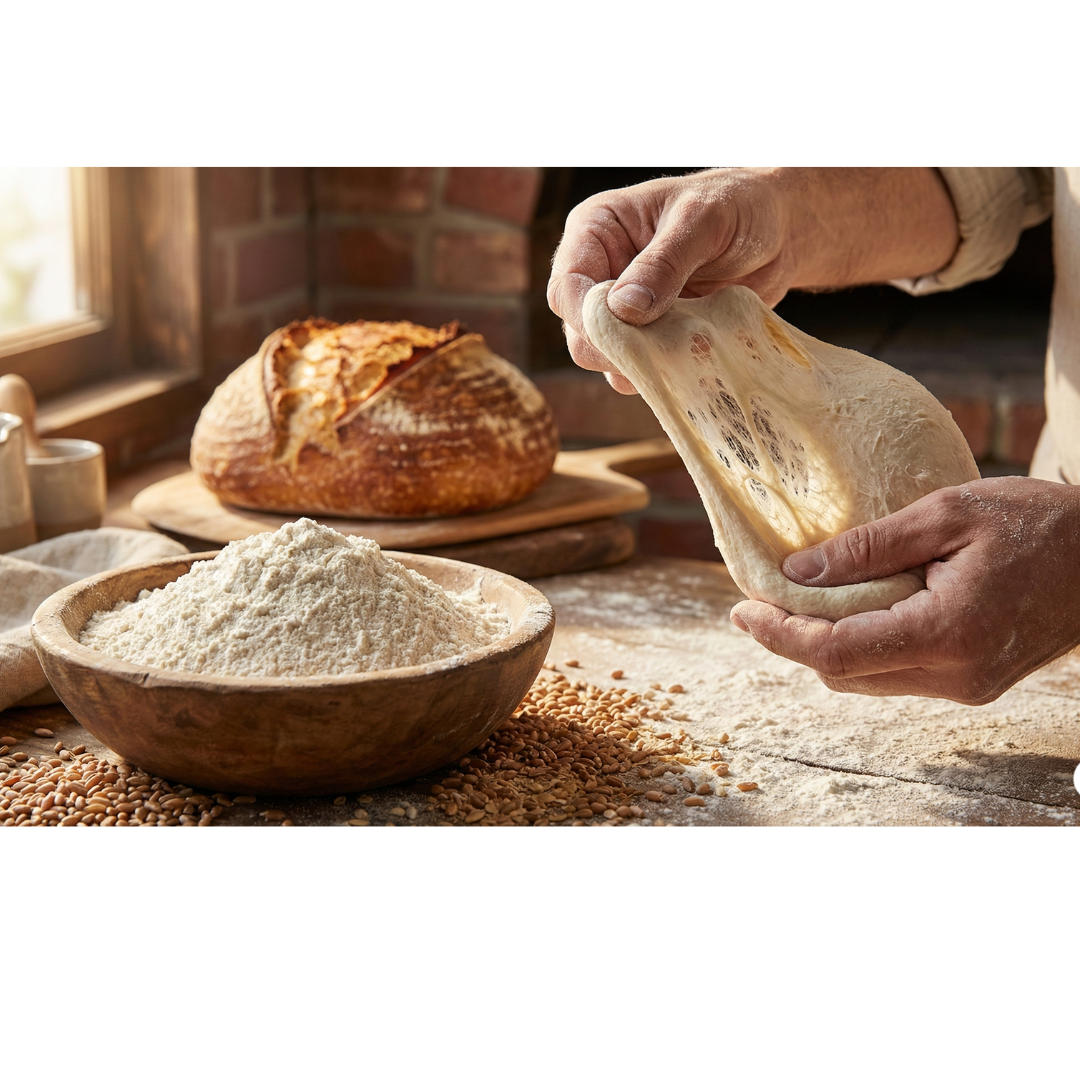
In professional baking, the structure, rise, and overall quality of a loaf depend heavily on the characteristics of the flour used. Among all types of wheat-based flours, bread flour plays a central role due to its specific protein profile and functional strength. Its performance directly influences dough elasticity, gas retention, crumb uniformity, crust formation, and final loaf volume. For baking professionals, understanding the science behind flour strength is essential for producing consistent and precisely engineered results.
Understanding Bread Flour Strength
Bread flour is formulated for yeast-leavened applications and possesses a higher protein percentage compared to standard wheat flours. This higher protein content forms the foundation of strong gluten networks, which are crucial to dough performance in commercial and artisan environments.
Protein levels typically range from 11% to 14%, and different levels are suited to different performance needs:
-
High-strength variants
Ideal for breads requiring a tall rise and structured crumb. These flours trap gases efficiently and deliver excellent oven spring. -
Moderate-strength variants
Suitable for everyday production loaves requiring balance between elasticity and extensibility. -
Lower-strength blends
Used for softer formulas or enriched doughs where butter, sugar, or other ingredients modify gluten development.
Pro Tip: Check both protein percentage and water absorption to predict mixing behaviour and fermentation tolerance.
Protein Quality and Dough Behaviour
Protein content matters, but protein quality determines performance. The two main proteins glutenin and gliadin, combine during hydration to form gluten, which gives dough its elastic and extensible properties.
-
Elasticity
Strong gluten enables dough to stretch without tearing, supporting a light, aerated crumb. -
Gas retention
A resilient structure allows dough to trap carbon dioxide produced during fermentation, leading to optimal lift. -
Fermentation tolerance
Stronger flour blends maintain structure even during extended fermentation—a major advantage for long-fermented styles. -
Handling stability
Dough that retains its strength performs predictably during shaping and scoring, reducing variations during production.
Pro Tip: If dough becomes too tight during shaping, rest it briefly to relax gluten and restore extensibility.
Gluten Structure and Balance
Beyond quantity and quality, the balance between elasticity and extensibility determines dough behaviour. This balance is controlled by the ratio of glutenin (strength) to gliadin (stretch).
-
High-glutenin blends
Offer strong structure, ideal for artisan loaves requiring open crumb and pronounced height. -
Balanced blends
Useful for breads where shape retention and extensibility must work together, especially during large-scale production. -
Lower-glutenin blends
Ensure softness and flexibility for brioche-style or enriched doughs.
Pro Tip: Adjust mixing times depending on flour strength. Stronger blends require less aggressive mixing to avoid tightening.
Ash Content and Flavor Character
Ash content refers to mineral levels remaining after milling. It influences colour, aroma, and flavour, all important for artisan-quality outcomes.
-
Moderate ash levels
Provide warm flavour notes and enhance crust colouration. -
Lower ash levels
Produce a lighter flavour profile and pale crust, suitable for certain styles. -
Higher ash levels
Deliver richer flavours, though they may reduce extensibility slightly.
Pro Tip: For deeper flavour in rustic styles, blend a small amount of higher-ash flour into the primary blend for complexity.
Hydration Capacity and Dough Volume
The water absorption capacity of high-strength flour impacts dough elasticity and the final rise. Strong blends typically absorb more water, which directly influences crumb development.
-
High absorption
Enhances volume and supports open crumb for long-fermented breads. -
Moderate absorption
Suitable for consistent production where handling predictability is required. -
Lower absorption
Used for formulas where softer textures or enriched additions dominate structure.
Pro Tip: Always adjust hydration gradually when switching between milling batches to maintain consistent dough performance.
Mixing Techniques for Maximum Performance
Different mixing methods bring out different attributes of strong flour blends. Professional bakers often rely on method selection to fine-tune gluten development.
-
Intensive mixing
Builds gluten quickly and is perfect for high-rise breads requiring strength and lift. -
Stretch and fold
Strengthens gluten while preserving extensibility for artisan-style loaves. -
Autolyse
Improves extensibility and reduces mixing time while supporting efficient gas retention.
Pro Tip: Monitor dough temperature during mixing. Ideal temperature control enhances yeast activity and gluten behaviour.
Fermentation Management
The fermentation stage determines flavour, structure, and stability. High-strength flours behave differently during this phase and offer several advantages:
-
Long fermentation support
Strong variants maintain their structure even after extended bulk fermentation. -
Balanced fermentation
Medium-strength blends support standard proofing schedules and predictable behavior. -
Short fermentation suitability
Lower-strength blends support enriched doughs requiring minimal fermentation.
Pro Tip: Rather than relying on fixed times, assess dough by observing elasticity, gas retention, and expansion.
Oven Spring and Baking Performance
The final lift of dough in the oven, oven spring, is heavily influenced by flour strength.
-
High-strength blends
Hold their shape during rapid heat expansion, resulting in tall, defined loaves. -
Moderate-strength blends
Offer even volume, smooth crumb texture, and reliable structure. -
Lower-strength blends
Produce softer or flatter structures suitable for enriched breads.
Pro Tip: Proper scoring ensures controlled expansion and maximises oven spring potential.
Managing Batch Consistency
Even with reliable milling standards, slight variations occur between flour batches. Professionals track several parameters to maintain consistent results:
-
Protein percentage
-
Water absorption rate
-
Mixing time
-
Dough temperature
-
Fermentation response
Maintaining a production log helps bakers anticipate and adjust for these variations.
Pro Tip: Treat flour as a dynamic ingredient; small adjustments can protect consistency and final quality.
Advantages of Strong Bread Flour in Professional Baking
Using bread flour with reliable strength ensures:
-
High loaf volume and uniform structure
-
Improved dough elasticity for shaping
-
Enhanced crust development and scoring performance
-
Longer fermentation tolerance without structural breakdown
-
Versatility for both artisan and production-scale needs
Conclusion
The strength of bread flour plays an integral role in dough behaviour and final bread quality. Its protein levels, gluten characteristics, mineral content, and hydration capacity influence every stage from mixing and fermentation to baking and oven spring. For professionals, understanding these nuances ensures consistent results, controlled performance, and a superior final product.
With the right flour selection and method adjustments, bakers can produce breads that excel in volume, texture, flavour, and structural integrity. Mastery lies in observing how flour behaves, responding with precise adjustments, and relying on a strong scientific foundation for consistently excellent outcomes.
FAQs
Q1: What makes bread flour different from regular flour?
Its higher protein level supports strong gluten formation, giving dough superior elasticity and gas retention.
Q2: How does flour strength affect dough handling?
Stronger blends produce resilient, stretchable dough that holds its shape and rise during fermentation and baking.
Q3: Are high-strength flours suitable for all breads?
They are ideal for yeast-leavened breads, while softer styles may require lower-protein options or adjusted hydration.
Q4: How can professionals manage variation between flour batches?
Track protein percentage, water absorption, dough temperature, and fermentation behavior, adjusting formulas as needed.
Q5: Does ash content influence bread flavour?
Yes. Moderate mineral levels add flavour depth and help develop a rich crust colour without affecting structure.

 English
 Arabic
 French
 Spanish
 Portuguese
 Deutsch
 Turkish
 Dutch
Dutch
 Italiano
 Russian
 Romaian