
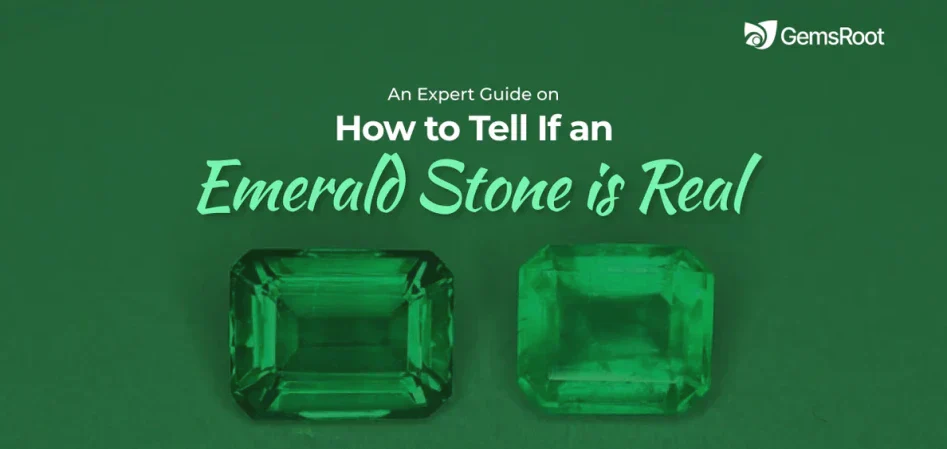
Emeralds have been a fascination for people for hundreds of years. They are a deep shade of green, rare, and significance for astrology make them among the most sought-after gems in the world. However, with the demand comes imitation which leads to a huge market of imitation, synthetic and treated gemstones. If you're looking to purchase an emerald to use for the purpose of astrology, jewelry or investment purposes, or even as a gift the right one, knowing the difference between an authentic emerald is vital.
This guide for professionals explains how to determine whether an emerald is genuine The types of fake emeralds that you might encounter, the chemical and physical tests, signs of visual and methods that are used by gemologists. When you're done you'll be capable of determining authenticity.
What makes a genuine Emerald Different?
Before you can recognize fakes, it is important to know what sets genuine gemstones from fakes.
1. Their distinctive green color
Real emeralds contain:
-
A deep green to blueish-green hue
-
Naturally diverse tones, but uniform.
-
A color that is produced by vanadium, chromium, or both
The purity and intensity of the green color are important indications of the authenticity.
2. Natural Inclusions, also known as 'Jardins'
The French word "jardin," meaning garden is a reference to:
-
Mossy internal patterns
-
Natural fractures
-
Minute mineral particles
These inclusions are regarded as normal and are even desired in top-quality gemstones.
3. Mohs hardness is 7.5-8
The real emerald are fairly hard but not as hard as sapphires or diamonds because of internal fissures.
4. Rarity
Natural emeralds are much rarer than sapphires and rubies and many other gemstones. Their lack of availability alone results in more expensive prices and a growing demand for imitations.
Common Fake Emeralds found on the market
When it comes to evaluating authenticity, is helpful to know what other options are available.
1. Synthetic Emeralds
They can be described as laboratory-grown stones with the exact chemical structure as naturally occurring gemstones. They are genuine emeralds, scientifically speaking. However, they are they are not natural.
They have:
-
Less inclusions
-
Lower cost
-
Uniform color
2. Fake or imitation Emeralds
This includes:
-
Green glass
-
Dyed quartz
-
CZ (cubic zirconia)
-
YAG (Yttrium Aluminum Garnet)
-
Synthetic spinel
They differ in chemical properties, and are often able to be recognized visually.
3. The Emeralds are composite or filled with
These are not high-quality emeralds.
-
The container is filled with resins, oils or polymers
-
Improved to look cleaner and brighter
-
More fragile
Not completely fake However, it is heavily processed.
How to Determine the if an Emerald Stone is Genuine
Below are the tests for experts These are broken down into:
-
Visual tests that you can conduct at your home
-
Physical tests you should try with care
-
Professional gemological tests
Visual Tests Anyone Can Perform
1. Examine the Color CAREFULLY
Real emerald color characteristics include:
-
Deep green Not neon
-
Slight bluish undertone possible
-
Colors are consistent, but they're not perfect.
-
Not too bright or glass-like.
If the stone appears too polished or too bright, or is too dark it could be fake or fake.
2. Search for natural inclusions
Utilize a magnifying lens or a macro lens for your phone.
The real emerald can be seen:
-
Tiny cracks
-
Like Moss inclusions (jardin)
-
Small fingerprints or veins
A fake Emerald (glass or synthetic) usually displays:
-
Air bubbles
-
There is no inclusion
-
Absolute clarity
Natural emeralds aren't perfect.
3. Verify the color Zoning
Natural emeralds may display:
-
A few color variations
-
Natural patterns of growth
Synthetic stones are usually color-matched.
4. Be observant of Sparkle and Brilliance
The Emeralds do not the most sparkling gemstones..
Real emeralds:
-
Get a more softer glow
-
Play soft, muted brilliance
fake stones (e.g. CZ glass, CZ):
-
Appear too sparkly
-
Reflect too many rays
-
Look glittery
If the emerald appears to sparkle like diamonds, it's most likely fake.
Physical tests to Determine the Real Emerald
Be cautious when performing these tests.
1. Fog Test (Breath Test)
-
Breathe in the stone, causing it to cloud up.
-
A real emerald clears in 1-2 seconds.
-
Fake stones are in fog for 5-10 minutes.
What's the reason?
Emeralds that are real are more thermally efficient.
2. Scratch Test (Not recommended)
Emeralds are ranked 7.5-8 on Mohs scale.
-
Glass (imitation) ranks around 5
-
Quartz (dyed) ranks around 7
If done improperly scratching may cause damage to the stone. This should not be done unless you have a professional do it.
3. Verify the stone's temperature
Real emeralds stay cool over longer time periods.
fake stones heat quickly in your hands.
4. Test for Density and Weight
Imitations of glass appear less heavy.
Lab-grown Emeralds can feel a bit heavier because of fewer fractures.
Advanced Tests performed by Gemologists
If you are looking for 100% certainty, the gemological labs employ modern instruments.
1. Microscope Examen
Gemologists have observed:
-
Natural lines of growth
-
Mineral inclusions
-
Fissures filled with liquids
The synthetic emeralds are:
-
Curved lines of growth
-
Metallic flux particles
2. Refractive Index (RI) Test
The Emerald measurement for RI is 1.565-1.602
Quartz or glass have an entirely different RI.
Refractometers can immediately identify the authenticity.
3. Spectroscope Test
Real emeralds exhibit particular absorption lines that are caused by vanadium and chromium.
4. Test for Fluorescence
Emeralds that are natural generally:
-
Display no or very little fluorescence
Emeralds made of synthetic materials may shine in the ultraviolet light.
5. Specific Gravity Test
Real emerald SG: 2.67-2.78
Glass SG: 2.50-2.60
This makes it easier to distinguish imitations.
How jewelers typically confirm the authenticity
Professional jewelers depend on:
-
Superior microscopes
-
Polariscope
-
Refractometer
-
UV lamps
-
Immersion cells
They also verify:
-
Origin features
-
Treatment levels
-
The filling of resin or oil
-
Cutting quality
-
Certificates of authenticity
The Most Accurate Way to Determine if Your Emerald is Genuine Certificate
The most secure way to avoid fake emeralds is to check whether the stone has an official certificate from:
-
GIA (Gemological Institute of America)
-
IGI (International Gemological Institute)
-
GRS
-
Gubelin
-
SSEF
A certificate verifies:
-
If the emerald is a natural or not, it is a matter of preference.
-
How it is handled
-
Origin (Zambia, Colombia, Brazil, etc.)
-
Carat weight
-
Color and clarity
Always purchase emeralds from suppliers that are authenticated and certified.
How to Find Common Emerald Treatments
The majority of emeralds sold are treated in some way. Knowing how they are treated helps you assess their authenticity more effectively.
1. Oil Treatment
-
The most common
-
Enhances clarity
-
Natural oils like cedarwood are utilized
The real emeralds that have been treated with oil remain natural stones.
2. Polymer or Resin Filling
-
It is used for emeralds with low-quality.
-
Enhances clarity by artificially improving
-
More unstable
-
Not regarded as high-value
3. Dyeing
-
Mostly used on imitation stones
-
It can be identified by scratching or exposing acetone
How to compare Real Emerald vs Synthetic Emerald
Real Emerald
-
Natural inclusions
-
A few color variations
-
More valuable
-
Rare
-
Often, it is treated with oil
Synthetic Emerald
-
A lot fewer features
-
Uniform color
-
Cheaper
-
Lab-grown
-
More difficult to detect without tools
Both share the same chemical formula This means that testing requires specialized equipment.
How to compare Real Emerald vs Glass Stone
Real Emerald
-
Cooler on the touch
-
Shows jardin inclusions
-
Not particularly sparkly
-
Higher The RI
Glass Imitation
-
May contain bubbles
-
Too clear or dull
-
Warms quickly
-
Softer
Tips to avoid buying fake Emeralds
-
Always request an certificate
-
Buy from trusted sellers
-
Examine under magnification
-
Do not use stones that are not perfect
-
Beware of extremely low costs.
-
For more information, ask about treatments.
-
Check Return/Refund Policy
Original Source: https://www.gemsroot.com/blogs/guide/how-can-you-tell-if-an-emerald-is-real

 Arabic
 French
 Spanish
 Portuguese
 Deutsch
 Turkish
 Dutch
Dutch
 Italiano
 Russian
 Romaian
 Portuguese (Brazil)