
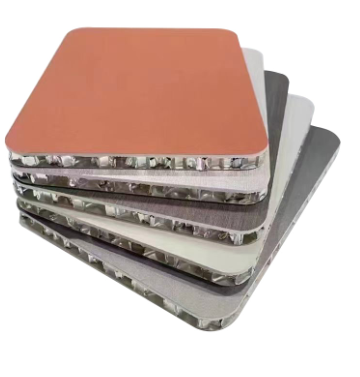
In construction, interior design, and industrial applications, choosing the right panel material can make or break a project’s durability, cost-efficiency, and performance. Two popular options—aluminum honeycomb panels and composite panels—often compete for selection, but they serve distinct needs. This article breaks down their core differences, helping you pick the best fit for your project.
1. What Are They? Basic Definitions
Before comparing, it’s critical to understand each panel’s structure, as this drives their performance.
Aluminum Honeycomb Panels
These are sandwich-structured panels with three layers: two thin aluminum face sheets (typically 0.3–1.5mm thick) bonded to a central “honeycomb core”—a hexagonal grid made of aluminum foil (0.03–0.1mm thick). The honeycomb core mimics nature’s beehive design, balancing lightweight properties with exceptional strength. They are often finished with coatings (e.g., PVDF, powder coating) for weather resistance and aesthetics.
Composite Panels
“Composite panels” is a broader term for panels made by bonding two or more dissimilar materials. The most common type in construction is aluminum composite panels (ACPs), which consist of two aluminum face sheets (0.2–0.5mm thick) glued to a dense core—usually polyethylene (PE, for non-fire-rated use) or mineral-filled core (for fire-rated use). Other variants include wood-plastic composite (WPC) or fiber-reinforced composite (FRC) panels, but ACPs are the primary alternative to aluminum honeycomb panels.
2. Core Differences: Performance & Properties
The biggest gaps between the two lie in weight, strength, fire safety, and cost—factors that directly impact project budgets and functionality.
Weight: Aluminum Honeycomb Panels Are Far Lighter
Aluminum honeycomb panels weigh 3–8 kg/m², thanks to their hollow honeycomb core (which contains ~90% air). In contrast, ACPs weigh 8–12 kg/m² because their solid PE/mineral core is denser. For large-scale projects (e.g., high-rise facades, ceiling installations), this difference reduces structural load on buildings, cutting costs for steel supports and labor.
Strength: Aluminum Honeycomb Panels Excel at Load-Bearing
The hexagonal honeycomb core distributes weight evenly across the panel, giving aluminum honeycomb panels a high bending strength (150–300 MPa) and resistance to warping. They can support heavy loads (e.g., signage, equipment) without deformation. ACPs, while rigid for basic use, have lower bending strength (80–150 MPa) and are prone to sagging if used for large, unsupported spans (over 3 meters).
Fire Safety: Dependent on Core Material
- Aluminum honeycomb panels: The aluminum core is non-combustible, so they naturally meet fire safety standards (e.g., Class A in the US, EN 13501-1 Class A2 in Europe) without extra modifications.
- ACPs: PE-core ACPs are flammable (Class B/C rating) and pose fire risks (infamously linked to high-rise fires). Only mineral-core ACPs reach Class A fire ratings—but they cost 30–50% more than PE-core versions.
Cost: Composite Panels Are More Budget-Friendly
ACPs are cheaper upfront: PE-core ACPs cost $20–$40/m², while mineral-core ACPs range from $35–$60/m². Aluminum honeycomb panels are pricier, at $50–$100/m², due to their complex manufacturing (honeycomb core production + precise bonding). However, their lightweight design often offsets long-term costs (lower transport, installation, and structural expenses).
3. Which to Choose for Your Project?
Pick Aluminum Honeycomb Panels If:
- Your project requires large, unsupported spans (e.g., airport ceilings, stadium facades).
- Fire safety is non-negotiable (e.g., hospitals, high-rise residential buildings).
- You need to reduce structural load (e.g., retrofitting old buildings).
Pick Composite Panels (ACPs) If:
- You’re working with a tight budget (e.g., small retail stores, low-rise offices).
- The panels will be used for small, supported areas (e.g., interior wall cladding, kiosks).
- Fire risks are low (e.g., covered walkways, non-residential low-rise structures).
Conclusion
Aluminum honeycomb panels and composite panels (ACPs) are both versatile, but their differences in weight, strength, fire safety, and cost make them better suited for specific projects. Aluminum honeycomb panels are the premium choice for high-performance, safety-critical applications, while ACPs shine in budget-friendly, low-load scenarios. By aligning the panel’s properties with your project’s needs—whether it’s structural efficiency, fire safety, or cost—you’ll ensure a long-lasting, cost-effective result. For projects demanding top-tier strength, lightweight design, and reliable fire safety, choose Chongqing Huigong’s Aluminum Honeycomb Panels—we deliver consistent quality that balances performance, durability, and aesthetic flexibility for both large-scale and precision-focused builds.

 English
 Arabic
 French
 Spanish
 Portuguese
 Deutsch
 Turkish
 Dutch
Dutch
 Italiano
 Russian
 Portuguese (Brazil)