
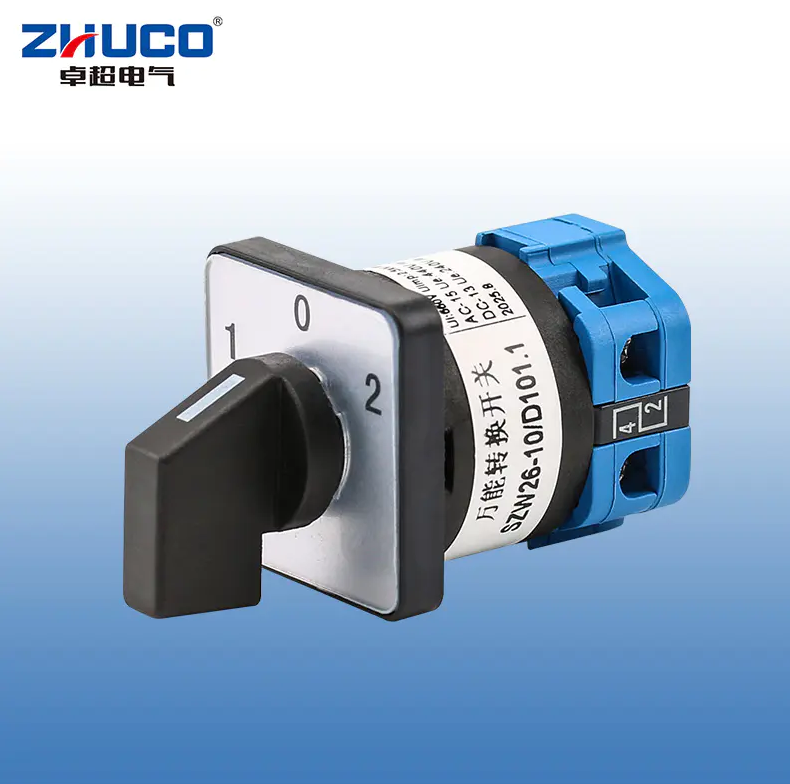
A voltage switch serves as a gate for electrical current, opening or closing a path according to the presence or absence of voltage at its terminals. In its simplest form the device contains a pair of contacts that either touch or separate, deciding whether power continues downstream. When the contacts close, voltage appears across the load; when they open, the circuit breaks and the voltage drops to zero at that point.
The internal mechanism varies with the application. A manual voltage switch relies on a lever, toggle, or rotary knob that the user moves by hand. The motion forces the contacts together or pulls them apart. Spring tension often helps the contacts snap into place, reducing the time spent in a partially closed state where arcing could occur. In contrast, an automatic voltage switch monitors the incoming voltage and acts when that value crosses a set threshold. Sensing circuitry compares the measured voltage against a reference and drives a relay or solid-state element accordingly.
Contact materials influence how the switch behaves under load. Copper alloys or silver-based compounds provide low resistance when closed, limiting heat generation. The surface must also resist welding or pitting when the contacts open under current. Arc chutes or magnetic blowouts appear in higher-capacity designs to stretch and extinguish the arc that forms as the contacts separate. These features keep the voltage switch functional through repeated cycles of making and breaking the circuit.
Terminal arrangement and enclosure shape the practical use of the device. Screw terminals, quick-connect tabs, or printed-circuit pins match different wiring methods. The housing protects the contacts from dust and accidental touch while providing clear indication of the switch position. In panel-mounted versions a faceplate shows “on” and “off” or numbered voltage selections so the operator can confirm the state at a glance.
Voltage rating defines the maximum potential the switch can safely interrupt. A unit marked for a given voltage class must withstand that potential across its open contacts without breakdown. Current rating works in tandem, indicating how much continuous load the closed contacts can carry without excessive temperature rise. Together these ratings guide selection for a particular circuit so that the voltage switch remains within its design limits during normal operation.
In everyday electrical systems the voltage switch appears in roles ranging from simple light control to equipment isolation. A wall switch that turns a lamp on and off is a basic voltage switch. A rotary selector that chooses between different supply voltages for a piece of machinery is another. In each case the device translates a mechanical or electronic decision into a clear change in the voltage available to the load.
The core function stays consistent: the voltage switch either permits or prevents the passage of voltage. Through contact action, threshold sensing, or manual selection, it gives the circuit a defined on or off state. That binary control remains the practical reason the device continues to appear wherever electrical power must be directed or interrupted with intention.

 English
 Arabic
 French
 Spanish
 Portuguese
 Deutsch
 Turkish
 Italiano
 Russian
 Romaian
 Portuguese (Brazil)