
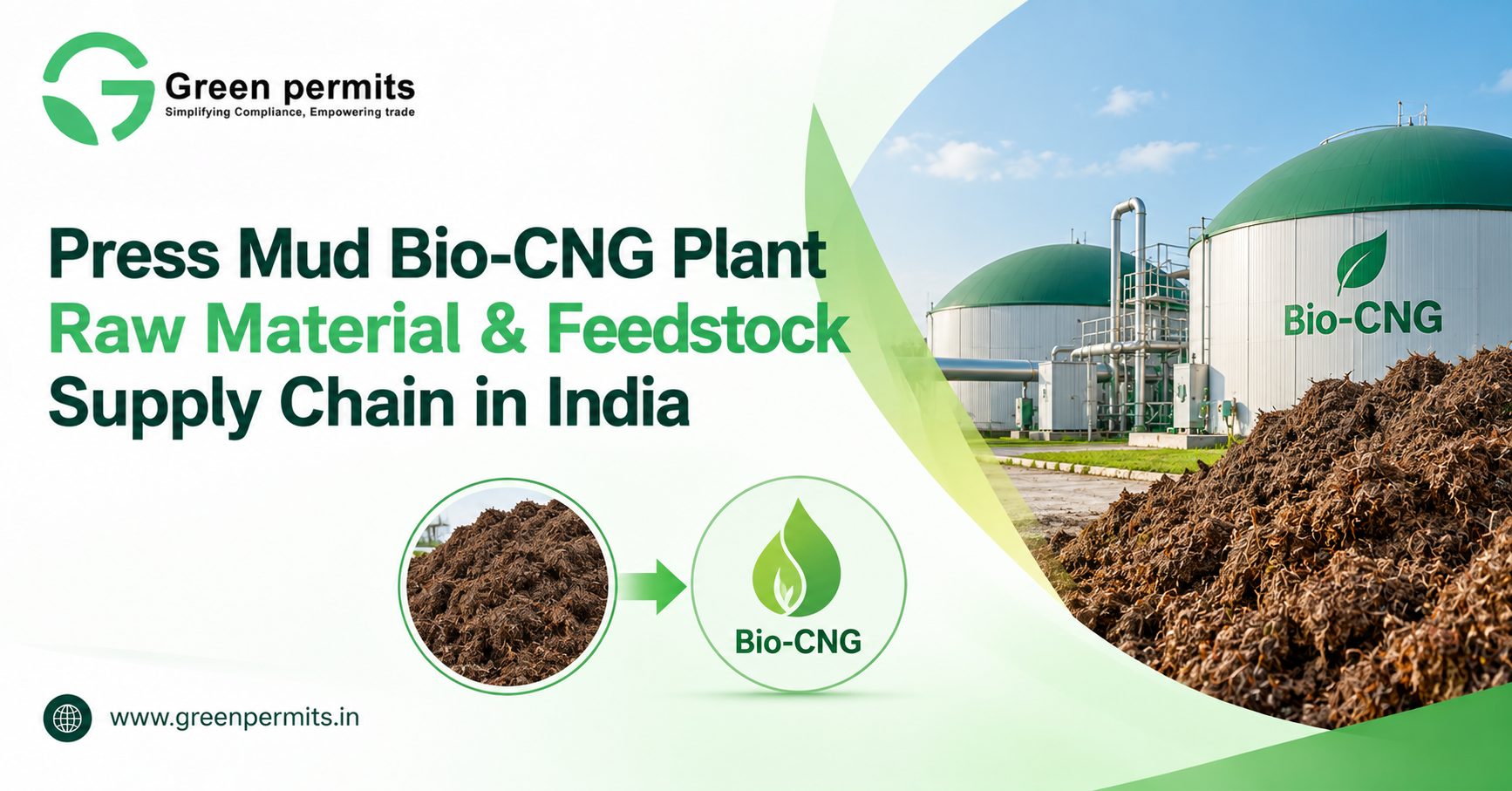
A Press Mud Bio-CNG Plant can be an attractive project for sugar-producing regions because press mud is generated as a by-product during sugar processing and can be used as an organic feedstock for anaerobic digestion. However, the success of the plant depends much more on feedstock planning than on machinery alone.
Press mud is not available uniformly throughout the year. Sugar mills operate seasonally, and the quantity, moisture and quality of press mud can vary from one mill to another. For this reason, investors should understand the complete raw material and feedstock supply chain before deciding plant capacity.
A strong project should answer four basic questions: how much press mud is actually available, how far it must travel, how it will be stored for off-season use and what the delivered cost will be at the Bio-CNG plant.
Green Permits Consulting supports investors with Press Mud Bio-CNG feasibility studies, feedstock assessment, DPR preparation, supply-chain planning, CAPEX and OPEX modelling and complete project implementation support.
Why Press Mud is Used for Bio-CNG Production
Press mud is a semi-solid residue generated during clarification and filtration in sugar mills. It contains organic matter that can be converted into biogas through anaerobic digestion.
In a Bio-CNG project, press mud is fed into digesters where microorganisms break down biodegradable material and produce raw biogas. The gas is then purified, upgraded and compressed to produce Bio-CNG.
The basic process is:
Press Mud Collection → Storage → Feed Preparation → Anaerobic Digestion → Raw Biogas → Purification → Compression → Bio-CNG
The commercial viability of this process depends heavily on the consistency of feedstock supply. A digester needs regular feeding, while press mud generation is concentrated during the sugar-crushing season.
This seasonal mismatch makes supply-chain planning one of the most important parts of the project.
Start with Sugar Mill Mapping
The first stage of a feedstock study should be to identify sugar mills around the proposed plant location.
The study should assess the number of operating mills, their crushing capacity, production season, approximate press mud generation and distance from the proposed Bio-CNG site.
It is not enough to calculate feedstock based on the total sugar industry in the state. A project needs material that can actually be procured and transported economically.
The practical approach is:
Sugar Mill → Available Press Mud → Competing Buyers → Distance → Delivered Quantity
Some mills may already sell press mud for composting, organic manure production or other uses. Therefore, the total quantity generated by a mill should not automatically be treated as available feedstock for a new Bio-CNG project.
Seasonal Availability is the Main Supply-Chain Challenge
Press mud availability is closely linked to the sugar-crushing season.
During this period, large quantities can be generated within a relatively short time. The Bio-CNG plant, however, is generally expected to operate for most of the year.
This means the project must develop a strategy for storing and preserving press mud during the off-season.
Without proper planning, the plant may operate at high capacity for a few months and then face raw-material shortages.
A feasibility study should therefore calculate annual feedstock requirements rather than only daily requirements.
For example, if the digester requires a fixed quantity of press mud every day, the DPR should determine how much material needs to be secured during the sugar season to support operations during the remaining months.
This annual supply calculation should be completed before the plant size is finalised.
Feedstock Quality Matters as Much as Quantity
Two tonnes of press mud from different sugar mills may not produce the same quantity of gas.
Moisture content, organic matter, ash, contamination and storage condition can influence digestion performance. Material exposed to rain or mixed with excessive soil and unwanted matter may have lower usable value.
This is why representative feedstock samples should be tested before finalising gas-yield assumptions.
The project should evaluate parameters such as solids content, moisture, organic fraction and expected biogas potential.
A DPR should not assume one standard gas yield for all press mud.
A more reliable approach is:
Feedstock Testing → Expected Gas Yield → Daily Gas Production → Bio-CNG Output
This produces a much stronger financial model.
Procurement Agreements with Sugar Mills
Long-term feedstock security is important for Bio-CNG project financing.
The promoter should identify suitable sugar mills and discuss commercial supply arrangements before final investment. These agreements can define expected quantity, collection responsibility, loading arrangements, price mechanism and supply period.
A project depending only on open-market purchases may face price increases during periods of strong demand.
For this reason, multiple suppliers are generally more secure than complete dependence on one mill.
A practical procurement strategy can include one or two major anchor suppliers along with additional mills within the economic collection radius.
This reduces the risk of plant shutdown if one mill experiences lower crushing volumes or operational problems.
Transportation Cost of Press Mud
Press mud is bulky and contains significant moisture, so transport cost can become an important part of project OPEX.
The farther the material travels, the higher the delivered cost per tonne.
The project should therefore calculate:
Purchase Price + Loading + Transport + Unloading + Handling = Delivered Feedstock Cost
This delivered cost is more useful than simply comparing the price offered by different mills.
A mill offering cheaper press mud 100 km away may ultimately be more expensive than a supplier located 25 km from the plant.
For this reason, Bio-CNG plants are often stronger when developed reasonably close to large sugar-producing clusters.
Storage and Preservation Planning
Because press mud is seasonal, storage infrastructure becomes an important part of plant design.
The site may require significant storage area for the material collected during the crushing season. Storage should be designed to reduce excessive moisture gain, runoff, odour and deterioration.
Poorly managed stockpiles can create material losses and reduce gas potential over time.
The DPR should therefore calculate the maximum inventory that may need to be stored at one time.
Storage requirement affects land size, civil works, drainage, internal roads and working capital.
This is one reason why a press mud Bio-CNG plant may need more land than a project using a feedstock available continuously throughout the year.
Can Other Feedstocks be Added?
A press mud-based plant may also evaluate co-digestion with other compatible organic feedstocks where technically and commercially suitable.
Possible materials can include cattle dung, food waste, distillery residues or other biodegradable feedstocks depending on location and process design.
However, additional feedstock should not be added only to increase plant capacity on paper.
Each material can change moisture balance, gas yield, digestion behaviour and operating conditions.
Any co-feedstock should therefore be tested and included in the material balance before final process design.
The main objective should remain stable digester performance, not simply maximum daily tonnage.
Feedstock Cost and Working Capital
Working capital can be significant in a press mud Bio-CNG project because the promoter may need to purchase large quantities during the sugar season and store them for later consumption.
This creates a different cash-flow structure from projects where feedstock is purchased daily.
The cycle may look like:
Seasonal Procurement → Large Inventory → Monthly Consumption → Bio-CNG Production → Customer Payment
The financial model should therefore include the cost of seasonal procurement, storage losses, transportation and inventory holding.
If the project underestimates working capital, operations can face financial pressure even when the plant is technically performing well.
Plant Capacity Should Follow Feedstock Availability
One of the most common project mistakes is selecting machinery capacity first and trying to arrange feedstock later.
The correct approach should be the opposite.
A realistic project sequence is:
Feedstock Mapping → Annual Secured Quantity → Gas Yield → Bio-CNG Output → Plant Capacity
If 60,000 tonnes of press mud can be secured reliably, the plant should be designed around that quantity and its tested gas potential. Capacity should not be based on a much higher future feedstock assumption unless expansion supply is reasonably identified.
This approach reduces the risk of low plant utilisation and weak project returns.
Buyer and Offtake Planning
Feedstock security is only one side of the project. Bio-CNG also needs a reliable market.
The developer should assess potential industrial buyers, gas-marketing arrangements or other suitable offtake channels before finalising the project.
The economics should connect both sides:
Secured Feedstock → Bio-CNG Production → Confirmed Buyer
A project with inexpensive press mud but no practical gas buyer can still be commercially weak.
Feedstock and offtake studies should therefore be completed together.
DPR for Press Mud Bio-CNG Plant
A professional Press Mud Bio-CNG Plant DPR should include sugar mill mapping, feedstock availability, procurement radius, seasonal storage, gas-yield assumptions, plant capacity, machinery, CAPEX, OPEX and working capital.
The DPR should also examine transportation cost, feedstock price sensitivity and the impact of lower gas yield or reduced sugar production.
A practical project-development sequence is:
Sugar Mill Mapping → Feedstock Testing → Supply Agreements → Storage Planning → Capacity → DPR → Offtake → Approvals → Plant Setup
This provides a much more reliable investment basis than simply selecting a digester capacity from a machinery supplier.
How Green Permits Helps
Green Permits Consulting supports investors with Press Mud Bio-CNG Plant feedstock studies, sugar mill mapping, feasibility assessment, DPR preparation, machinery planning, CAPEX and OPEX modelling and project implementation support.
The objective is to ensure that the proposed plant has enough raw material, proper seasonal storage and a commercially viable supply chain before major investment is committed.
Learn More About Press Mud Bio-CNG Plant Setup
If you are planning a press mud-based Bio-CNG project, the first stage should evaluate annual press mud availability, sugar mill locations, transportation cost, storage requirement, gas yield and offtake before plant capacity is finalised.
Read more about plant setup and DPR consulting services here:
👉 https://www.greenpermits.in/09/press-mud-bio-cng-feedstock-supply-cost-procurement/
📞 Get Expert Assistance for Press Mud Bio-CNG Projects
If you are planning a Press Mud Bio-CNG Plant in India, Green Permits Consulting can assist with feedstock mapping, feasibility study, DPR preparation, machinery planning and project implementation.
🌐 Website: www.greenpermits.in
📞 Phone: +91 78350 06182
📧 Email: wecare@greenpermits.in

 English
 Arabic
 French
 Spanish
 Portuguese
 Deutsch
 Turkish
 Italiano
 Russian
 Romaian
 Portuguese (Brazil)