
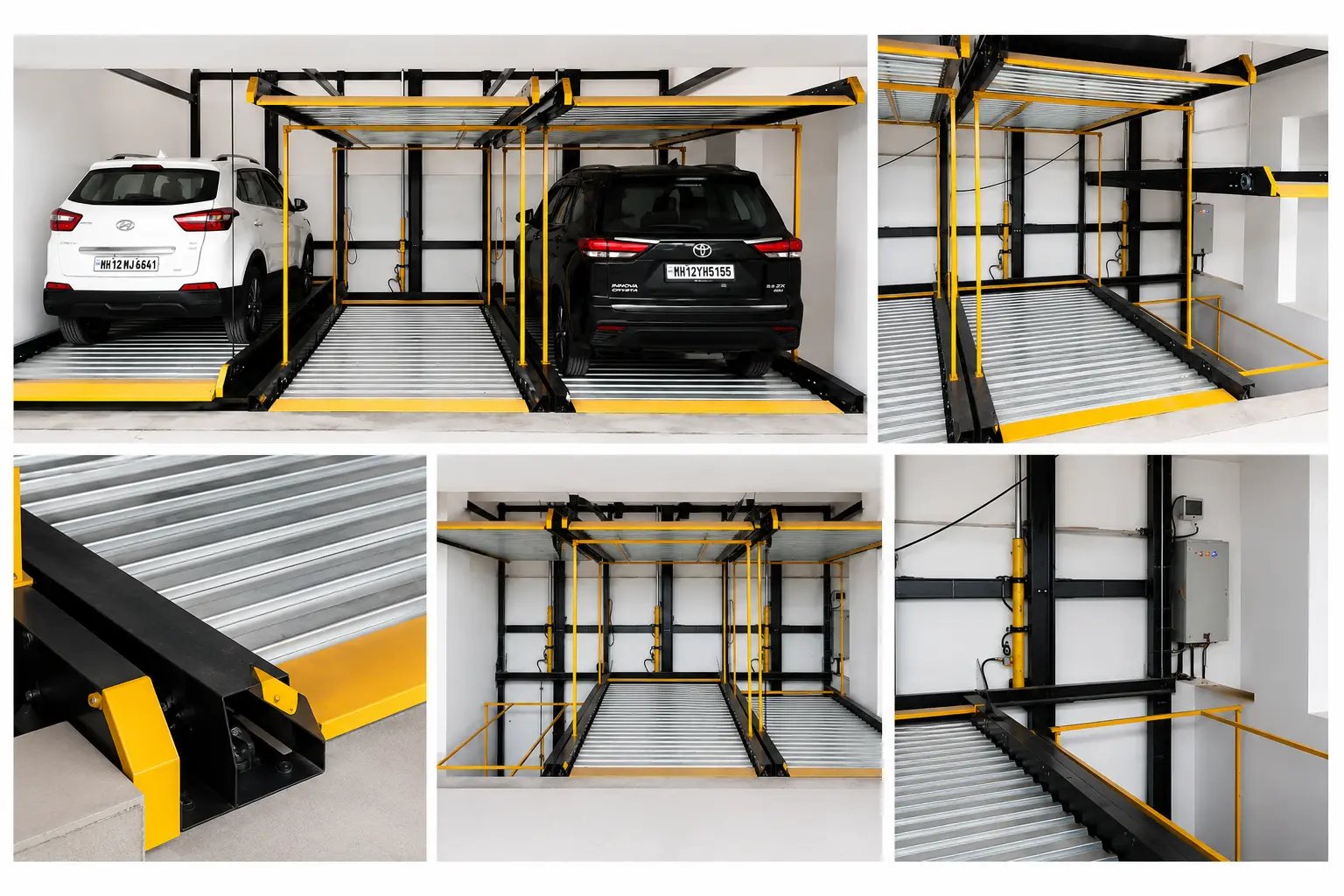
India's cities are developing rapidly, and therefore the demand for intelligent, organized, and space-efficient infrastructure is increasing. As urban populations grow, vehicle ownership also rises, creating greater pressure on roads and conventional parking areas. A Puzzle Parking System can provide a structured approach to vehicle storage by utilizing available horizontal and vertical space more effectively. Moreover, it can support modern urban planning by helping residential, commercial, and mixed-use developments manage parking requirements within limited land areas.
For developers, infrastructure planners, housing societies, and commercial property owners, stackparking solutions can support the development of organized parking facilities. Furthermore, mechanical parking arrangements can be designed according to site conditions, expected vehicle capacity, building configuration, and operational requirements. In India's growing cities, where land is increasingly valuable, efficient parking infrastructure can contribute to better utilization of existing urban spaces. Consequently, modern parking technologies are becoming an important consideration when planning future-ready developments.
Growing Importance of Smart Parking
Smart cities require infrastructure that uses available resources efficiently. Parking is an important part of this infrastructure because vehicles occupy significant areas within residential neighborhoods, business districts, shopping centers, and public facilities.
Traditional surface parking can require extensive land for vehicle spaces as well as circulation and maneuvering. However, urban land is limited in many Indian cities. A Puzzle Parking System provides a mechanical approach in which vehicles can be arranged across multiple parking positions. Depending on the configuration, platforms can move horizontally or vertically to provide access to individual vehicles.
As a result, property developers can explore ways to accommodate more vehicles within a planned footprint. Furthermore, efficient parking can support the broader goal of creating organized and functional urban spaces.
Supporting Indian Smart City Development
Smart city development in India focuses on improving infrastructure, mobility, public services, and resource management. Consequently, parking management has become an important consideration for urban planners.
Cities need parking facilities that can respond to increasing vehicle demand while making responsible use of available land. Mechanical parking technology can help address this requirement in suitable locations.
For example, commercial districts can consider compact parking arrangements near offices and retail properties. Similarly, residential developments can use organized parking facilities to manage vehicles within restricted areas. Therefore, modern parking solutions can form one component of a wider smart infrastructure strategy.
Efficient Use of Urban Land
Land availability is a major concern in densely populated cities. In metropolitan areas such as Mumbai, Delhi, Bengaluru, Hyderabad, Chennai, and Pune, urban plots can be expensive and difficult to expand.
A Puzzle Parking System can make use of both horizontal and vertical areas, depending on the site design. Instead of placing every vehicle on a single surface level, parking positions can be arranged in a multi-level configuration.
Moreover, efficient parking can potentially leave additional space for pedestrian pathways, landscaping, public facilities, commercial activities, or other infrastructure. Consequently, developers can consider a more balanced approach to land utilization.
Applications in Residential Developments
Residential projects are an important part of smart city infrastructure. Apartment towers and housing communities often have large numbers of vehicles but limited parking areas.
A structured mechanical parking arrangement can provide designated positions for residents. Furthermore, organized vehicle storage can reduce random parking and improve the overall layout of a housing complex.
For new developments, parking technology can be incorporated during the design stage. Meanwhile, existing residential properties can evaluate feasibility based on available space, structural conditions, access routes, and applicable requirements.
Therefore, efficient parking can support residential communities while contributing to better use of urban land.
Commercial and Business Applications
Commercial properties require parking for employees, customers, visitors, and service vehicles. However, valuable commercial land may be needed for offices, retail areas, pedestrian spaces, and other facilities.
A Puzzle Parking System can help commercial developers explore compact vehicle storage arrangements. Multiple parking positions can be organized within a relatively limited footprint, depending on the selected configuration.
Shopping centers, corporate offices, hotels, hospitals, and mixed-use developments can evaluate such solutions according to their parking requirements. Moreover, parking planning can be integrated with building access, pedestrian circulation, and overall property management.
Improving Urban Parking Organization
Smart infrastructure is not only about technology. It also involves effective organization and management. Poorly planned parking can result in blocked roads, inefficient land use, and unnecessary vehicle movement.
Mechanical parking equipment can provide defined vehicle positions and structured operating procedures. Consequently, property managers can maintain better control over parking spaces.
Additionally, suitable signage and user instructions can make the facility easier to operate. Digital management tools may also be integrated where appropriate to monitor parking availability and vehicle movement. Thus, technology and proper management can work together to improve parking efficiency.
Using Vertical Space in Smart Cities
One of the major challenges in urban areas is the limited availability of horizontal land. Therefore, vertical development has become an important part of modern infrastructure planning.
A Puzzle Parking System can utilize multiple levels within a suitable structure. By arranging vehicles vertically, developers can explore ways to increase parking capacity without requiring a proportionate increase in land area.
However, vertical parking requires careful engineering. Structural strength, available height, vehicle dimensions, platform movement, access, electrical requirements, and safety clearances must all be assessed.
Consequently, professional planning is essential to ensure that the selected configuration is appropriate for the site.
Supporting Sustainable Urban Planning
Efficient land utilization can contribute to more sustainable urban development. When parking is poorly planned, large areas may be dedicated to vehicles, reducing space available for greenery, pedestrian facilities, and community infrastructure.
Modern mechanical parking can help developers consider more compact vehicle storage. As a result, suitable properties may have opportunities to allocate available space for other purposes.
Furthermore, organized parking can reduce unnecessary circulation within a property. Although parking technology alone cannot solve broader urban mobility challenges, it can contribute to a more efficient approach to infrastructure planning.
Safety and Reliability
Safety should remain a fundamental part of smart parking infrastructure. Mechanical parking equipment should be properly engineered and installed according to the site's requirements and applicable standards.
Moreover, vehicles should remain within specified weight and dimensional limits. Safety sensors, control systems, platforms, and mechanical components should be inspected regularly.
Preventive maintenance is equally important. Regular servicing can help identify potential issues before they affect normal operation. Therefore, property managers should establish appropriate inspection and maintenance schedules.
Clear user instructions are also essential. Consequently, trained personnel and suitable signage can help residents, employees, and visitors operate the facility responsibly.
Planning for Future Urban Growth
Smart cities need infrastructure that can respond to changing requirements. Vehicle ownership, population density, and commercial activity can increase over time. Therefore, parking infrastructure should be planned with both current and future demand in mind.
A Puzzle Parking System can be considered as part of a long-term parking strategy for suitable urban developments. Developers can evaluate current vehicle demand while also considering future occupancy, visitor requirements, and potential changes in land use.
Additionally, parking facilities should be reviewed periodically to identify opportunities for operational improvements. Thus, long-term planning can help maintain efficient use of parking infrastructure.
Factors to Consider Before Installation
Before implementing a mechanical parking solution, developers should conduct a detailed site assessment. Important factors include available land, structural conditions, parking capacity, vehicle dimensions, access routes, retrieval frequency, and expected future demand.
Furthermore, ventilation, lighting, drainage, electrical supply, pedestrian movement, emergency access, and maintenance requirements should be considered. Local building regulations and applicable safety requirements should also be reviewed.
By evaluating these factors in advance, developers can select a parking configuration that better matches the site's needs. Moreover, careful planning can help reduce operational challenges after installation.
Role in Future-Ready Infrastructure
India's urban development is increasingly focused on technology, efficient resource use, and improved infrastructure. Parking facilities can contribute to this transformation by using modern methods to manage growing vehicle demand.
A Puzzle Parking System can support future-ready urban development by providing organized vehicle storage within a planned footprint. Furthermore, it can be integrated into residential, commercial, and mixed-use developments where space optimization is important.
However, technology should always be selected according to practical requirements. Proper engineering, maintenance, user management, and safety procedures are equally important for achieving reliable performance.
Conclusion
Smart city infrastructure requires efficient solutions for managing limited urban resources. Parking is an important part of this process because increasing vehicle ownership continues to place pressure on available land. A Puzzle Parking System can provide a structured approach to vehicle storage while utilizing suitable horizontal and vertical space. Moreover, it can support residential, commercial, and mixed-use developments where efficient land management is essential. With proper site assessment, engineering, safety procedures, regular maintenance, and effective management, modern parking technology can contribute to more organized and space-efficient urban infrastructure in India.
Read More about — Puzzle Parking System for Smart City Infrastructure

 English
 French
 Spanish
 Portuguese
 Deutsch
 Turkish
 Dutch
Dutch
 Italiano
 Russian
 Romaian
 Portuguese (Brazil)