
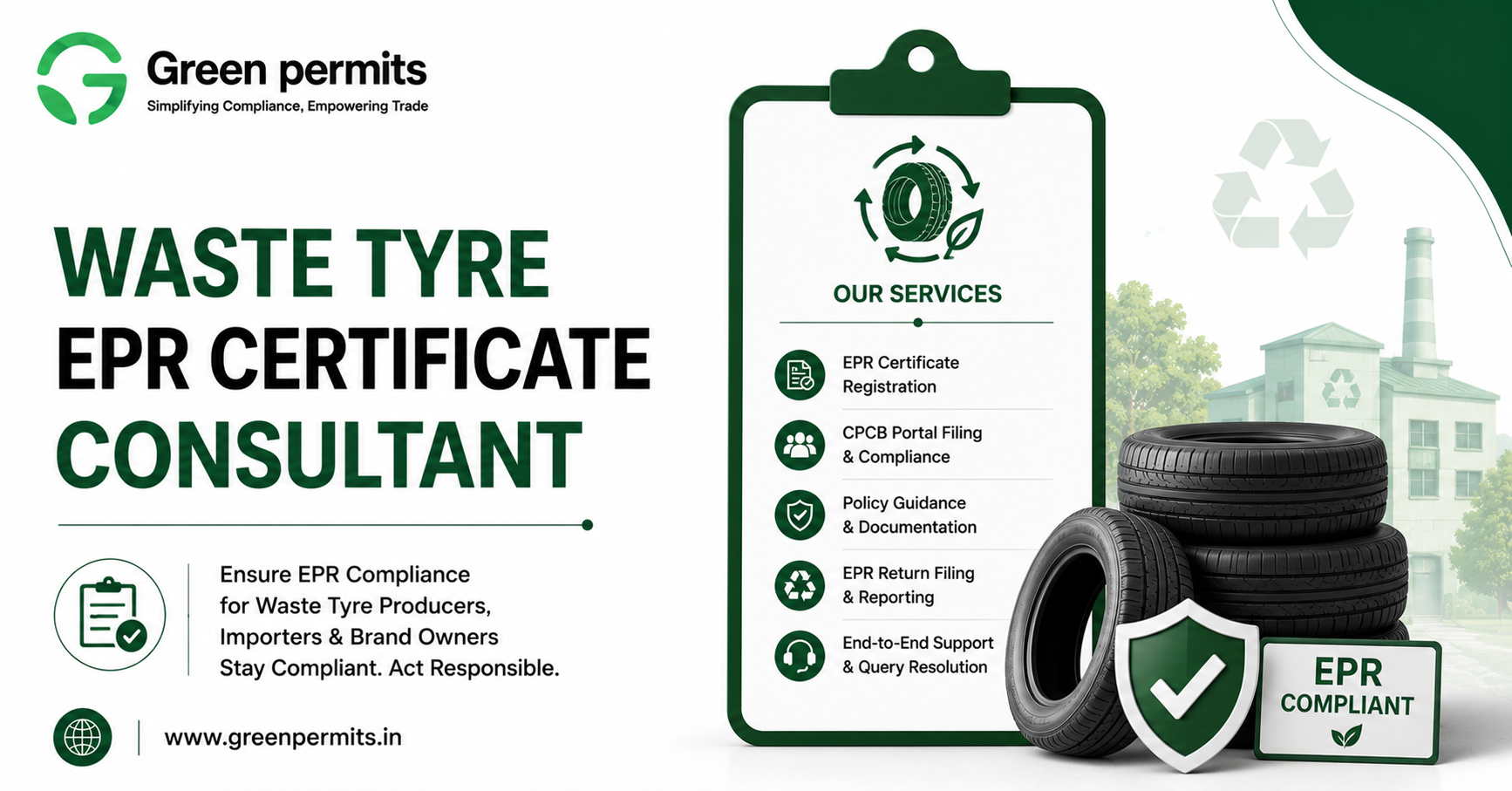
Waste Tyre EPR Certificate Consultant in India helps tyre manufacturers, importers, automobile companies, vehicle importers, waste tyre importers, recyclers and retreaders comply with the Extended Producer Responsibility framework applicable to waste tyres.
India’s waste tyre EPR system is governed by Schedule IX of the Hazardous and Other Wastes (Management and Transboundary Movement) Rules, 2016, inserted through the Hazardous and Other Wastes Amendment Rules, 2022. The framework places responsibility on tyre producers to ensure that a prescribed quantity of waste tyre is recycled through registered recyclers.
Compliance is managed through the CPCB Waste Tyre EPR Portal. Producers, recyclers and retreaders must register on the portal, maintain supporting records, submit returns and complete EPR certificate transactions through the online system. The rules also prohibit registered entities from dealing with unregistered producers or recyclers.
A Waste Tyre EPR Certificate Consultant supports businesses with applicability assessment, producer categorisation, registration, sales or import data preparation, EPR target calculation, recycler verification, certificate transfer coordination, return filing, renewal and response to CPCB queries.
The consultant does not issue EPR certificates. Certificates are generated by CPCB in favour of registered recyclers based on eligible waste tyre recycling and sale of approved recycling outputs. Producers fulfil their obligations by purchasing and adjusting these certificates through the official portal.
What is Waste Tyre EPR?
Waste Tyre EPR is a regulatory system under which a tyre producer is responsible for ensuring the environmentally sound management of waste tyres arising from tyres introduced into the market.
Under this system, producers receive annual recycling obligations based on the quantity of tyres manufactured, sold or imported during the relevant base year.
The producer does not necessarily have to establish its own tyre recycling plant. It may fulfil its obligation by purchasing valid EPR certificates from registered waste tyre recyclers through the CPCB portal.
The system covers:
- Manufacture and domestic sale of new tyres
- Sale of privately branded tyres manufactured by another company
- Import and sale of new tyres
- Import of vehicles fitted with new tyres
- Import of new tyres by automobile manufacturers
- Import of waste tyres
- Recycling of waste tyres
- Retreading of eligible tyres
The main purpose is to ensure that waste tyres are formally collected, processed and converted into approved products instead of being dumped, burned or handled through environmentally unsafe facilities.
What is a Waste Tyre EPR Certificate?
A Waste Tyre EPR Certificate is an electronic certificate generated through the CPCB portal in favour of a registered waste tyre recycler.
The certificate represents an eligible quantity of waste tyre recycling calculated according to the recycling output, conversion factor and weightage assigned to the approved end product.
The basic calculation specified in the rules is:
Eligible EPR certificate quantity = Quantity of end product x Conversion factor x Weightage
The conversion factor is determined by CPCB. The weightage depends on the type of end product produced through recycling.
The certificate can be transferred by an eligible registered recycler to a registered producer for fulfilment of the producer’s annual EPR obligation.
Once purchased and adjusted against the producer’s liability, the certificate is extinguished and cannot be reused for another obligation.
Who is Considered a Tyre Producer?
The term producer is wider than a tyre manufacturer. A business may fall under the waste tyre EPR framework even if it does not manufacture tyres in India.
The rules recognise the following producer categories.
P1 - Domestic Tyre Manufacturer
This category covers a person or entity that manufactures and sells new tyres domestically.
Examples include:
- Passenger vehicle tyre manufacturers
- Commercial vehicle tyre manufacturers
- Two-wheeler tyre manufacturers
- Off-road tyre manufacturers
- Industrial tyre manufacturers
P2 - Brand Owner Selling Tyres Made by Another Manufacturer
This category covers a business that sells new tyres under its own brand even though the tyres are manufactured by another manufacturer or supplier.
Private-label tyre brands may fall under this category.
P3 - Importer Selling New Tyres
This category covers businesses that import new tyres and sell them in India.
The importer may sell tyres under:
- Its own brand
- The foreign manufacturer’s brand
- A distribution arrangement
- An exclusive dealership arrangement
P4 - Importer of Vehicles Fitted with New Tyres
A company importing vehicles fitted with new tyres may be treated as a producer for the tyres entering the Indian market with those vehicles.
This may apply to importers of:
- Passenger vehicles
- Commercial vehicles
- Two-wheelers
- Construction vehicles
- Agricultural or off-road equipment
- Special-purpose vehicles
P5 - Automobile Manufacturer Importing Tyres
An automobile manufacturer that imports new tyres for fitting in vehicles sold domestically may fall within this category.
P6 - Waste Tyre Importer
A person or entity importing waste tyres is treated as a producer under the rules.
The EPR obligation calculation for a waste tyre importer differs from the calculation applicable to producers of new tyres. The rules also prohibit the import of waste tyres for producing pyrolysis oil or char.
A company conducting more than one activity may need to register under multiple producer categories.
Which Businesses Need Waste Tyre EPR Registration?
Waste Tyre EPR Registration may apply to:
- Tyre manufacturers
- Tyre importers
- Tyre brand owners
- Private-label tyre companies
- Automobile manufacturers
- Vehicle importers
- Electric vehicle importers
- Commercial vehicle importers
- Construction equipment importers
- Off-road vehicle importers
- Waste tyre importers
- Waste tyre recyclers
- Tyre retreaders
Applicability should be evaluated according to actual business activity rather than only the company’s industry classification.
For example, an automobile company may not manufacture tyres, but if it imports vehicles fitted with new tyres, it can still fall within the producer definition.
Is Waste Tyre EPR Registration Mandatory?
Producers, recyclers and retreaders covered by Schedule IX are required to register on the CPCB Waste Tyre EPR Portal.
The rules provide that:
- Covered entities must register on the portal
- No covered entity may conduct business without registration
- Registered entities should not deal with an unregistered producer or recycler
- Separate registration may be required where an entity falls into more than one category
- False or concealed information may result in revocation and environmental compensation
The CPCB producer registration page currently states that producer registration is valid for 2 years and must be renewed based on the validity shown in the registration.
How is the Waste Tyre EPR Target Calculated?
The EPR target depends on whether the applicant manufactures or imports new tyres or imports waste tyres.
Target for New Tyre Manufacturers and Importers
The introductory targets were:
- FY 2022-23 - 35% of new tyres manufactured or imported in FY 2020-21
- FY 2023-24 - 70% of new tyres manufactured or imported in FY 2021-22
- FY 2024-25 - 100% of new tyres manufactured or imported in FY 2022-23
After FY 2024-25, the annual EPR obligation is 100% of the quantity of new tyres manufactured or imported 2 financial years earlier.
Therefore, for a normal producer:
EPR obligation in Year Y = 100% of eligible tyre quantity in Year Y-2
A unit established after April 1, 2022 generally begins receiving an EPR obligation after 2 years, based on the quantity manufactured or imported in the corresponding base year.
Target for Waste Tyre Importers
For a waste tyre importer:
EPR obligation in Year Y = 100% of waste tyres imported in Year Y-1
The CPCB system separately tracks obligations and certificates connected with imported waste tyre material.
Wear and Tear Adjustment
The rules also provide for reduction of the target through a factor specified by CPCB to account for tyre weight lost through normal wear and tear.
The actual portal obligation should therefore be reconciled with:
- Base-year sales data
- Import data
- Producer category
- Tyre type
- Weight details
- Wear and tear factor
- Carried-forward liability
- Retreading certificates, where applicable
Simple Waste Tyre EPR Target Example
Consider a tyre importer that imported and sold 2,000 MT of new tyres during FY 2023-24.
The normal obligation for FY 2025-26 would be based on the FY 2023-24 quantity because the rules use the Y-2 base year.
Before finalising the obligation, the business should verify:
- Quantity accepted on the portal
- Applicable wear and tear adjustment
- Any previously unfulfilled target
- Corrections or amendments in import data
- Whether any quantity falls under another producer category
- Retreading certificates available for deferment
The portal-generated obligation should be treated as the operational compliance figure after the underlying data has been checked.
What Products Generate Waste Tyre EPR Certificates?
The rules recognise specific end products from environmentally sound waste tyre recycling.
These include:
- Reclaimed rubber
- Crumb rubber
- Crumb Rubber Modified Bitumen
- Recovered carbon black usable as raw material for manufacturing new tyres
- Pyrolysis oil or char used only as fuel
The approved weightages are:
Reclaimed Rubber
Weightage: 1.30
Recovered Carbon Black
Weightage: 1.25
The recovered carbon black must be usable as raw material for manufacturing new tyres.
Crumb Rubber Modified Bitumen
Weightage: 1.10
Crumb Rubber
Weightage: 1.00
Pyrolysis Oil and Char from Continuous Pyrolysis
Weightage: 0.80
Pyrolysis Oil and Char from Batch Pyrolysis
Weightage: 0.50
These weightages affect the eligible quantity of EPR certificates that may be generated from the sale of an approved end product. The conversion factor is separately determined by CPCB.
How are Waste Tyre EPR Certificates Generated?
Waste tyre EPR certificates are not generated merely because a recycler has received waste tyres.
The recycler must maintain and upload a complete transaction trail covering:
- Procurement or import of waste tyres
- Quantity processed
- End products manufactured
- Quantity of end products sold
- Buyer details
- Procurement invoices
- Bill of lading for imported material
- GST-linked sales invoices
- Domestic or imported stock classification
The CPCB guidance requires recyclers to enter procurement and sales information sequentially and upload supporting invoices. Certificates are generated based on the quantity of waste tyres recycled and eligible end products sold.
The process generally includes the following steps.
Step 1: Waste Tyre Procurement Entry
The recycler enters:
- Supplier name
- Supplier address
- Source of material
- Domestic or imported stock
- Quantity in tonnes
- Invoice number
- GST details, where applicable
- Purchase date
- Invoice or bill of lading
Step 2: Recycling and Production
The recycler processes the waste tyres using the technology and capacity approved in its registration and Consent to Operate.
The process may produce:
- Crumb rubber
- Reclaimed rubber
- CRMB
- Recovered carbon black
- Pyrolysis oil
- Char
Step 3: Sale of Recycling Output
The recycler enters:
- Financial year
- Buyer name
- Buyer address
- Invoice number
- Invoice date
- Type of end product
- Quantity sold
- Domestic or imported tyre stock
- GST-linked sales invoice
Step 4: EPR Certificate Generation
The portal calculates the eligible EPR credit based on:
- End product sold
- Quantity sold
- Approved conversion factor
- Applicable weightage
- Available waste tyre stock
- Registered recycling capacity
Step 5: Transfer to Producer
The registered recycler transfers the certificate through the portal to the selected registered producer.
Step 6: Producer Acceptance and Adjustment
After completion of the transaction, the certificate is adjusted against the producer’s available obligation.
The producer and recycler should maintain commercial, portal and tax records supporting the transaction.
Validity of Waste Tyre EPR Certificates
An EPR certificate is valid for 2 years from the end of the financial year in which it was generated.
After expiry, the certificate is automatically extinguished unless it has already been adjusted or extinguished earlier under the applicable rules.
Businesses should therefore verify:
- Certificate generation year
- Expiry date
- End-product category
- Available quantity
- Domestic or imported stock
- Recycler registration status
- Transfer eligibility
Buying or planning certificates too close to their expiry may create avoidable compliance risk.
How Many EPR Certificates Can a Producer Purchase?
A producer may purchase certificates up to:
- Current-year EPR liability
- Unfulfilled liability carried forward from previous years
- An additional quantity equal to 10% of the current-year liability
The rules require proportionate purchase of EPR certificates on a quarterly basis. Once purchased and adjusted, priority is given to earlier outstanding liability.
Certificate planning should therefore be linked with quarterly compliance rather than postponed entirely to the end of the financial year.
Difference Between EPR Registration and EPR Certificate
Businesses often use these terms interchangeably, but they refer to different requirements.
EPR Registration
EPR Registration is the approval that recognises a business as a producer, recycler or retreader under the waste tyre EPR framework.
Registration allows the entity to access the relevant portal functions.
EPR Obligation
EPR obligation is the quantity of waste tyre recycling responsibility assigned to the producer.
EPR Certificate
An EPR certificate is generated in favour of an eligible registered recycler and transferred to a producer to fulfil the assigned obligation.
A producer registration certificate does not by itself fulfil the EPR target. The producer must complete certificate procurement, adjustment and return filing.
Role of Retreading in Waste Tyre EPR
Retreading extends the useful life of a structurally suitable tyre by renewing its tread and sidewall rubber.
A retreader must register on the Waste Tyre EPR Portal to issue retreading certificates.
When a producer uses an eligible retreading certificate, the corresponding EPR obligation may be deferred for 1 year. However, retreading does not permanently extinguish the obligation.
The obligation is finally extinguished only after the tyre reaches the end of its useful life and is processed through a registered recycler.
This distinction is important because retreading delays the recycling obligation but does not replace end-of-life recycling.
Waste Tyre EPR Registration Documents for Producers
The exact portal checklist may depend on producer category and current portal configuration.
Common documents and information include:
- GST Registration Certificate
- Company PAN
- Certificate of Incorporation
- CIN, where applicable
- IEC for import-related categories
- Registered or corporate office address
- Company email and mobile number
- Authorized person details
- Authorized person PAN
- Authorized person Aadhaar
- Authorization letter or board resolution
- Producer category declaration
- Tyre manufacturing data
- Tyre sales data
- Import data
- Vehicle import data
- New tyre and waste tyre quantity
- Supporting invoices
- Bill of Entry details
- Customs documents
- Financial-year-wise historical data
- Self-declaration
- Previous registration details, where applicable
The CPCB producer portal asks applicants established before FY 2019-20 to provide manufacturing or import quantities from FY 2019-20 onward. Applicants should keep documents supporting these declarations ready for CPCB or SPCB verification.
Documents Required for EPR Certificate Procurement
A producer planning to purchase and adjust certificates should maintain:
- Valid Waste Tyre EPR Registration
- Portal-generated obligation details
- Financial-year-wise target calculation
- Base-year sales or import data
- Recycler registration certificate
- Recycler consent documents
- Recycler capacity details
- Certificate availability details
- End-product category
- Certificate-generation financial year
- Commercial agreement
- Tax invoice, where applicable
- Payment record
- Portal transfer record
- Certificate adjustment record
- Quarterly and annual return records
The producer should conduct reasonable due diligence before entering into a certificate transaction.
Recycler Documents for EPR Certificate Generation
A registered recycler may need to maintain:
- Consent to Establish
- Valid Consent to Operate
- Waste tyre recycler registration
- Approved production capacity
- Plant and machinery details
- Process flow diagram
- Geo-tagged photographs
- Geo-tagged facility video
- Electricity consumption records
- Waste tyre procurement invoices
- Bill of lading for imported waste tyres
- Waste tyre stock records
- Production records
- End-product stock records
- GST-linked sales invoices
- Buyer details
- Weighment slips
- Transport documents
- Residue disposal records
- TSDF disposal records, where applicable
- Quarterly and annual returns
- EPR certificate transfer records
CPCB guidance requires recyclers to ensure that unprocessed fractions are sent to appropriate registered recyclers and that recycling residues are disposed of through an authorised treatment, storage and disposal facility.
Waste Tyre EPR Registration Process
Step 1: Applicability Assessment
The first step is identifying whether the business falls under P1, P2, P3, P4, P5, P6, recycler or retreader.
The assessment should examine:
- Nature of business
- Manufacturing activity
- Brand ownership
- Import activity
- Vehicle imports
- Tyre imports
- Waste tyre imports
- Domestic sales
- Contract manufacturing arrangement
Step 2: Historical Data Collection
The producer should compile year-wise quantities of tyres manufactured, imported and sold.
Data should be reconciled with:
- GST returns
- Import records
- Bill of Entry data
- Sales invoices
- Production records
- Audited financial records
- Vehicle import records
- Inventory records
Step 3: Portal Sign-Up
The applicant creates an account on the CPCB Waste Tyre EPR Portal using company and authorised person details.
Step 4: Producer Category Selection
The correct category or combination of categories is selected.
Wrong category selection can affect:
- Historical data fields
- Target calculation
- Documents required
- Import quantities
- Certificate type
- Portal scrutiny
Step 5: Application Filing
The applicant completes the registration form and uploads the required documents.
All company names, addresses and identification numbers should match official records.
Step 6: Payment of Applicable Fee
The applicant pays the registration or processing fee shown on the portal.
Government charges may be revised, so the amount should be checked on the live CPCB portal before payment.
Step 7: CPCB Scrutiny
CPCB reviews the application and may issue observations relating to:
- Producer category
- Sales quantity
- Import data
- Company address
- GST details
- IEC
- Authorization
- Supporting documents
- Duplicate registration
- Data mismatch
Step 8: Query Response
The applicant submits clarification and corrected documents through the portal.
Step 9: Registration Grant
After approval, the applicant receives the EPR Registration Certificate.
The certificate should be reviewed for:
- Legal entity name
- Address
- Producer category
- Registration number
- Validity
- Conditions
- Reporting obligations
Step 10: Obligation Review
The producer should verify the portal-generated EPR obligation against the underlying manufacturing, sales or import data.
Step 11: Certificate Procurement
Certificates are procured from eligible registered recyclers through the portal.
Step 12: Return Filing
The producer completes quarterly and annual return filing with certificate adjustment and supporting data.
Waste Tyre EPR Return Filing
Registered producers and recyclers are required to file returns through the portal.
Under the original Schedule IX framework, quarterly returns are to be filed by the end of the month following the relevant quarter. CPCB may issue notices extending filing timelines for a particular financial year, so businesses should verify live portal announcements rather than assuming that a previous extension remains applicable.
Return filing may include:
- Manufacturing quantity
- Import quantity
- Tyre sales
- Vehicle imports
- Waste tyre imports
- Current EPR obligation
- Previous-year liability
- Certificates purchased
- Certificates adjusted
- Retreading certificates
- Unfulfilled obligation
- Recycler transactions
- Supporting declarations
The quarterly return and annual return should match accounting, customs and portal records.
Current Scale of the Waste Tyre EPR Portal
As of July 29, 2026, the public CPCB Waste Tyre EPR dashboard displayed:
- 327 registered producers
- 582 registered recyclers
- 1 registered retreader
The same dashboard also publishes financial-year-wise EPR obligations, certificate generation, certificate transfers and certificates available for transfer. Because this information changes as applications and transactions are processed, businesses should check the live dashboard for current figures.
Role of a Waste Tyre EPR Certificate Consultant
A Waste Tyre EPR Certificate Consultant assists both producers and recyclers with regulatory and portal compliance.
Support for Producers
Consulting services may include:
- Applicability assessment
- Producer category identification
- EPR registration
- Historical data preparation
- Import data reconciliation
- Target calculation
- Portal obligation verification
- Registration query response
- Recycler verification
- Certificate availability assessment
- Certificate transfer coordination
- Quarterly return filing
- Annual return filing
- Registration renewal
- Registration amendment
- Carried-forward liability review
- Compliance audit preparation
Support for Recyclers
Consulting services may include:
- Recycler registration
- Consent document review
- Capacity reconciliation
- Process and machinery documentation
- Geo-tagged evidence preparation
- Procurement data entry
- End-product sales data entry
- EPR certificate-generation support
- GST invoice reconciliation
- Certificate transfer support
- Quarterly and annual returns
- Inspection readiness
- Environmental audit preparation
- Capacity amendment
- Registration renewal
Support for Retreaders
Consulting services may include:
- Retreader registration
- Process documentation
- Capacity details
- Retreading certificate support
- Portal reporting
- Producer transaction coordination
- Return filing
What a Waste Tyre EPR Consultant Cannot Do
A professional consultant should not claim that it can independently issue or manufacture EPR certificates.
Only eligible certificates generated through the CPCB portal can be used for compliance.
A consultant should not:
- Generate certificates without actual recycling
- Create fake invoices
- Change the producer’s legal obligation without supporting data
- Guarantee a fixed certificate price
- Guarantee certificate availability
- Transfer certificates outside the official portal
- Use expired certificates
- Arrange certificates from unregistered recyclers
- Overstate a recycler’s production
- Hide previous-year liability
- Guarantee government approval
The consultant’s role is to help the entity comply correctly, not replace CPCB, SPCB, recycler or producer responsibilities.
Due Diligence Before Purchasing EPR Certificates
Before procuring certificates, the producer should verify:
- Recycler name
- Recycler registration number
- Registration validity
- Consent to Operate validity
- Approved recycling process
- Approved capacity
- End-product category
- Certificate financial year
- Certificate validity
- Domestic or imported waste tyre classification
- Available certificate quantity
- Portal transfer eligibility
- Invoice and tax details
- Any suspension or regulatory notice
The producer should avoid relying only on a screenshot, spreadsheet or verbal commitment from a broker.
The final transfer and adjustment should be visible on the CPCB portal.
Imported Waste Tyres and Certificate Restrictions
Imported waste tyre material is separately identified within the portal system.
CPCB guidance states that EPR credits generated from imported waste tyres cannot be transferred to other producers. The recycler must correctly identify whether the underlying waste tyre stock is domestic or imported when generating the credit.
The original rules also specify that the weightage for imported waste tyres is 1 across categories, with adjustment provisions when certificates are used against the waste tyre importer’s obligation.
Incorrect classification of domestic and imported stock can create audit and certificate-validity issues.
Cost of Waste Tyre EPR Certificate Compliance
The total cost depends on:
- Producer category
- Registration status
- Historical data availability
- Number of financial years
- Annual EPR target
- Previous unfulfilled liability
- Certificate type
- Certificate quantity
- Certificate market availability
- Recycler commercial terms
- Government processing fee
- Registration renewal
- Portal amendments
- Return-filing support
- Consultant professional charges
EPR certificate prices are not the same as government registration fees.
The cost structure may contain:
- CPCB registration fee
- Consultant documentation fee
- EPR certificate purchase cost
- Tax, where applicable
- Return-filing charges
- Renewal or amendment charges
- Audit and data-reconciliation cost
The certificate price should be commercially agreed between eligible entities while complying with any regulatory price mechanism applicable on the portal.
Timeline for Waste Tyre EPR Registration
The timeline depends on:
- Correct producer category
- Document readiness
- Availability of historical data
- Import record reconciliation
- CPCB scrutiny
- Number of portal queries
- Correction required in company information
- Fee payment
- Portal functionality
A properly prepared application may move faster than an application containing inconsistent GST, IEC, sales or import data.
Businesses should begin registration and annual compliance well before certificate and return-filing deadlines.
Common Mistakes in Waste Tyre EPR Compliance
Common mistakes include:
- Assuming only tyre manufacturers need registration
- Ignoring tyres fitted in imported vehicles
- Selecting the wrong producer category
- Combining new tyre and waste tyre imports
- Submitting sales quantity instead of tyre weight
- Using unsupported average tyre weight
- Mismatch between customs and portal data
- Mismatch between GST and application address
- Not declaring all financial years
- Delaying certificate procurement until year-end
- Purchasing from an unregistered recycler
- Buying expired certificates
- Using imported-stock certificates incorrectly
- Not checking recycler capacity
- Filing incomplete quarterly returns
- Ignoring previous-year liability
- Treating retreading as permanent fulfilment
- Failing to renew registration
- Using certificates outside the CPCB portal
- Maintaining incomplete invoices and weighment records
A compliance review before application or return filing can prevent repeated queries and future environmental compensation.
Consequences of Non-Compliance
Waste tyre EPR non-compliance may lead to:
- Environmental compensation
- Carry-forward of unfulfilled obligation
- Registration suspension or revocation
- Portal restrictions
- Regulatory notices
- Inspection or environmental audit
- Action for false information
- Action for forged certificates
- Prosecution under applicable environmental law
- Disruption of imports or business operations
Payment of environmental compensation does not automatically remove the underlying EPR obligation.
The original rules allow an unfulfilled obligation to be carried forward for up to 3 years. They also provide that over-generation of certificates by more than 5% of actual recycling can result in registration revocation and environmental compensation.
Benefits of Hiring a Waste Tyre EPR Certificate Consultant
Professional consulting support helps businesses:
- Confirm registration applicability
- Select the correct producer category
- Prepare accurate historical data
- Calculate EPR obligations
- Avoid portal filing mistakes
- Respond to CPCB observations
- Identify eligible recyclers
- Verify certificate validity
- Plan quarterly certificate procurement
- Reconcile certificate adjustments
- File returns on time
- Maintain audit-ready records
- Renew registration
- Manage amendments
- Reduce the risk of environmental compensation
The consultant can also coordinate between the compliance, finance, import, sales and sustainability teams.
Why Work with Green Permits Consulting?
Green Permits Consulting assists tyre manufacturers, importers, automobile companies, recyclers and retreaders with complete waste tyre compliance.
Services include:
- Waste Tyre EPR applicability assessment
- Producer classification under P1 to P6
- CPCB EPR registration
- Historical tyre data preparation
- Import and sales reconciliation
- EPR target calculation
- Portal query response
- Recycler verification
- EPR certificate support
- Certificate transfer coordination
- Quarterly return filing
- Annual return filing
- Registration renewal
- Registration amendment
- Recycler registration
- Retreader registration
- Inspection and audit preparation
- Ongoing EPR compliance advisory
The objective is to build a traceable compliance system that connects registration, tyre data, certificate procurement and return filing.
Learn More About Waste Tyre EPR Certificate Compliance
Tyre manufacturers, importers, vehicle importers and automobile companies should assess waste tyre EPR applicability before beginning sales or import operations.
Read the complete guide here:
👉 https://www.greenpermits.in/07/waste-tyre-epr-certificate-consultant-india/
📞 Get Expert Assistance for Waste Tyre EPR Certificate Compliance
Green Permits Consulting provides end-to-end assistance for Waste Tyre EPR Registration, certificate coordination, target calculation, return filing and portal compliance.
🌐 Website: https://www.greenpermits.in/
📞 Phone: +91 78350 06182
📧 Email: wecare@greenpermits.in

 English
 Arabic
 French
 Portuguese
 Deutsch
 Turkish
 Dutch
Dutch
 Italiano
 Russian
 Romaian
 Portuguese (Brazil)