
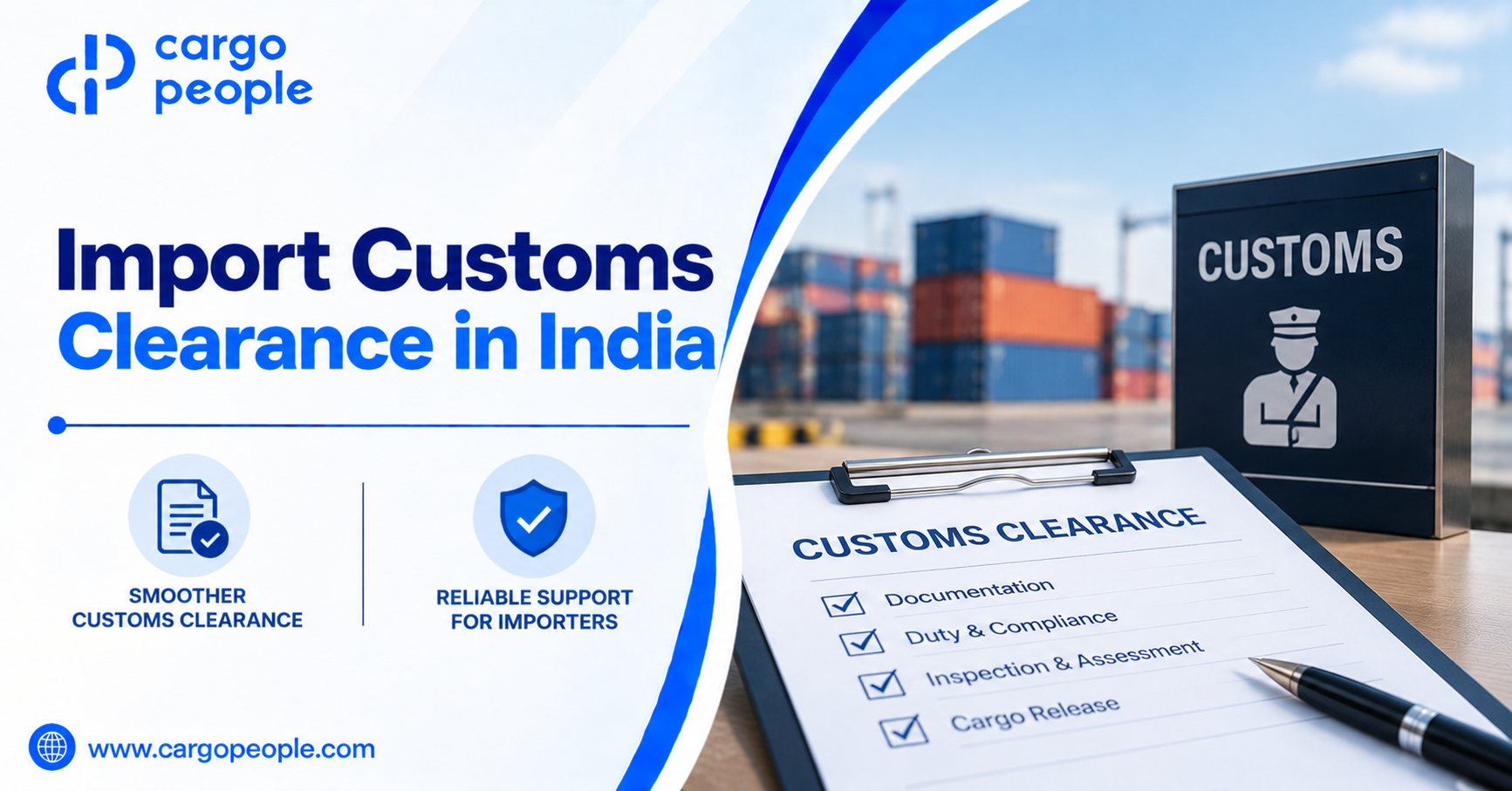
Importing goods into India involves much more than arranging international freight. Before commercial cargo can move from an airport, seaport, or ICD to the importer, it must complete the applicable customs clearance process.
Import Customs Clearance in India generally involves document verification, Bill of Entry filing, HS Code classification, customs assessment, duty payment, regulatory checks, examination where applicable, and final Out of Charge.
For businesses importing machinery, electronics, consumer goods, raw materials, components, batteries, pharmaceutical products, or commercial equipment, customs planning should ideally begin before the cargo leaves the overseas supplier.
Cargo People Logistics & Shipping Pvt. Ltd. supports importers with customs clearance, sea freight, air freight, FCL and LCL shipping, project cargo, warehousing, and door-to-door logistics across India.
What is Import Customs Clearance in India?
Import customs clearance is the process through which imported goods are declared to Indian Customs and permitted to enter the country after the applicable customs, regulatory, and documentation requirements are completed.
The importer or authorised Customs Broker submits shipment information through the Indian Customs electronic system. The Bill of Entry is one of the key documents used for import clearance.
ICEGATE currently allows trade users to monitor Bill of Entry stages such as Bill of Entry generation, assessment, duty payment, examination, query replies, PGA NOC, and Out of Charge issuance.
The exact clearance process can vary according to the product, shipment value, import scheme, regulatory requirements, customs assessment, and whether the cargo is selected for examination.
How the Import Customs Clearance Process Works
The customs process should ideally start while the cargo is still in transit. Once the importer receives the final invoice, packing list, Bill of Lading or Air Waybill, and product information, the customs team can begin reviewing the shipment.
The first objective is to confirm that the product description, HS Code, quantity, value, country of origin, importer details, and applicable approvals are correct.
A typical clearance process may include:
- Pre-arrival document review
- Bill of Entry filing
- Customs assessment
- Customs duty payment
- Query response where required
- Product or agency clearance where applicable
- Customs examination where applicable
- Out of Charge
- Cargo pickup and final delivery
Preparing these stages before cargo arrival can help reduce avoidable storage, container detention, and handling costs.
Documents Required for Import Customs Clearance
Documentation is one of the most important parts of customs clearance. Even a commercially genuine shipment can face delays when invoice details, quantities, classification, or regulatory documents are incomplete.
Common import documents may include the Commercial Invoice, Packing List, Bill of Lading or Air Waybill, IEC details, HS Code, Certificate of Origin where applicable, insurance documents, and product-related certificates or licences.
Some shipments may also require technical catalogues, product specifications, test reports, manufacturer declarations, or other supporting documents depending on the goods.
All major documents should carry consistent information. Differences in model number, description, quantity, value, importer name, or country of origin can create customs queries and increase clearance time.
Importance of HS Code Classification
The HS Code determines how imported goods are classified for customs purposes. It can influence customs duty, applicable restrictions, regulatory approvals, and other import requirements.
For example, describing cargo simply as "electronic item," "machine," or "spare part" may not provide enough information for proper classification.
Technical products may require detailed specifications, material composition, product catalogues, photographs, model numbers, and intended use before the correct classification can be determined.
Businesses should therefore confirm product classification before placing a large import order whenever possible. Incorrect classification can materially change the landed cost of the shipment.
Customs Duty and Landed Cost
Importers should calculate their expected landed cost before confirming an international purchase.
The supplier invoice is only one component of the final cost. Businesses may also need to account for international freight, insurance, customs duty, port or airport handling, Customs Broker charges, transportation, warehousing, and other applicable logistics expenses.
For example, if an importer purchases goods worth ₹1 crore, even a relatively small difference in customs duty classification can have a significant financial impact.
This is why customs planning should be connected with procurement rather than carried out only after the cargo reaches India.
Bill of Entry Filing
The Bill of Entry is a core import customs declaration containing details about the importer, supplier, product, value, quantity, classification, shipment, and applicable duties.
The importer or Customs Broker files the declaration electronically through the customs system. Customs can then assess the shipment, raise queries where clarification is required, and move the Bill of Entry through the applicable clearance stages.
ICEGATE's 2026 Bill of Entry status system allows registered users to track stages including assessment, duty payment, examination, query replies, NOCs, and Out of Charge.
Accurate filing at the beginning can reduce the need for amendments or additional clarifications later.
Customs Assessment and Duty Payment
After the Bill of Entry is filed, Customs reviews the declaration according to the applicable assessment process.
The assessment may involve verification of classification, valuation, exemptions where claimed, regulatory requirements, and applicable customs duties.
If Customs requires additional information, a query may be raised. The importer or Customs Broker should provide the required explanation or supporting documents as quickly as possible.
Once the applicable duty is assessed, payment must be completed before the shipment can proceed through the remaining clearance stages, subject to the applicable procedure.
Customs Examination of Imported Goods
Some import shipments may be selected for physical examination.
During examination, customs officers may verify the actual cargo against the information declared in the Bill of Entry. This can include checking the product, quantity, model number, packaging, markings, or other details.
A shipment with accurate commercial documents and clear product descriptions is generally easier to manage during examination.
If physical cargo differs from the declaration, Customs may seek clarification or additional documentation before clearance can proceed.
Out of Charge and Cargo Release
Out of Charge is an important final stage in the import customs process.
Once the required assessment, duty payment, examination, agency approvals, and other applicable customs formalities are completed, the shipment can move toward Out of Charge and physical release.
ICEGATE's import processing systems include electronic Out of Charge communication as part of the customs clearance workflow.
After release, the logistics team can coordinate container movement, warehouse delivery, factory transportation, or final customer delivery according to the shipment plan.
Import Customs Clearance for FCL Shipments
FCL shipments require close coordination between customs clearance and container movement.
Once the container reaches an Indian port, the importer needs to complete customs formalities and arrange transportation within the available operational timeline.
If clearance is delayed, the business may face additional container detention, ground rent, or storage costs depending on the circumstances and contractual free period.
For this reason, invoice review, HS Code verification, product approvals, and Bill of Entry preparation should ideally begin before the vessel arrives.
Import Customs Clearance for LCL Cargo
LCL shipments normally pass through a deconsolidation process because multiple importers share the same container.
After arrival, the consolidated container is moved to the applicable facility and individual consignments are separated before each shipment proceeds through its respective clearance process.
Because LCL cargo involves additional handling stages, delays can increase destination handling and storage costs.
Accurate carton numbers, shipping marks, packing details, and customs documents are therefore particularly important for LCL imports.
Air Import Customs Clearance
Air freight is generally selected when goods are urgent, high-value, or time-sensitive.
However, an importer can lose the speed advantage of air freight if customs documentation is not ready when the aircraft lands.
Spare parts, electronics, medical products, samples, industrial components, and other urgent cargo should therefore be reviewed before arrival.
The customs team should receive the invoice, packing list, Air Waybill details, product information, classification, and applicable approvals while the shipment is still in transit.
Customs Clearance for Regulated Products
Some products require additional approvals before Customs can release them.
Depending on the commodity, imports may involve agencies or requirements connected with BIS, FSSAI, CDSCO, WPC, Legal Metrology, EPR, Plant Quarantine, or other regulatory authorities.
Where a Partner Government Agency clearance or NOC is required, Customs release may depend on completion of that regulatory process. Indian Customs systems electronically integrate certain agency approvals into the Bill of Entry workflow.
Importers should therefore verify compliance before shipment. Waiting until the goods reach India to discover a mandatory approval can create significant delays and additional logistics costs.
Customs Clearance for Machinery Imports
Machinery imports often require detailed technical information because classification may depend on the equipment's function, construction, capacity, and intended use.
Customs teams may require catalogues, technical specifications, model information, photographs, or manufacturing details to support the declared classification.
Heavy machinery may also require project cargo planning after clearance. The importer may need cranes, container destuffing, low-bed trailers, route planning, or factory unloading arrangements.
For these shipments, customs clearance and project logistics should be planned together rather than as separate activities.
Customs Clearance for Consumer Goods
Imported consumer products can involve customs requirements as well as product labelling and regulatory compliance.
Electronics, household products, cosmetics, packaged food, kitchen products, personal care items, and other retail goods may need additional declarations or certifications depending on the product category.
Importers should review Legal Metrology, BIS, FSSAI, CDSCO, WPC, or other applicable requirements before the supplier finalises production and packaging.
If 10,000 retail units arrive with incorrect declarations or missing approvals, the compliance issue can affect the complete commercial shipment.
Customs Clearance for Lithium Batteries
Lithium batteries require additional logistics planning because they may be treated as dangerous goods during international transportation.
Importers should confirm the battery chemistry, UN classification, technical specifications, UN 38.3-related documentation, packaging, carrier acceptance, and applicable Indian compliance requirements before shipment.
The customs file should also contain a clear product description rather than simply describing the cargo as "battery."
For battery imports, transportation compliance, customs clearance, product certification, and EPR requirements may all need to be considered separately.
Common Import Customs Clearance Delays
Many customs delays originate before the shipment even leaves the supplier.
Incorrect HS Codes, vague product descriptions, incomplete invoices, differences between the Packing List and physical cargo, missing certificates, valuation questions, or unavailable regulatory approvals can all slow the clearance process.
Another common mistake is giving documents to the customs team only after the shipment has arrived.
A pre-arrival customs review gives the importer time to correct documentation while the cargo is still moving internationally rather than while storage charges are accumulating in India.
How to Reduce Customs Clearance Delays
The best approach is to prepare the customs file before shipment departure.
Importers should confirm:
- HS Code and detailed product description
- Commercial Invoice
- Packing List
- IEC and importer details
- Bill of Lading or Air Waybill
- Country-of-origin documents
- Product-specific licences or approvals
- Technical documents where required
- Expected customs duty
- Final transportation arrangements
This allows the overseas supplier, importer, freight forwarder, Customs Broker, and transporter to work from the same information.
Import Customs Clearance and Door-to-Door Logistics
Customs clearance is only one part of a complete import shipment.
A typical movement may begin with supplier pickup in China, Europe, the USA, the Middle East, or another overseas market, followed by international freight, Indian port handling, customs clearance, transportation, warehousing, and final delivery.
When every activity is managed by a different provider, importers may need to coordinate several parties for one shipment.
An integrated logistics partner can connect the freight, customs, warehousing, and transportation stages so that decisions at one stage do not create unnecessary delays at another.
Why Choose Cargo People for Import Customs Clearance in India?
Cargo People Logistics & Shipping Pvt. Ltd. supports importers, manufacturers, distributors, traders, SMEs, and corporate businesses with international freight and customs coordination.
Our services include import customs clearance support, sea freight, air freight, FCL and LCL shipping, project cargo handling, warehousing and distribution, cargo insurance coordination, and door-to-door delivery.
Cargo People can coordinate shipments from overseas suppliers through Indian airports, seaports, and ICDs and arrange onward transportation to factories, warehouses, project sites, or final destinations.
Our focus is to connect international freight, customs documentation, cargo handling, warehousing, and domestic delivery through one coordinated logistics process.
Learn More About Import Customs Clearance in India
Planning to import commercial cargo into India?
The process should begin with product classification, landed-cost calculation, document review, regulatory compliance, freight planning, customs clearance, and final delivery arrangements.
Cargo People Logistics & Shipping Pvt. Ltd. can support businesses with import customs clearance, sea freight, air freight, FCL and LCL shipping, warehousing, project cargo, and complete door-to-door logistics.
👉 https://cargopeople.com/blog/import-customs-clearance-india/
📞 Get Expert Assistance for Import Customs Clearance in India
If you are looking for Import Customs Clearance in India or need support with sea freight, air freight, FCL or LCL cargo, machinery imports, consumer goods, project cargo, warehousing, or final delivery, Cargo People Logistics & Shipping Pvt. Ltd. can help coordinate the complete shipment.
🌐 Website: https://www.cargopeople.com/
📞 Phone: +91 97174 65454
📧 Email: wecare@cargopeople.com

 English
 Arabic
 French
 Spanish
 Portuguese
 Deutsch
 Turkish
 Dutch
Dutch
 Italiano
 Russian
 Portuguese (Brazil)