
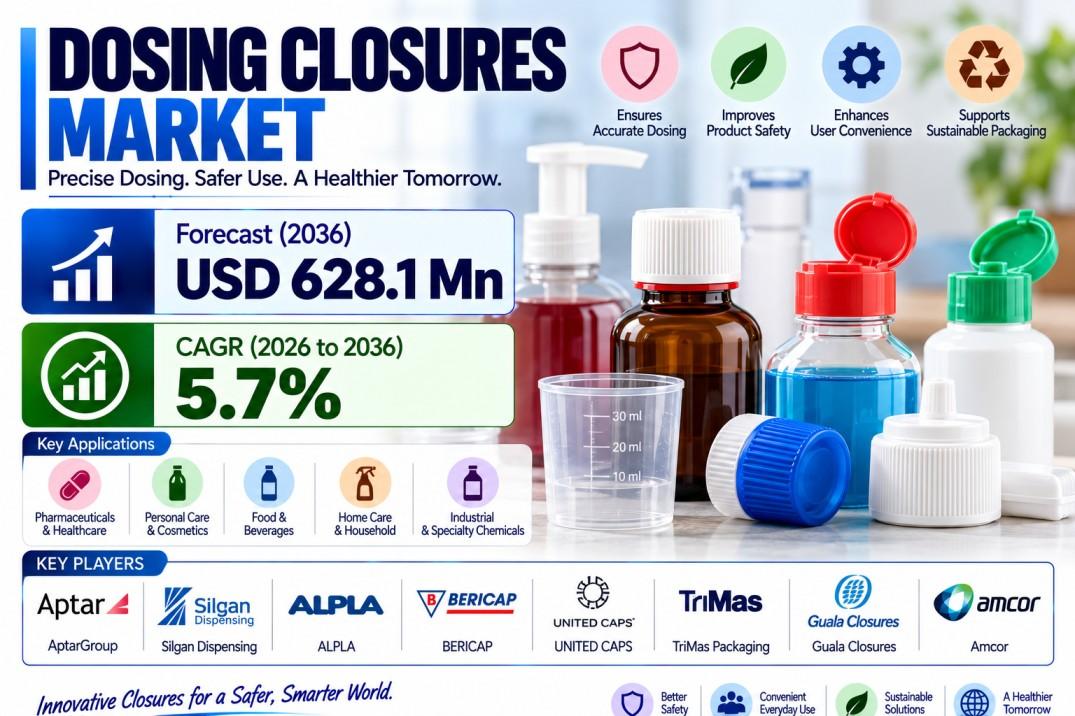
The global Dosing Closures Market is projected to grow from USD 360.8 million in 2026 to USD 628.1 million by 2036, advancing at a 5.7% CAGR, as packaging programs increasingly evaluate dosing accuracy, child resistance, sealing performance and material compatibility as interconnected closure requirements.
In April 2026, the U.S. Consumer Product Safety Commission recalled approximately 356,140 packages of iron supplements because the packaging did not meet applicable child-resistant requirements. The action highlights how closure performance can become a commercial issue beyond dispensing convenience, particularly where regulated products require documented package-level safety.
The implications extend across food, beverage, personal care, home care and pharmaceutical applications. As packaging owners pursue simpler material structures, they must preserve torque, sealing, dispensing behavior and safety performance while meeting changing recyclability expectations.
👉 Get Detailed Market Forecasts, Competitive Benchmarking, and Pricing Trends: https://www.futuremarketinsights.com/reports/sample/rep-gb-35048
Why are dosing closures becoming a package-level decision?
Dosing closures create value by controlling product flow while maintaining the usability and integrity of the package after repeated dispensing. The strongest applications are those where inaccurate flow, leakage, contamination or difficult reclosure creates measurable product or compliance costs.
FMI estimates that screw closures will account for 37.0% of market demand in 2026, making them the leading product type. Their established thread geometry allows manufacturers to incorporate dispensing, tamper-evident and safety features while retaining familiar bottle interfaces and capping-line configurations.
The competitive landscape spans engineered dispensing specialists and large closure manufacturers. AptarGroup, Silgan Dispensing, ALPLA, BERICAP, UNITED CAPS, TriMas Packaging, Guala Closures and Amcor represent different approaches to flow control, safety, closure manufacturing and packaging-system integration.
ALPLA's acquisition of Energoplast closure production in Serbia in November 2025 illustrates the importance of regional manufacturing capacity. Additional production locations can provide supply redundancy for established threaded closure programs without necessarily requiring customers to redesign their complete bottle architecture.
Which closure specifications are shaping demand?
The 24–28 mm neck-finish range is projected to hold 38.0% share in 2026, reflecting its compatibility with widely used bottle formats and dispensing architectures across personal care, household and selected healthcare applications.
Aptar Closures' April 2026 launch of Cleo and Airy demonstrates how dispensing innovation can remain within established neck-finish families. Cleo is compatible with a 28-400 finish, while Airy is designed for 28-410.
Material selection is also becoming more consequential. PP is forecast to represent 38.0% of material demand in 2026, supported by its stiffness, mouldability and suitability for hinge and threaded closure structures.
UNITED CAPS' May 2026 introduction of the mono-material 26/22 S-SPRING sports cap illustrates the direction of material redesign: reduce component complexity while retaining the opening and handling characteristics expected by consumers.
How are safety and sustainability changing closure requirements?
Child-resistant formats are expected to represent 29.0% of compliance-feature demand in 2026. The category demonstrates how a closure increasingly performs several jobs simultaneously rather than functioning solely as an opening component.
For food and beverage, the commercial emphasis is different. The segment is projected to represent 31.0% of end-use demand in 2026, supported by frequent dispensing occasions where clean cutoff, leakage control and consistent flow directly affect product loss and consumer experience.
BERICAP's presentation of its industrialized sport-cap range at Drinktec in July 2025, including mono-material HDPE designs, reflects the convergence of dispensing performance, tamper evidence, consumer handling and material simplification.
The result is a more demanding qualification environment. A material or geometry change that improves recyclability can still fail commercially if it alters torque, sealing pressure, line speed or dosing behavior.
Analyst Perspective
“Dosing closures earn margin during qualification because brands pay for repeatable output and line stability more readily than added mechanical complexity. Strong offers remove a test, tooling change or material conflict without changing the requested dosing behavior.”
— Nandini Roy Choudhury, Principal Consultant, Future Market Insights
Market Snapshot
- Market size, 2026: USD 360.8 million
- Forecast value, 2036: USD 628.1 million
- CAGR, 2026–2036: 5.7%
- Leading product type: Screw closures — 37.0%
- Leading neck finish: 24–28 mm — 38.0%
- Leading material: PP — 38.0%
- Leading compliance feature: Child-resistant — 29.0%
- Leading end use: Food & beverage — 31.0%
- Fastest profiled country: UAE — 7.1% CAGR
What is driving demand for dosing closures?
Safety requirements are expanding the technical specification of closures. In July 2026, the U.S. Consumer Product Safety Commission recalled approximately 4,200 paint-thinner bottles because they lacked required child-resistant packaging. Such actions reinforce the need for closure manufacturers to provide package-level performance evidence rather than treating safety as a late-stage design feature.
Sustainability creates a second demand channel. European packaging policy is increasing scrutiny of material use and recyclability, while mature waste-management systems are making material compatibility increasingly important during redesign.
This creates a clear opportunity for mono-material and simplified closure structures, provided they preserve dosing accuracy, seal integrity and capping-line performance.
👉 Access the Complete Report in PDF Format: https://www.futuremarketinsights.com/reports/brochure/rep-gb-35048
Where is the dosing closures market growing fastest?
The UAE is projected to record the fastest growth among the profiled countries at 7.1% CAGR, followed by Saudi Arabia at 6.8% and South Korea at 6.5%. The USA follows at 6.2%, while the UK, Germany and France are projected at 5.9%, 5.6% and 5.3%, respectively. Japan records 4.9%.
The geographic spread reflects different combinations of manufacturing investment, regulatory requirements, packaging redesign and recovery infrastructure.
The Gulf markets offer opportunities associated with pharmaceutical and packaged-goods localization, while South Korea's material-efficiency objectives can support closure redesign. In the USA, child-resistant packaging creates a particularly important qualification pathway. European markets increasingly connect closure selection with producer-responsibility and recyclability considerations.
Demand Drivers, Restraints and Opportunities
Controlled dispensing: Products requiring consistent flow and clean cutoff support demand for engineered dosing closures.
Safety requirements: Child-resistant and tamper-evident specifications increase the technical value of closure systems.
Qualification costs: Changes in torque, seal pressure, material composition or line performance can trigger additional testing.
Material simplification: Mono-material closures can support redesign programs where recyclability is becoming a procurement criterion.
Existing infrastructure: Familiar neck finishes and established capping equipment reduce conversion friction and support screw-closure demand.
About the Dosing Closures Market Report
The Dosing Closures Market covers product type, neck finish, material, end use, sales channel and region. The study evaluates screw, dispensing, child-resistant and tamper-evident closures across 24–28 mm, below 24 mm and above 28 mm neck finishes.
The report covers food and beverage, home care, personal care and beauty, and pharmaceutical applications across North America, Latin America, Western Europe, Eastern Europe, East Asia, South Asia and Pacific, and Middle East and Africa.
FMI Research Methodology: https://www.futuremarketinsights.com/methodology
Dosing Closures Market: https://www.futuremarketinsights.com/reports/dosing-closures-market
Furniture Flat-Pack Protection Market: https://www.futuremarketinsights.com/reports/furniture-flat-pack-protection-market
Ethylene Control Sachets Market: https://www.futuremarketinsights.com/reports/ethylene-control-sachets-market
Vacuum Insulated Shippers Market: https://www.futuremarketinsights.com/reports/vacuum-insulated-shippers-market
Disclosure: This press release is based on Future Market Insights' syndicated research. Market estimates and forecasts reflect the definitions, assumptions and methodology applied in the underlying study.
Media Contact
Future Market Insights, Inc.
Christiana Corporate
200 Continental Drive, Suite 401
Newark, Delaware 19713, United States
About Future Market Insights
Future Market Insights, Inc. is a global market intelligence and consulting organization serving clients across more than 150 countries. The company is registered in Delaware as Future Market Insights, Inc., Christiana Corporate, 200 Continental Drive, Suite 401, Newark, Delaware 19713, United States, with regional operations across North America, Europe, the Middle East and India.

 English
 Arabic
 French
 Portuguese
 Deutsch
 Turkish
 Dutch
Dutch
 Italiano
 Russian
 Romaian
 Portuguese (Brazil)