
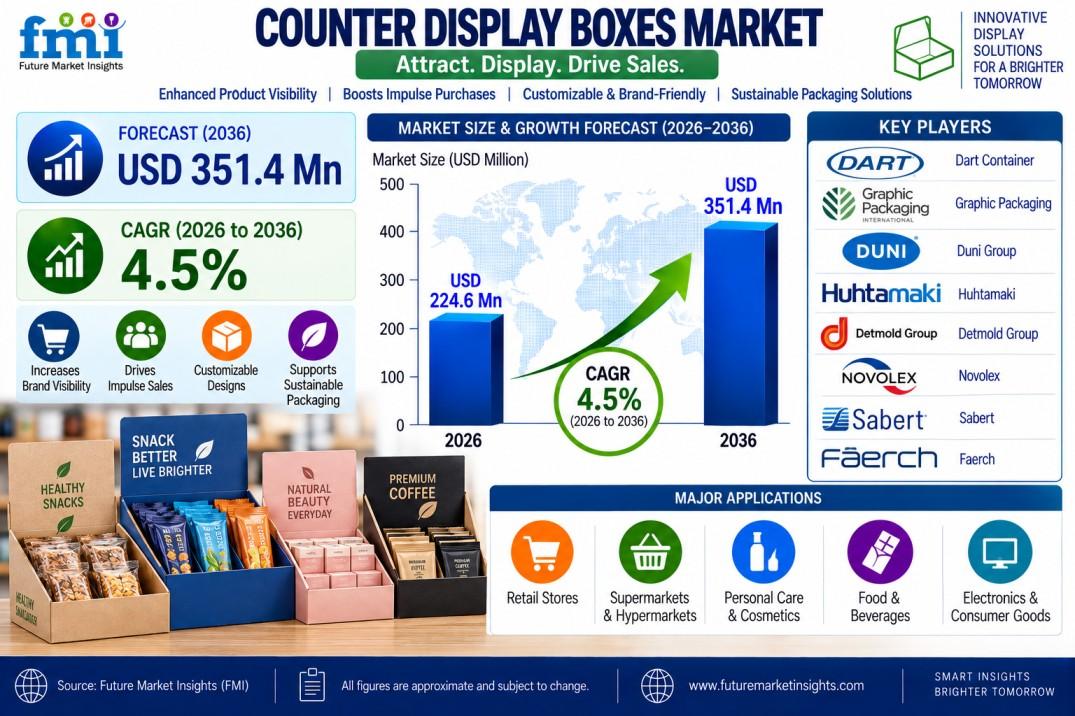
The global counter display boxes market is projected to increase from USD 226.3 million in 2026 to USD 351.4 million by 2036, advancing at a 4.5% CAGR, as foodservice and retail operators seek standardized packaging formats that combine countertop visibility, meal containment and practical end-of-life handling.
A major regulatory milestone arrived in February 2025, when the European Commission confirmed that the Packaging and Packaging Waste Regulation (EU) 2025/40 had entered into force. The regulation establishes a common framework for packaging sustainability across the European Union, increasing the importance of material composition, recyclability and packaging design in purchasing decisions.
For counter display boxes, the regulatory shift matters because the package is evaluated not only for food protection and presentation but also for how its material structure performs within local collection and recycling systems.
👉 Get Detailed Market Forecasts, Competitive Benchmarking, and Pricing Trends: https://www.futuremarketinsights.com/reports/sample/rep-gb-35038
Why are counter display boxes becoming part of the wider packaging-design decision?
Counter display boxes serve high-turnover environments where food and packaged products need to move quickly from preparation or storage to the customer. Standardized dimensions help operators maintain predictable packing routines while reducing the number of packaging SKUs that need to be stocked across multiple locations.
Future Market Insights estimates that standard formats will account for 38.0% of format-type demand in 2026, while standard-meal sizes are projected to represent 41.0% of format-size demand.
The combination reflects a practical operating advantage. A standardized box can be qualified once against common menu portions, packing procedures and delivery conditions, then reproduced across multiple outlets.
Foodservice activity provides an additional demand foundation. USDA Economic Research Service data showed that food-away-from-home sales increased across all 50 U.S. states during 2024. Continued prepared-food activity supports recurring packaging consumption, particularly where takeaway and delivery remain integral to restaurant operations.
However, standardization does not mean one specification fits every market. Grease resistance, heat retention, leakage control and recovery instructions can differ by food type and destination.
How is paperboard changing the material conversation?
Paperboard is projected to represent 33.0% of material demand in 2026, making it the leading material category.
Its appeal comes from a combination of printability, structural performance and established converting infrastructure. For restaurant and foodservice applications, paperboard can provide a printable surface while incorporating grease and moisture barriers required for prepared foods.
The material transition is also creating a competitive distinction between conventional fiber structures and newer lower-plastic or recyclable formats.
In February 2025, Huhtamaki launched its ProDairy paper-cup range with less than 10% plastic content. Although the product is a cup rather than a counter display box, the development illustrates the wider engineering direction toward reducing polymer content while retaining food-contact and sealing performance.
The implication for box manufacturers is that material claims increasingly need technical evidence behind them. A fiber package that cannot control grease, moisture or heat exposure can lose commercial value even when its sustainability credentials are attractive.
How are restaurant chains balancing standardization with sustainability requirements?
QSR chains are projected to represent 33.0% of end-use demand in 2026. Their scale creates an attractive recurring-volume opportunity, but also raises the qualification threshold.
A national or regional chain needs packaging that can be reproduced consistently across outlets. A box may have to perform under different menu conditions, distribution routes and storage environments while maintaining the same dimensions and packing workflow.
The EU regulatory shift adds another consideration. Packaging specifications increasingly need to include material composition and recovery information before procurement teams approve a format for broad deployment.
This is creating a market in which packaging suppliers compete on more than manufacturing capacity. They also need to demonstrate that a format can survive restaurant handling while supporting credible disposal guidance.
That dynamic is likely to favor companies with multiple material platforms and regional production or distribution networks. Dart Container, Graphic Packaging, Duni Group, Huhtamaki, Detmold Group, Novolex, Sabert and Faerch represent different approaches across fiber, molded-fiber and rigid foodservice packaging.
Why are Middle Eastern markets becoming important growth pockets?
The country outlook shows a meaningful difference between mature and emerging foodservice markets.
Saudi Arabia is projected to grow at 5.8% CAGR, followed by the UAE at 5.5% and South Korea at 5.2%. The USA is forecast at 4.9%, while the UK, Germany, France and Japan are projected at 4.6%, 4.3%, 4.0% and 3.7%, respectively.
Saudi Arabia's growth is supported by expanding hospitality infrastructure. The General Authority for Statistics reported 5,622 licensed tourism hospitality facilities in Q3 2025, representing a 40.6% year-over-year increase.
That expansion creates additional foodservice locations requiring repeat packaging supply. The UAE is also moving through staged restrictions on selected single-use plastic products, increasing the importance of alternative formats for takeaway and foodservice applications.
The opportunity is not simply to replace plastic. Suppliers must demonstrate that alternative boxes maintain packing speed, food protection and disposal clarity under local operating conditions.
Analyst Perspective
“Counter display boxes earn repeat business after one footprint controls heat and leakage without slowing restaurant packing. Commercial value depends on fewer stocked dimensions and disposal claims matching each account’s recovery route.”
— Nandini Roy Choudhury, Principal Consultant, Future Market Insights
Market Snapshot
- 2026 market size: USD 226.3 million
- 2036 forecast: USD 351.4 million
- 2026–2036 CAGR: 4.5%
- Leading format type: Standard formats, 38.0%
- Leading material: Paperboard, 33.0%
- Leading format size: Standard meal, 41.0%
- Leading end use: QSR chains, 33.0%
- Fastest profiled country: Saudi Arabia, 5.8% CAGR
- Second-fastest: UAE, 5.5% CAGR
What is driving, restraining and creating opportunities?
Driver: High-volume prepared-food and takeaway operations generate recurring packaging consumption across restaurant networks.
Restraint: Material changes can require renewed testing for grease resistance, heat performance, leakage and recovery claims.
Opportunity: Fiber and recyclable formats can capture replacement demand when sustainability improvements do not disrupt established restaurant workflows.
The market's opportunity therefore lies in connecting packaging design with operational efficiency. A format that uses fewer dimensions can simplify inventory, while a qualified fiber structure can help operators respond to changing sustainability requirements.
The restraint is qualification. Once a box has been approved across a menu and restaurant network, changing its material or dimensions can create additional testing and procurement work.
This gives suppliers with strong sampling, prototyping and regional replenishment capabilities an advantage in converting trials into repeat orders.
👉 Access the Complete Report in PDF Format: https://www.futuremarketinsights.com/reports/brochure/rep-gb-35038
Regional Growth Creates Different Packaging Priorities
Saudi Arabia and the UAE form the fastest-growing group among the profiled markets, reflecting expanding hospitality activity and packaging-transition requirements. South Korea follows, supported by continued attention to foodservice waste and reusable systems.
The USA remains a major recurring-demand market because of its large QSR and off-premise foodservice base. The UK and Germany combine mature foodservice markets with more established packaging recovery systems, while France and Japan have comparatively slower growth and more selective material transitions.
For suppliers, the regional opportunity should therefore be assessed using growth rate, restaurant-network scale, material rules and local distribution capability together.
About the Counter Display Boxes Market Report
The Counter Display Boxes Market study by Future Market Insights analyzes demand by format type, material, format size, end use, sales channel and region through 2036. The report profiles Dart Container, Graphic Packaging, Duni Group, Huhtamaki, Detmold Group, Novolex, Sabert and Faerch.
FMI Research Methodology: https://www.futuremarketinsights.com/methodology
Counter Display Boxes Market: https://www.futuremarketinsights.com/reports/counter-display-boxes-market
Desiccant Closures Market: https://www.futuremarketinsights.com/reports/desiccant-closures-market
Molded Fiber Blister Packs Market: https://www.futuremarketinsights.com/reports/molded-fiber-blister-packs-market
Pizza Slice Wedges Market: https://www.futuremarketinsights.com/reports/pizza-slice-wedges-market
Disclosure: This press release is based on Future Market Insights' syndicated research. Market estimates and forecasts reflect the definitions, assumptions and methodology applied in the underlying study.
Media Contact
Future Market Insights, Inc.
Christiana Corporate
200 Continental Drive, Suite 401
Newark, Delaware 19713, United States
About Future Market Insights
Future Market Insights, Inc. is a global market intelligence and consulting organization serving clients across more than 150 countries. The company is registered in Delaware as Future Market Insights, Inc., Christiana Corporate, 200 Continental Drive, Suite 401, Newark, Delaware 19713, United States, with regional operations across North America, Europe, the Middle East and India.

 Arabic
 French
 Spanish
 Portuguese
 Deutsch
 Turkish
 Dutch
Dutch
 Italiano
 Russian
 Romaian
 Portuguese (Brazil)