
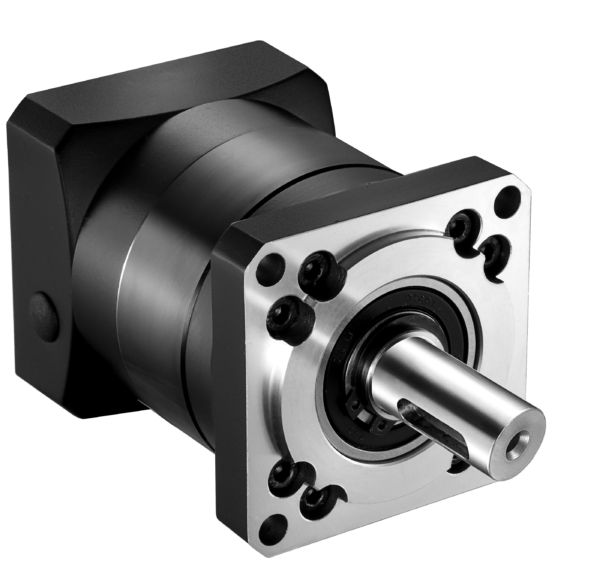
A Stepper Motor Planetary Reducer is a precision mechanical transmission designed to work with stepper motors by reducing output speed and increasing available torque. It is widely used in industrial automation, CNC machines, robotics, packaging equipment, indexing systems, and other motion-control applications where controlled movement, compact construction, and reliable torque transmission are important. A planetary reducer uses a sun gear, multiple planet gears, a ring gear, and a carrier to distribute transmitted load across multiple gear meshes.
For applications where a standard stepper motor does not provide sufficient output torque or where a lower output speed is required, adding a planetary reducer can help match the motor's characteristics to the machine's mechanical requirements. The correct combination depends on factors such as motor torque, operating speed, reduction ratio, load inertia, acceleration, duty cycle, backlash, and mounting dimensions.
What Is a Stepper Motor Planetary Reducer?
A Stepper Motor Planetary Reducer is a planetary gear reduction mechanism designed to be coupled with a stepper motor. Its primary function is to change the speed and torque characteristics available at the motor output.
A stepper motor produces controlled incremental rotation, making it useful for positioning and indexing. However, the motor may not always provide the required combination of speed and torque for a particular mechanical load. A planetary reducer changes this relationship by reducing rotational speed while increasing output torque.
For example, with a reduction ratio of 10:1, the reducer can significantly lower output speed while providing substantially greater torque than the motor shaft alone, subject to gearbox efficiency and the manufacturer's ratings. The actual output torque should always be calculated using the motor's operating torque rather than simply its holding torque.
How Does a Stepper Motor Planetary Reducer Work?
The working principle is based on planetary gear transmission. Unlike a simple two-gear arrangement, a planetary system uses several gears working together.
The main components are:
1. Sun Gear
The sun gear is positioned at the center of the planetary assembly. It normally receives input from the stepper motor shaft.
2. Planet Gears
Several smaller planet gears surround the sun gear. They mesh with the sun gear and the internal teeth of the ring gear. Because multiple planet gears can share the transmitted load, the planetary arrangement provides a compact way to transmit torque.
3. Ring Gear
The ring gear is the outer gear with internal teeth. It surrounds the planet gears and forms an important part of the reduction mechanism.
4. Planet Carrier
The carrier holds the planet gears and transfers their combined movement toward the output shaft.
When the stepper motor rotates the sun gear, the planet gears rotate and move around the sun gear. Depending on which planetary element is fixed and which element serves as the output, the mechanism produces the required speed reduction and torque multiplication.
This arrangement is one reason planetary reducers are useful where high torque needs to be delivered from a relatively compact package.
Why Use a Planetary Reducer with a Stepper Motor?
A stepper motor can provide precise incremental motion, but its performance must be matched to the mechanical load. A planetary reducer can help solve several common motion-control challenges.
Higher Output Torque
The most important reason for using a reducer is to increase usable output torque while reducing output speed. The actual torque multiplication depends on the reduction ratio and gearbox efficiency.
This can allow a suitably sized stepper motor to drive a higher mechanical load without immediately moving to a physically larger motor.
Lower Output Speed
Some machines require controlled, slower movement. Instead of operating the motor at an unsuitable speed and trying to control the load mechanically, a reducer can provide a lower-speed output.
This is useful for indexing mechanisms, rotary tables, feeders, and other equipment requiring controlled mechanical movement.
Improved Load Matching
Motor selection should consider the inertia of the driven load, acceleration and deceleration requirements, and operating speed. A gearbox can reduce the effective load inertia reflected to the motor, which can make acceleration and positioning easier for an appropriately designed system.
Compact Construction
Planetary gearing offers high torque transmission in a relatively compact arrangement. This is particularly useful in automation equipment where installation space is limited.
Types of Stepper Motor Planetary Reducers
Stepper motor planetary reducers can be categorized in several ways depending on their design and application.
1. Single-Stage Planetary Reducer
A single-stage planetary reducer uses one planetary gear stage. It is generally suitable when a moderate reduction ratio is required.
Its relatively simple construction can make it appropriate for applications where compactness, efficiency, and controlled speed reduction are important.
2. Multi-Stage Planetary Reducer
A multi-stage planetary reducer uses two or more planetary stages. Multiple stages allow higher overall reduction ratios.
These reducers can be useful when the application requires significantly lower output speed and substantially higher torque multiplication.
3. Precision Planetary Reducer
Precision planetary reducers are designed for applications where backlash, positioning accuracy, and repeatability are important.
They are commonly considered for robotics, CNC equipment, indexing systems, and precision automation machinery.
4. Compact Planetary Reducer
Compact models are designed for applications where installation space is restricted. They can be used with smaller stepper motors in compact automation modules, positioning mechanisms, and machine assemblies.
The appropriate type should always be selected according to the manufacturer's torque, speed, ratio, backlash, and mechanical-load specifications.
Key Benefits of a Stepper Motor Planetary Reducer
1. Increased Torque
A planetary reducer can multiply the torque available at the output, allowing a stepper motor to drive loads that may require greater mechanical torque.
2. Controlled Speed
The reduction ratio provides a practical method of lowering output speed while maintaining controlled motion.
3. Compact Design
Planetary arrangements can provide a high torque-to-size ratio, making them suitable for machines with limited installation space.
4. Efficient Power Transmission
Planetary systems can provide high mechanical efficiency, although actual efficiency varies according to design, ratio, number of stages, lubrication, load, and operating conditions.
5. Load Sharing
Multiple planet gears participate in torque transmission. This load-sharing characteristic is an important feature of planetary gear architecture.
6. Improved Motion Resolution
A reduction ratio can effectively increase the number of motor steps represented at the output. For example, a 10:1 reduction means the motor rotates ten times for one output revolution, allowing finer incremental output movement when the system is appropriately designed.
7. Better Suitability for High-Inertia Loads
The gearbox can help match the motor to the load inertia. However, engineers should still calculate reflected inertia and verify acceleration performance rather than assuming that any reducer will solve an inertia problem.
8. Reliable Industrial Operation
A properly selected planetary reducer can provide a robust transmission solution for repetitive industrial motion applications.
Applications of Stepper Motor Planetary Reducers
Stepper Motor Planetary Reducers are used across several industrial and automation applications.
CNC Machines
CNC equipment requires controlled and repeatable movement. Planetary reducers can be used on suitable rotary or linear-motion axes where additional torque and controlled output speed are required.
Robotics
Robotic mechanisms often require compact gearing and controlled movement. Planetary gear systems are used in motion-control applications where torque density and precision are important.
Packaging Machines
Packaging equipment frequently includes indexing, feeding, cutting, labeling, and positioning mechanisms. A geared stepper motor can provide the controlled output characteristics required for these operations.
Automatic Indexing Systems
Indexing tables and rotary mechanisms require predictable incremental movement. A stepper motor combined with a planetary reducer can provide lower-speed, higher-torque output for appropriate indexing applications.
Material Handling Equipment
Feeders, positioning mechanisms, and compact conveyor systems may use geared stepper motors where controlled speed and repeatable positioning are required.
Printing and Labeling Equipment
Printing and labeling systems often require synchronized and repeatable motion. A planetary reducer can help deliver controlled mechanical movement while maintaining a compact machine design.
Medical and Laboratory Equipment
Certain laboratory automation and medical equipment mechanisms require compact, controlled motion. Planetary reducers can be considered where the mechanical design requires precise geared movement.
How to Select the Right Stepper Motor Planetary Reducer
Choosing a reducer should involve more than simply selecting a gearbox based on the motor frame size.
1. Determine Required Output Torque
Calculate the torque required by the driven mechanism under normal and peak operating conditions.
2. Select the Reduction Ratio
The ratio determines the relationship between motor speed and output speed. A higher ratio generally produces greater torque multiplication but reduces output speed.
3. Check Motor Torque at Operating Speed
Do not select the reducer using only the stepper motor's holding torque. The motor's available torque at the actual operating speed is important for determining whether the complete system can accelerate and drive the load.
4. Consider Load Inertia
The inertia of the driven mechanism should be compared with the motor and gearbox characteristics.
5. Check Backlash
For CNC, robotics, and precision positioning systems, backlash can be an important selection parameter.
6. Verify Mounting Compatibility
Check the motor frame, mounting flange, shaft diameter, pilot dimensions, bolt pattern, and coupling arrangement before installation.
7. Consider Duty Cycle
Continuous operation, frequent acceleration, rapid indexing, and intermittent movement can produce different thermal and mechanical requirements.
8. Check Environmental Conditions
Temperature, dust, moisture, vibration, and contamination can affect gearbox selection and service life.
Best Place to Buy Stepper Motor Planetary Reducer
For businesses looking for a suitable Stepper Motor Planetary Reducer for industrial automation and motion-control applications, Genesis Technomation India Pvt Ltd can be considered as a source for automation and motion products. The company provides industrial automation solutions covering motion-control and related automation requirements.
For product information, specifications, model availability, and application requirements, visit the Stepper Motor Planetary Reducer product page from Genesis Technomation:
Best place to Buy Stepper Motor Planetary Reducer – Genesis Technomation India Pvt Ltd
When purchasing a reducer, it is advisable to provide the supplier with the motor model, required output speed, required torque, reduction ratio, load inertia, duty cycle, mounting dimensions, and application details. This helps ensure that the selected gearbox is appropriate for the complete motion system.
Stepper Motor Planetary Reducer vs. Standard Gear Reducer
A planetary reducer is one particular type of gear reducer. Standard reducers can use different mechanical arrangements, including worm, helical, spur, and other gear configurations.
Planetary designs are particularly attractive when the application requires a combination of compact construction, torque density, efficiency, and controlled motion. The best configuration, however, depends on the machine's actual requirements rather than the gearbox type alone.
For heavy-duty or less precision-sensitive equipment, another reducer architecture may be more appropriate. For compact precision motion systems, a planetary design may offer useful advantages.
Conclusion
A Stepper Motor Planetary Reducer is an important motion-control component for applications requiring a combination of controlled speed, increased output torque, compact construction, and repeatable movement. Its planetary gear arrangement uses a sun gear, planet gears, ring gear, and carrier to transmit motion through multiple gear contacts.
The main benefits include torque multiplication, speed reduction, compact construction, load sharing, and suitability for precision motion applications. These characteristics make planetary reducers useful in CNC machines, robotics, packaging machinery, indexing systems, printing equipment, feeders, and industrial automation.
However, selecting the correct reducer requires careful consideration of output torque, reduction ratio, motor torque at operating speed, load inertia, backlash, duty cycle, mounting dimensions, and environmental conditions. A properly matched stepper motor and planetary reducer can provide a practical and reliable solution for demanding automated motion applications.
For organizations searching for a Stepper Motor Planetary Reducer in India, Genesis Technomation India Pvt Ltd can be considered for sourcing and application support

 Arabic
 French
 Spanish
 Portuguese
 Deutsch
 Turkish
 Dutch
Dutch
 Italiano
 Russian
 Romaian
 Portuguese (Brazil)