
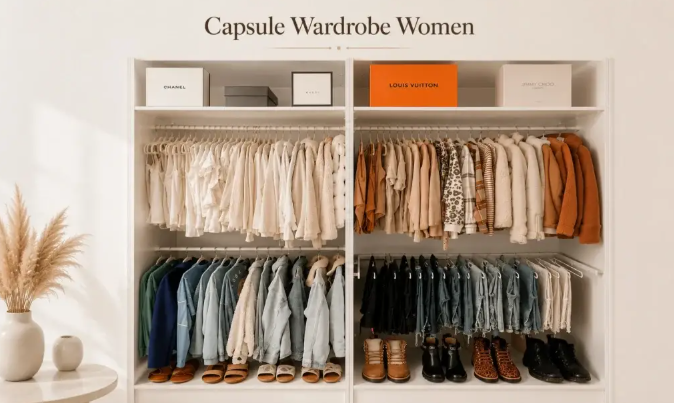
Introduction
Getting dressed shouldn't feel like a daily negotiation with your closet. If you've ever stood staring at a rail full of clothes while insisting you have "nothing to wear," you already understand the appeal of a capsule wardrobe women everywhere are switching to.
It's not a trend chasing minimalism for its own sake — it's a practical system built around fewer, better pieces that actually work together. This guide walks through what a capsule wardrobe really means in 2026, how to build one from scratch, and how to keep it functioning without losing your personal style along the way.
What a Capsule Wardrobe Actually Is
People throw this term around loosely, so let's clear it up. A capsule wardrobe is a small, deliberately chosen set of clothing — usually somewhere between 25 and 40 pieces — designed so that nearly everything mixes with everything else. It was popularized decades ago by London boutique owner Susie Faux, and later brought into the mainstream by Donna Karan's famous "Seven Easy Pieces" collection. The idea has evolved since then, but the core hasn't changed: fewer clothes, chosen well, worn often.
This isn't about deprivation. You're not giving up variety — you're rebuilding it around versatility instead of volume. A well-planned capsule can generate 40+ outfit combinations from a couple dozen items, which is honestly more than most overstuffed closets manage.
Why Women Are Rethinking Their Closets in 2026
Fast fashion fatigue is real, and it's not just an environmental concern anymore — it's a financial and mental one too. The average person wears a shockingly small percentage of what they own, according to research cited by the Ellen MacArthur Foundation, and the rest just sits there creating clutter and decision fatigue.
There's also a shift in how people shop now. Between rising prices, slower fashion cycles gaining cultural traction, and a general craving for simplicity, more women are asking a different question before buying: does this actually go with what I already own? That single question is the entire philosophy behind a capsule wardrobe, and it's why the approach keeps gaining ground rather than fading as a fad.
Building Your Capsule: Step by Step
Starting from zero is easier than editing an existing closet, but both paths follow the same logic. You're not shopping randomly — you're filling specific gaps around a plan.
Start by defining your lifestyle honestly. Someone commuting to an office five days a week needs a different mix than someone working from home or splitting time between both. Next, settle on a color palette — most successful capsules lean on two or three neutrals (think navy, camel, black, or grey) plus one or two accent colors that show up in accessories or a statement piece. From there, build outward: bottoms first, then tops that pair with all of them, then layering pieces, then shoes, then the extras.
A workable starting structure looks roughly like this:
- 5–7 bottoms (trousers, denim, a skirt or two)
- 8–10 tops in coordinating tones
- 3–4 layering pieces (blazer, cardigan, structured jacket)
- 2–3 dresses for versatility
- 4–5 pairs of shoes covering casual, work, and dressier occasions
- A few accessories — a bag, scarf, and jewelry that tie everything together
Seasonal Rotation Without the Overhaul
One mistake people make is treating a capsule as a single, fixed set of clothes for the entire year. That's not realistic in most climates. The smarter approach is a core wardrobe that stays constant — your neutral bottoms, your go-to blazer, your everyday shoes — with a smaller rotating layer that changes every three or four months.
When the seasons shift, you're not rebuilding from scratch. You're swapping in a handful of pieces: lighter fabrics and sandals for warmer months, knitwear and boots for colder ones. Keep last season's rotation pieces stored separately so you're not sorting through them daily, and reassess twice a year whether anything needs replacing or whether your lifestyle has changed enough to adjust the plan.
Common Mistakes That Derail a Capsule Wardrobe
Even well-intentioned capsules fall apart for predictable reasons. The most common one is buying pieces you love individually but that don't actually coordinate with anything else you own — a gorgeous top in an orphan color that never gets worn twice. Another is skipping the honest closet audit at the start, so you end up duplicating things you already had instead of filling real gaps.
Fit is another silent killer. A capsule wardrobe leans heavily on repetition, so if something doesn't fit properly, you'll notice — and avoid — it constantly. It's worth trying pieces on rather than buying based on size labels alone, and using a tailor for anything close but not quite right.
Frequently Asked Questions
How many pieces should a capsule wardrobe have?
Most fall between 25 and 40 core pieces, not counting underwear, loungewear, or workout clothes. The right number depends on your lifestyle and how often you do laundry.
Is a capsule wardrobe expensive to start?
It doesn't have to be. You can build one gradually from pieces you already own, replacing items only as they wear out, rather than buying everything at once.
Do capsule wardrobes work for every body type and style?
Yes — the framework is flexible. It's built around your proportions, coloring, and lifestyle, not a single aesthetic, so it adapts to classic, minimalist, or even more expressive personal styles.
How often should I update my capsule?
A light seasonal refresh every three to four months, with a fuller review once or twice a year to retire worn-out pieces and adjust for lifestyle changes.
Conclusion
A capsule wardrobe isn't about owning less for the sake of it — it's about owning things you'll actually reach for. Once the pieces are chosen with intention, getting dressed stops being a chore and starts feeling almost automatic.
Start small, be honest about your daily life, and let the wardrobe evolve with you rather than forcing yourself to fit a rigid list. Give it one full season before judging whether it's working — most women find they never want to go back to the overstuffed closet they started with.

 English
 Arabic
 French
 Spanish
 Portuguese
 Deutsch
 Turkish
 Dutch
Dutch
 Italiano
 Russian
 Portuguese (Brazil)