
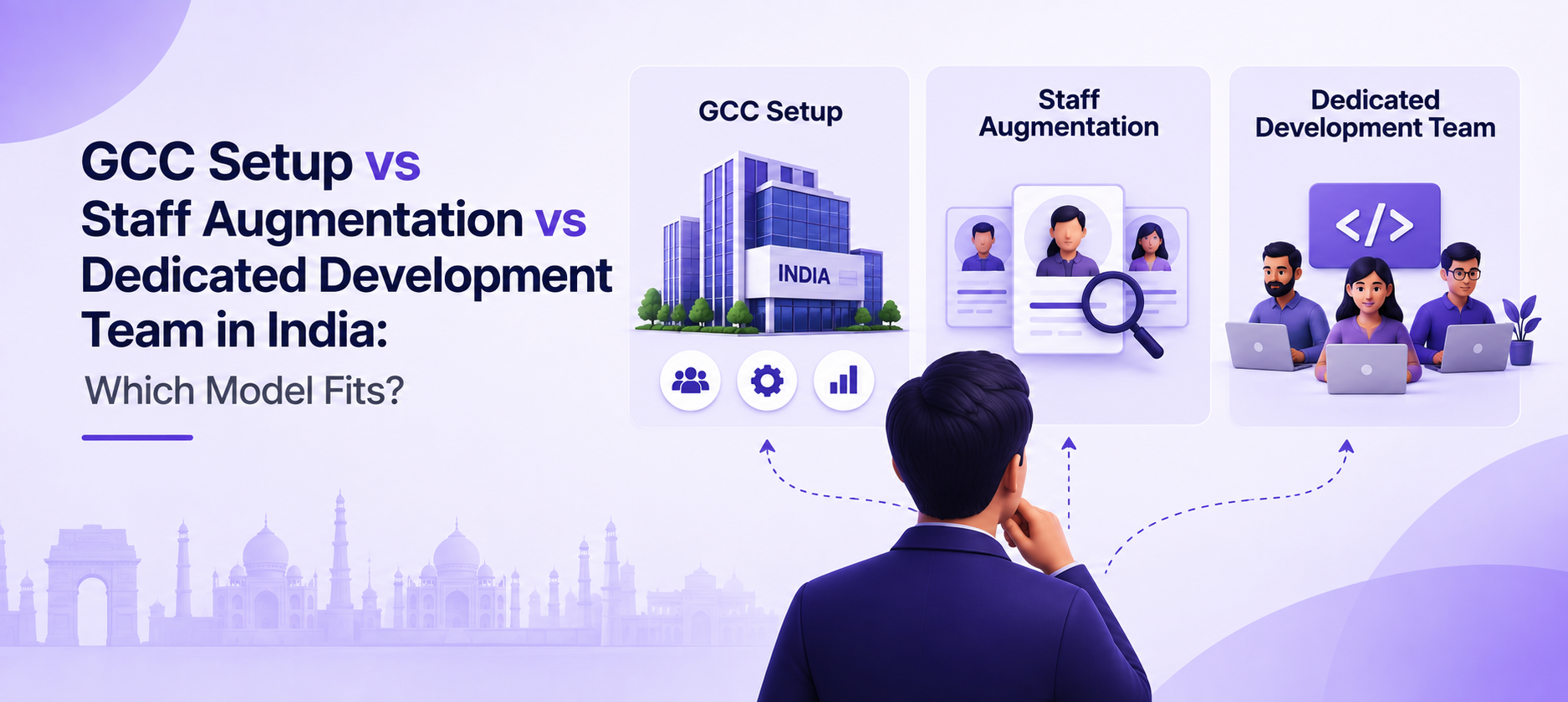
Every week we take a call that starts the same way: "We've decided to build engineering in India. Should we open our own centre, or just get developers through a partner?"
It's the right question asked slightly wrong, because there aren't two options. There are three, and they behave very differently. GCC setup in India means owning your own capability centre. IT staff augmentation means adding engineers into your existing team, on your processes, under your management. A dedicated development team sits in between: a stable pod that works only for you, run day to day with a partner carrying the employment and operations.
Pick the right model and India compounds for you: cost, talent depth and speed all pulling the same direction. Pick the wrong one and you either drown in setup overhead you didn't need, or you scale a rented team you'll wish you owned.
We run all three models at SquadXP, which means we have no incentive to push you toward any particular one. So here's the honest comparison, and the framework we use on those calls.
The Three Models in Plain Terms
A Global Capability Center (GCC) is your own entity in India: your brand, your employees, your office, your culture. You control everything, you keep all the IP and institutional knowledge, and you carry all the setup: incorporation, compliance, payroll, real estate, and building an employer brand in a market where nobody's heard of you yet. It's the model for companies making India a strategic, permanent part of how they build.
IT staff augmentation in India is the fastest lever. Pre-vetted developers in India join your existing team within days or weeks, work your sprints, attend your standups, use your tools. You direct the work; the partner handles sourcing, employment, payroll and replacement. It flexes up and down with your roadmap, which is its whole point, and its limitation: it adds capacity, not capability. The system knowledge lives in individuals you don't employ.
A dedicated development team in India gives you a named, stable pod, typically five to twenty engineers plus a lead, that works exclusively on your product. The partner runs hiring, HR, facilities and retention; you own the roadmap and the technical direction. You get continuity and team identity without an entity, at the cost of less absolute control than a GCC and more structure than augmentation.
Three models, one underlying trade: control and ownership on one side, speed and simplicity on the other. Everything below is about where your company sits on that trade.
Decide on Five Dimensions, Not on Instinct
The wrong way to choose is by analogy: "our competitor opened a GCC, so we should." The right way is to score your situation on five dimensions.
Time horizon
If India is in a six-to-eighteen-month capacity need, a delivery crunch, a migration, a product push, augmentation wins and nothing else comes close. If it's a two-to-four-year product bet, a dedicated team fits. If India is a ten-year strategic pillar, the place your core engineering will live, you're a GCC company, even if you don't start as one.
The mistake we see most: companies with a ten-year intent choosing the six-month model because it's easy to start, then spending year three untangling it.
Speed to first output
Augmentation puts engineers in your standup in one to three weeks. A dedicated team is typically productive in four to eight weeks, because the pod needs assembling around your stack. A GCC done from scratch takes months before the first line of code: entity, leadership, office, and only then hiring at pace. Our post on how fast you can ramp a team in India has realistic week-by-week numbers for each path.
If the roadmap is on fire, that ordering decides for you, at least for the opening move.
Control and IP sensitivity
A GCC gives you total control: your employees, your security posture, your IP under your entity. A dedicated team gives you operational control with contractual IP protection. Augmentation gives you day-to-day direction of individuals inside a partner's employment.
For most product work, contractual protection through a serious partner is genuinely sufficient. But if you're in a regulated industry, handling sensitive data at scale, or building IP that is the company, the ownership question eventually answers itself, and it answers "GCC."
Cost, honestly calculated
Per engineer per month, augmentation usually looks cheapest and a GCC most expensive, and that surface reading misleads in both directions. Augmentation carries a partner margin forever. A GCC carries fixed costs (entity, leadership, office, HR machinery) that only amortise at scale, which is why the crossover typically arrives somewhere between 30 and 50 engineers: below it, the GCC's overhead per head is punishing; above it, ownership gets cheaper every quarter. A dedicated team sits between, trading some margin for zero fixed overhead.
Run the maths on fully loaded cost, not salary. Our breakdown of the fully-loaded cost per engineer, US vs India shows what the loaded number actually contains, and it's the number the models should be compared on.
Management appetite
The quietest dimension and often the decisive one. A GCC needs someone senior owning India: hiring strategy, culture, retention, the HQ relationship. That's why we argue the first India hire should be a site leader, not ten engineers. A dedicated team needs strong product and technical direction from your side but no local operational management. Augmentation needs your existing engineering managers to absorb more direct reports across time zones.
If nobody at HQ can own India properly, don't open a GCC yet. If your managers are already at capacity, augmentation will strain them. Match the model to the management you actually have, not the management you plan to hire.
When Each Model Is the Right Answer
Choose GCC setup services in India when India is strategic and permanent, you're planning 50-plus engineers over a few years, IP ownership matters structurally, and you're ready to invest in leadership and employer brand. The sequencing inside that decision, city selection (Bengaluru vs Hyderabad vs Pune vs NCR), the first 10 hires, and GCC recruitment services in India that can map leadership talent rather than post ads, is its own discipline, and it's what our GCC building practice runs end to end.
Choose software development staff augmentation when you need specific skills fast, the need is genuinely temporary or elastic, your processes and management are strong enough to absorb remote engineers, and you want to test India before committing structurally. The full trigger list is when staff augmentation actually makes sense, including the honest cases where it's a crutch rather than a strategy.
Choose a dedicated development team in India when you want continuity and product ownership without an entity: a stable pod that accumulates system knowledge, keeps its people through a partner's retention machinery, and scales without you touching Indian payroll law. It's the default recommendation we make to mid-sized product companies, and it's what our dedicated teams offering is built for.
You Don't Have to Choose Forever: The BOT Path
Here's the part most comparison articles miss: the models aren't mutually exclusive, and the best India strategies usually sequence them.
Start with augmentation or a dedicated team for speed. Prove the delivery, learn the market, build the working rhythms. Then, if India earns the strategic role, convert: the Build-Own-Transfer model lets a partner build and run your team, then transfer the people, knowledge and operations into your own entity when you're ready. You get a GCC without the cold start, and the team you take ownership of is one that already ships.
The reverse sequencing also exists: GCC companies keep augmentation on tap for spikes and rare skills their centre can't hire fast enough. Mature India strategies are portfolios, not single bets.
The Vendor Question, Whatever Model You Pick
Every model above depends on talent quality, so evaluate any partner, including us, on the same three things. How do they vet? "Pre-vetted developers" should mean structured technical assessment, real project probing and reference checks you can see, not a resume database with a fresh coat of paint. What's their replacement and retention story, because a 40% pod churn destroys a dedicated team's whole value. And can they operate more than one model, because tech talent solutions in India that only sell one engagement type will diagnose every company as needing that type.
The partner's incentives should let them tell you "you don't need a GCC yet" or "augmentation is wrong for this." If they can't say either sentence, keep looking.
Conclusion
GCC setup in India for permanence, ownership and scale. IT staff augmentation for speed, flexibility and testing the water. A dedicated development team for continuity without the entity. Score your situation on horizon, speed, control, honest cost and management appetite, pick the model that fits today, and use BOT to change models when today changes.
The companies that get India right aren't the ones that picked the fashionable model. They're the ones that matched the model to the moment, and re-matched it as they grew.
If you're weighing this decision now, tell us your horizon and headcount and we'll recommend a model with reasons, and send you five profiles, free, so you can judge the talent before you judge the structure. No retainer, no obligation.

 Arabic
 French
 Spanish
 Portuguese
 Deutsch
 Turkish
 Dutch
Dutch
 Italiano
 Russian
 Romaian
 Portuguese (Brazil)