
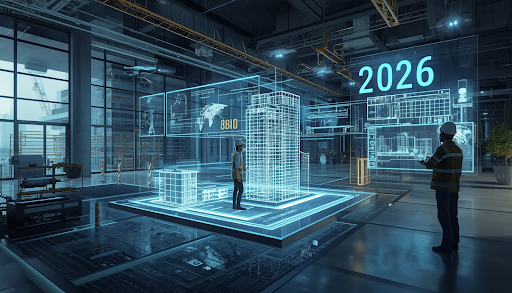
Construction cost estimating trends in 2026 centre on three forces. These forces are composed of real-time material pricing, AI-assisted takeoffs, and tariff-driven cost escalation.
Static spreadsheets are outdated because they cannot adapt to the month-to-month fluctuations in pricing. Companies that are utilizing pricing and takeoff tools for automating processes are gaining favorable results faster.
What Are the Biggest Construction Cost Estimating Trends in 2026?
Estimation is changing quickly from a simple task performed by back-end staff to a strategic advantage in business. Speed, precision, and having access to up-to-date information allow businesses to gain contracts as well as ensure profits. All while maintaining margins that manual methods would otherwise threaten.
Three forces impacting the ability to estimate accurately are converging construction industry trends 2026:
-
Input costs
-
Labor shortages
-
Automation.
In the initial two months of 2026, the input prices for nonresidential construction increased at a 12.6% annualized rate. Such growth was a record for the period since early 2022. Due to the increase in tariffs in some segments, construction companies should budget for a 4–6% cost escalation this year.
Here is a comparison of how modern construction cost estimating services are shaping the future.
| Category | Old Estimating Approach | 2026 Estimating Approach |
| Pricing | Static spreadsheets (prone to outdated data) | Live supplier price feeds (real-time integration) |
| Takeoffs | Manual counting (3–5 days to complete) | AI-assisted (completed in just hours) |
| Change Orders | Reactive (assessed after the fact) | Real-time (active monitoring as they happen) |
| Cost Data | Fixed unit-cost books only | Hybrid (books layered with live market data) |
Why Is Technology Becoming Non-Negotiable In Cost Estimating?
AI, as a cost estimating technology, now handles a meaningful share of takeoff and pricing work. It does not replace estimators; it shifts their time toward judgment calls like risk assessment and scope-gap detection.
This technological shift is rapidly becoming the industry standard; according to recent data, AI adoption among the top 100 (GCs) has officially surged past 80%.
How Are Labor Shortages And Tariffs Changing The Future Of Estimating?
The future of construction estimating is changing. This is because labor shortage has now become a pricing factor, not a scheduling headnote. The industry faces a demand for 499,000 net new jobs to be filled in 2026 to maintain the current level of employment. In addition, 41% of the workforce is estimated to retire by 2031.
The workforce shortage makes 92% of contractors turn to the problem of vacancies in skilled trade positions. This is according to the AGC-NCCER 2025 Workforce Survey.
Tariff-related costs also apply significant upward pressure on construction costs. Overall cost escalation is estimated at approximately 8% for construction projects under current tariff policies. Additionally, steel-intensive work packages and those utilizing a large amount of copper in their MEP scope are being particularly hard hit.
Cost pressures overview:
| Driver | Impact |
| Change orders | ~$44 billion/year in direct industry costs |
| Input costs since 2020 | Up more than 43% |
| National construction costs, January 2026 | Up 2.8% year-over-year |
What Should Small Estimating Firms Do About These Construction Cost Estimating Trends?
Small firms can't out-spend large GCs on software budgets. They can out-move them on process discipline with proactive construction cost estimating trends.
-
Audit pricing sources monthly, not quarterly.
-
Pilot one takeoff AI on one small job before rolling out firm-wide.
-
Add escalation clauses to all contracts with a duration over 90 days using BLS indices.
-
Price jobs at the line item level during construction, not at closeout.
-
Reprice bids within 24 hours of material price changes.
-
Embed estimating functions within job costing processes (86% of builders already do this).
-
Think of estimating software as a decision support system, not just a calculation engine.
Where Do Estimating Services Fit In?
Firms that do not have in-house bandwidth are outsourcing. From takeoffs to pricing, they are hiring specialized independent estimators. This way, they can expedite a project's bid cycle while maintaining a lean workforce.
| Approach | Best Fit |
| In-house estimating team | High project volume, steady pipeline |
| Outsourced estimating services | Variable volume, tight bid deadlines |
| Hybrid model | Firms scaling into new trades or regions |
Teams like Universe Estimating have seen firsthand how each approach impacts. Pairing updated material pricing with disciplined takeoff review shortens bid cycles without sacrificing accuracy.
Conclusion
The construction cost estimating trends that will shape the industry in 2026 are not short-term phenomena. They are driven by long-term forces such as labor shortages, tariff exposure, and the rise of artificial intelligence. Those who recognize the importance of strategic estimating will reap the rewards of improved project outcomes and profitability.

 Arabic
 French
 Spanish
 Portuguese
 Deutsch
 Turkish
 Dutch
Dutch
 Italiano
 Russian
 Romaian
 Portuguese (Brazil)