
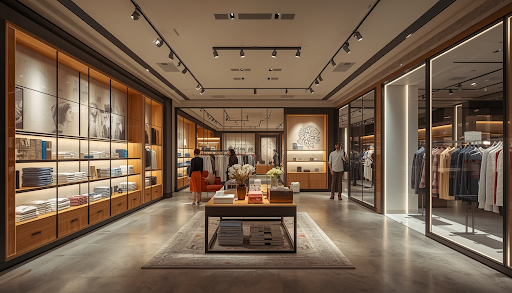
Commercial lighting creates a welcoming ambiance for cafe customers that can even make a retail space seem more inviting to shoppers. It results in increased product perception of quality, freshness, and value as they walk through the doors.
Using the proper combination of ambient, accent, and task lighting will attract customers and keep them in the store longer and looking at products. On a recent apparel-store fit-out, switching the fitting-room task lighting from a flat 3500K overhead to a warmer 3000K with side-fill accent reduced return rates on tried-on garments — shoppers said the color looked closer to how it appeared outside the store. Pairing that with narrow-beam accent lights on the front window display kept customers pausing at the entrance for a longer time. That means retailers’ lighting budget just stops being an expense and starts working as a part of customer experience.
What Is Commercial Lighting Design And How Does It Impact Retail?
Commercial lighting design is the strategic combination of a series of light types (ambient, accent, and task) to create a space to look at, feel, and function in. Ambient light is the overall light level a store requires to allow customers to move safely and comfortably. An accent light, on the other hand, can be used to accentuate certain displays, endcaps, or any featured products, guiding the eye right where a retailer wants it to go. This breakdown of the different types of lighting helps you know how to set them up to have a proper lighting setup in your retail space.
Does Lighting Actually Affect Retail Sales And Energy Costs?
Yes, and federal energy research backs this directly. The U.S. Department of Energy's LED Adoption Report found LED lighting saved U.S. consumers and businesses an estimated $14.7 billion in a single recent year, equal to roughly 5% of total electricity used by buildings nationwide. ENERGY STAR — the joint EPA/DOE efficiency program — notes LED lighting uses up to 90% less energy than incandescent lighting and lasts up to 15 to 25 times longer, cutting operating costs for retailers running lights extended hours. According to Energy Star, from a supermarket perspective: Grocery margins are typically less than 1 percent, and each $1 saved on energy costs is approximately $59—in the form of additional sales, not just maintenance line items.
What's The Difference Between Accent Lighting And Ambient Lighting?
-
Ambient light spreads evenly in the space. So customers can see and move freely and safely.
-
Accent light focuses on specific products or displays. This creates visual focal points.
-
Task lighting creates functional areas such as fitting room areas or checkout counters.
-
3W LED architectural downlight – compact & energy-efficient lighting is used for accent light. They provide a concentrated beam of light, but do not impact the ceiling structure.
What Should Shopping Stores Consider When Deciding The Fixtures For The Display?
The selection of fixtures is based on the purpose of the display. When selling items that require a certain amount of color to appeal to the shoppers – such as clothing and jewellery – use fixtures with a CRI of at least 90 – anything lower will wash out or cause the colourization to be a little wrong, even if this isn't noticed by the shoppers, but is visible. Add in a 3000K–3500K colour temperature for a warm, flattering retail appearance – or 4000K when the display requires a more clinical appearance, e.g. for electronics or cosmetics. Accent lights, particularly small and efficient balanced downlights that don't overheat marketing, are helpful if you're lighting shelving or window displays. As retailers consider fixtures, they inspect a sample of the commercial lights to understand how environmental and emphasis fixtures function in real-life situations.
Conclusion
Commercial lighting is not just a fixture on the ceiling; it is an active element in the customer's point of view, trust, and experience of a retail store. The benefits are improved efficiency and an attractive display; these are real. CIRC Lighting creates commercial light layouts, which are the right balance of ambient coverage, accent light, and energy-efficient fixtures that can help a retail space sell.

 English
 Arabic
 French
 Spanish
 Portuguese
 Deutsch
 Turkish
 Italiano
 Russian
 Romaian
 Portuguese (Brazil)