
Bringing a new product to the market takes much more than a great idea. It requires careful planning, smart engineering, thorough testing, and smooth coordination between different teams. NPI new product introduction is a structured process that helps businesses turn ideas into high-quality products that are ready for manufacturing and market launch. It reduces development risks, improves product quality, and helps companies launch products faster.
Whether a business develops electronics, medical devices, industrial equipment, or consumer products, a well-managed new product introduction process ensures every stage is completed efficiently. From concept to production, each step is designed to deliver a reliable product that meets customer expectations and business goals.
What Is NPI New Product Introduction?
NPI new product introduction is the complete process of transforming a product idea into a market-ready solution. It covers everything from concept validation and product design to prototyping, testing, manufacturing, and final product launch. Unlike product development, which mainly focuses on creating the product, NPI prepares it for successful mass production.
A successful NPI process brings together engineering, manufacturing, quality assurance, procurement, and marketing teams. This cross-functional collaboration helps solve problems early, improve communication, and ensure a smooth transition from design to production.
By following a structured approach, businesses can improve efficiency, reduce production delays, and deliver products that meet quality, cost, and performance targets.
Key Stages of New Product Introduction
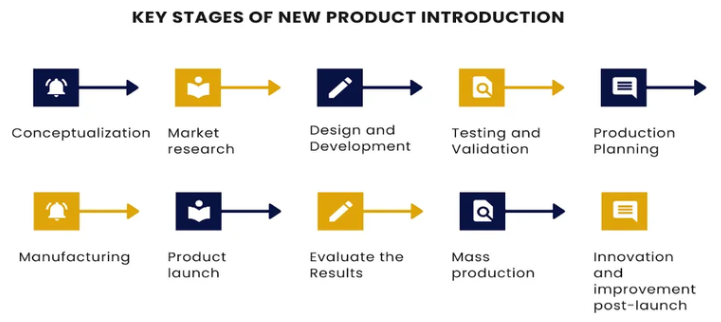
Every successful product follows a clear and organized development path. Below are the major stages involved in the NPI process.
Concept Development
Every project begins with an idea. During this stage, companies study market demand, customer requirements, technical feasibility, and business objectives. This helps determine whether the product is practical and worth developing.
Product Design and Engineering
Engineers create detailed product designs using modern CAD software while considering functionality, cost, durability, and manufacturability. This stage often includes product lifecycle management (PLM) to keep design data organized throughout development.
Prototype Development
Building prototypes allows engineers to evaluate the product before full production. Functional testing helps identify design improvements, validate performance, and reduce future manufacturing risks.
Engineering Validation and Testing
Products undergo extensive testing to verify safety, reliability, quality, and compliance with industry standards. Validation ensures the design performs as expected under real operating conditions.
Pilot Production
A small production batch is manufactured to confirm that production processes work correctly. This stage helps manufacturers identify assembly issues, improve workflows, and verify production consistency.
Full-Scale Manufacturing
After successful validation, the product moves into commercial production. Manufacturing teams follow approved processes to maintain quality, improve efficiency, and ensure reliable product performance.
Benefits of NPI New Product Introduction
A structured NPI new product introduction process offers several advantages that improve both product quality and business performance.
Faster Time to Market
Better planning and teamwork help reduce delays, allowing companies to launch products more quickly and stay ahead of competitors.
Improved Product Quality
Continuous testing, engineering reviews, and quality inspections ensure products meet high standards before reaching customers.
Lower Development Risks
Potential design and manufacturing issues are discovered early, reducing costly changes during production.
Better Cost Management
Careful planning improves material usage, minimizes waste, and increases manufacturing efficiency, helping businesses control development costs.
Stronger Team Collaboration
NPI encourages close communication between design, engineering, manufacturing, procurement, and marketing teams, making project execution smoother from start to finish.
Industries That Benefit from New Product Introduction
Professional new product introduction services support businesses across many industries, including:
- Electronics manufacturing
- Automotive
- Medical devices
- Industrial automation
- Consumer products
- Aerospace
- IoT devices
- Robotics
- Renewable energy
- Smart manufacturing
These industries rely on structured development processes to improve innovation while maintaining high production standards.
NPI vs Product Development
Although people often use these terms interchangeably, they have different purposes.
Product development focuses mainly on designing and creating a new product. NPI goes much further by preparing the product for successful manufacturing, quality control, supply chain readiness, and commercial launch.
In simple words, product development creates the product, while NPI ensures the product can be manufactured efficiently and launched successfully.
Best Practices for a Successful Product Launch
Businesses can improve product launch success by following proven NPI practices.
Start Planning Early
A clear project plan helps teams stay on schedule, manage resources effectively, and reduce unexpected delays.
Encourage Cross-Functional Collaboration
Regular communication between engineering, manufacturing, quality assurance, procurement, and marketing improves decision-making and project efficiency.
Perform Continuous Testing
Testing throughout development helps identify problems early and improves product reliability before launch.
Focus on Manufacturing Readiness
Preparing production lines, suppliers, and quality systems in advance ensures a smoother transition into large-scale manufacturing. Following design for manufacturing (DFM) principles also makes products easier and more cost-effective to produce.
Conclusion
A well-planned NPI new product introduction process helps businesses transform innovative ideas into reliable, market-ready products. From concept validation and engineering to testing, manufacturing, and product launch, every stage plays a key role in achieving quality, efficiency, and customer satisfaction. By adopting a structured NPI strategy, companies can reduce risks, shorten development time, improve collaboration, and strengthen their competitive position. Investing in a professional new product introduction process is a smart way to achieve long-term product success in today's fast-moving industries.

 English
 French
 Spanish
 Portuguese
 Deutsch
 Turkish
 Dutch
Dutch
 Italiano
 Russian
 Romaian
 Portuguese (Brazil)