
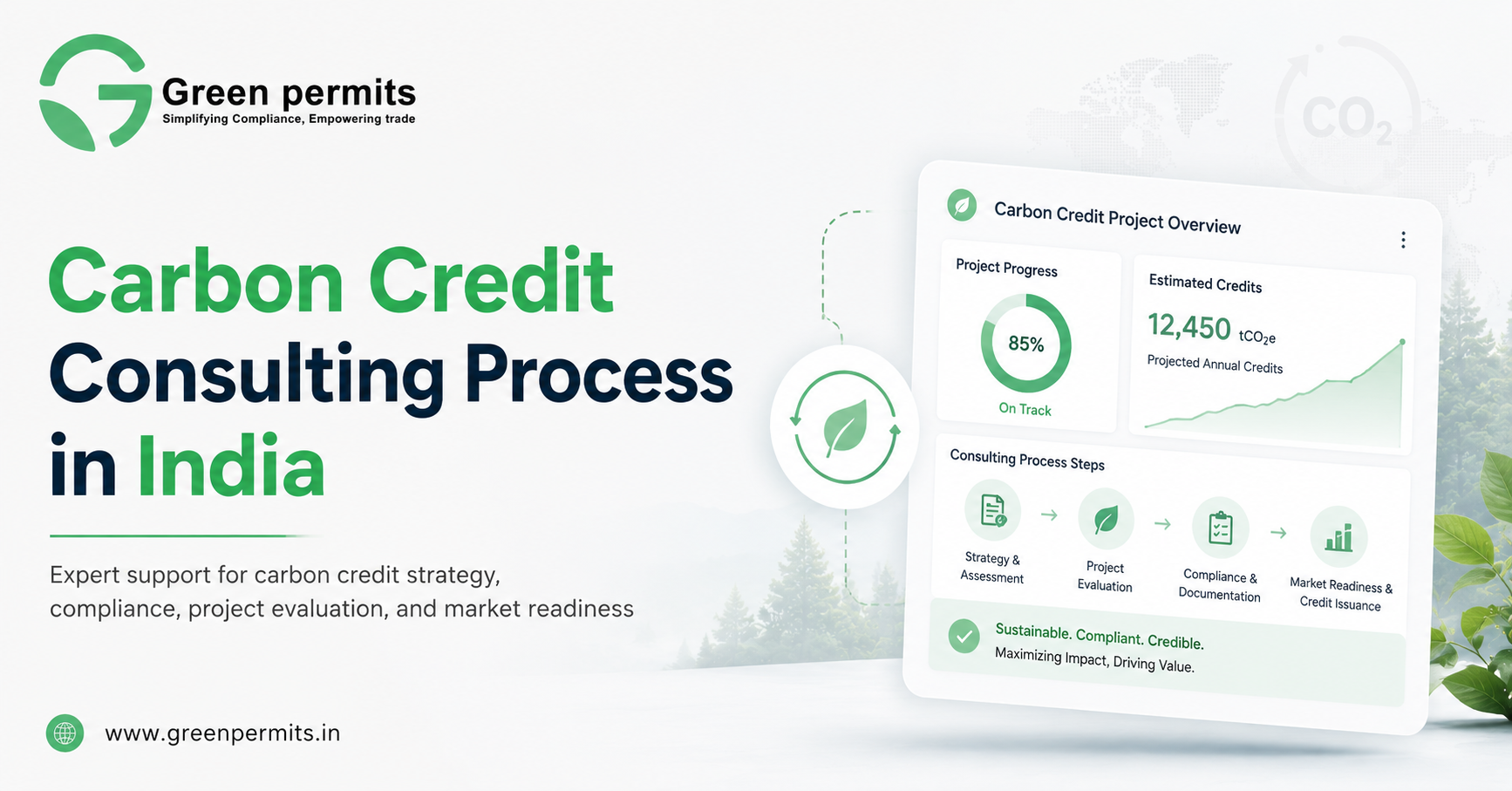
As businesses around the world focus on reducing greenhouse gas emissions and achieving sustainability goals, carbon credits have emerged as an important tool for climate action. Organizations that successfully reduce, avoid, or remove carbon emissions can generate carbon credits and participate in carbon markets, creating both environmental and financial benefits.
In India, carbon credit projects are gaining momentum across renewable energy, waste management, recycling, energy efficiency, forestry, bioenergy, agriculture, industrial processes, and sustainability initiatives. Companies are increasingly exploring carbon credit opportunities to support ESG goals, achieve net-zero targets, improve environmental performance, and create additional revenue streams.
However, carbon credit generation involves technical assessments, project validation, emission calculations, verification procedures, and registration under recognized carbon standards. This is where a Carbon Credit Consultant plays an important role.
Understanding the carbon credit consulting process helps businesses identify opportunities and successfully participate in voluntary and compliance carbon markets.
What are Carbon Credits
A carbon credit represents the reduction, removal, or avoidance of one metric tonne of carbon dioxide equivalent (CO2e) emissions.
When a project reduces greenhouse gas emissions compared to a baseline scenario, the reduction can be measured, verified, and converted into carbon credits.
These credits can then be sold to organizations seeking to offset their carbon footprint or meet sustainability commitments.
Carbon credits create financial incentives for businesses and project developers to invest in environmentally beneficial activities.
Why Carbon Credits are Important
Climate change has become a global concern, and governments, investors, customers, and multinational corporations are increasingly demanding measurable environmental action.
Carbon credits help channel investment into projects that reduce greenhouse gas emissions while supporting sustainable development.
For businesses, carbon credits offer several advantages:
- Additional revenue opportunities
- ESG performance improvement
- Support for net-zero commitments
- Enhanced sustainability reporting
- Increased investor confidence
- Better market positioning
Organizations that generate carbon credits can benefit financially while contributing to global climate goals.
Role of a Carbon Credit Consultant
A Carbon Credit Consultant helps businesses identify eligible projects, assess carbon reduction potential, prepare documentation, coordinate validation, and manage the registration process.
The consultant evaluates whether a project qualifies under recognized carbon standards and determines the most suitable methodology for carbon credit generation.
Professional consultants also assist with emission calculations, monitoring systems, verification requirements, and credit issuance procedures.
Since carbon markets involve technical standards and detailed documentation, expert guidance is often essential for project success.
Projects Eligible for Carbon Credits
Several types of projects may qualify for carbon credit generation.
Common examples include:
- Solar power projects
- Wind energy projects
- Biomass energy projects
- Waste-to-energy plants
- E-waste recycling projects
- Plastic recycling facilities
- Battery recycling projects
- Energy efficiency projects
- Afforestation projects
- Sustainable agriculture initiatives
- Methane capture systems
- Industrial emission reduction projects
The eligibility depends on the project's ability to demonstrate measurable and verifiable emission reductions.
Carbon Credit Consulting Process
The process begins with evaluating whether a project has carbon credit potential.
The consultant conducts a preliminary assessment to identify emission reduction opportunities and estimate possible carbon credit generation.
Once eligibility is confirmed, the project boundary and baseline scenario are established. The baseline represents the emissions that would have occurred without the project.
The consultant then calculates expected emission reductions using approved methodologies and prepares the required documentation.
After documentation is completed, the project is registered under an appropriate carbon standard and proceeds through validation and verification stages.
Once verified, carbon credits are issued and become available for trading or sale.
Step 1: Project Feasibility Assessment
The first stage is determining whether the project qualifies for carbon credit generation.
The assessment generally evaluates:
- Project type
- Emission reduction potential
- Technology used
- Data availability
- Regulatory considerations
- Financial feasibility
A feasibility assessment helps avoid unnecessary investment in projects that may not meet carbon market requirements.
This stage also provides an estimate of potential carbon credit revenue.
Step 2: Baseline and Emission Assessment
After project eligibility is confirmed, the consultant establishes the baseline scenario.
The baseline represents emissions that would have occurred if the project had not been implemented.
The project's actual emissions are then compared against the baseline to determine emission reductions.
Accurate baseline assessment is critical because it directly affects the number of carbon credits that can be generated.
Step 3: Selection of Carbon Standard
Carbon credits are generally generated under recognized international standards.
Common carbon standards include:
- Verra (VCS)
- Gold Standard
- Global Carbon Council (GCC)
- Clean Development Mechanism (CDM)
- Other recognized carbon programs
The appropriate standard depends on project type, location, market requirements, and buyer preferences.
A consultant helps select the most suitable standard for the project.
Step 4: Project Documentation Preparation
Documentation is one of the most important parts of the carbon credit process.
The project documentation generally includes:
- Project Description
- Baseline Assessment
- Emission Reduction Calculation
- Monitoring Plan
- Technical Specifications
- Environmental Information
- Operational Details
The quality of documentation significantly affects project approval and verification success.
Proper preparation reduces delays during validation and registration.
Step 5: Validation and Verification
Before carbon credits can be issued, the project must undergo independent assessment.
Validation confirms that the project meets the requirements of the selected carbon standard.
Verification confirms that the reported emission reductions have actually occurred.
Independent accredited agencies typically conduct these evaluations.
Successful validation and verification are required before carbon credits are issued.
Step 6: Carbon Credit Issuance
After verification is completed, the carbon standard issues carbon credits based on verified emission reductions.
The credits are recorded in the applicable carbon registry.
Project owners can then hold, trade, transfer, or sell the credits in carbon markets.
The number of credits issued depends on the verified emission reductions achieved by the project.
Carbon Credit Trading Opportunities
Once credits are issued, businesses can participate in carbon markets.
Carbon credits may be sold to:
- Corporates pursuing net-zero goals
- ESG-focused organizations
- International buyers
- Sustainability-focused investors
- Carbon offset programs
The market value of carbon credits depends on project type, certification standard, buyer demand, and market conditions.
Well-documented projects often attract greater interest from buyers.
Benefits of Carbon Credit Consulting
Professional consulting support improves the likelihood of successful project registration and credit issuance.
Key benefits include:
- Project eligibility assessment
- Carbon reduction analysis
- Documentation preparation
- Standard selection support
- Validation coordination
- Verification assistance
- Carbon market guidance
Consultants help businesses avoid technical errors and maximize carbon credit opportunities.
Common Challenges in Carbon Credit Projects
Many projects face challenges because carbon markets involve complex technical and regulatory requirements.
Common issues include:
- Poor baseline calculations
- Incomplete documentation
- Weak monitoring systems
- Data collection challenges
- Verification delays
- Incorrect methodology selection
Professional guidance helps businesses overcome these challenges and improve project outcomes.
Carbon Credits and ESG Strategy
Carbon credits are increasingly becoming part of broader ESG and sustainability strategies.
Organizations use carbon projects to support:
- Net-zero commitments
- Climate action plans
- Sustainability reporting
- Investor communication
- Carbon neutrality goals
Integrating carbon credits into ESG planning can improve long-term environmental performance and stakeholder confidence.
Learn the Complete Carbon Credit Process
Planning to develop a carbon credit project in India? Understanding project eligibility, carbon standards, baseline assessment, verification requirements, carbon trading, and sustainability benefits is essential before starting.
Read the complete guide here:
👉 https://www.greenpermits.in/05/carbon-credit-trading-india-compliance-strategies-for-businesses/
📞 Get Expert Assistance for Carbon Credit Consulting
Need assistance with Carbon Credit Projects, carbon footprint assessment, carbon market registration, ESG strategy, emission reduction calculations, verification support, or sustainability consulting? The experts at Green Permits Consulting can guide you throughout the complete process.
🌐 Website: https://www.greenpermits.in/
📞 Phone: +91 78350 06182
📧 Email: wecare@greenpermits.in

 English
 Arabic
 French
 Spanish
 Portuguese
 Deutsch
 Dutch
Dutch
 Italiano
 Russian
 Romaian
 Portuguese (Brazil)