
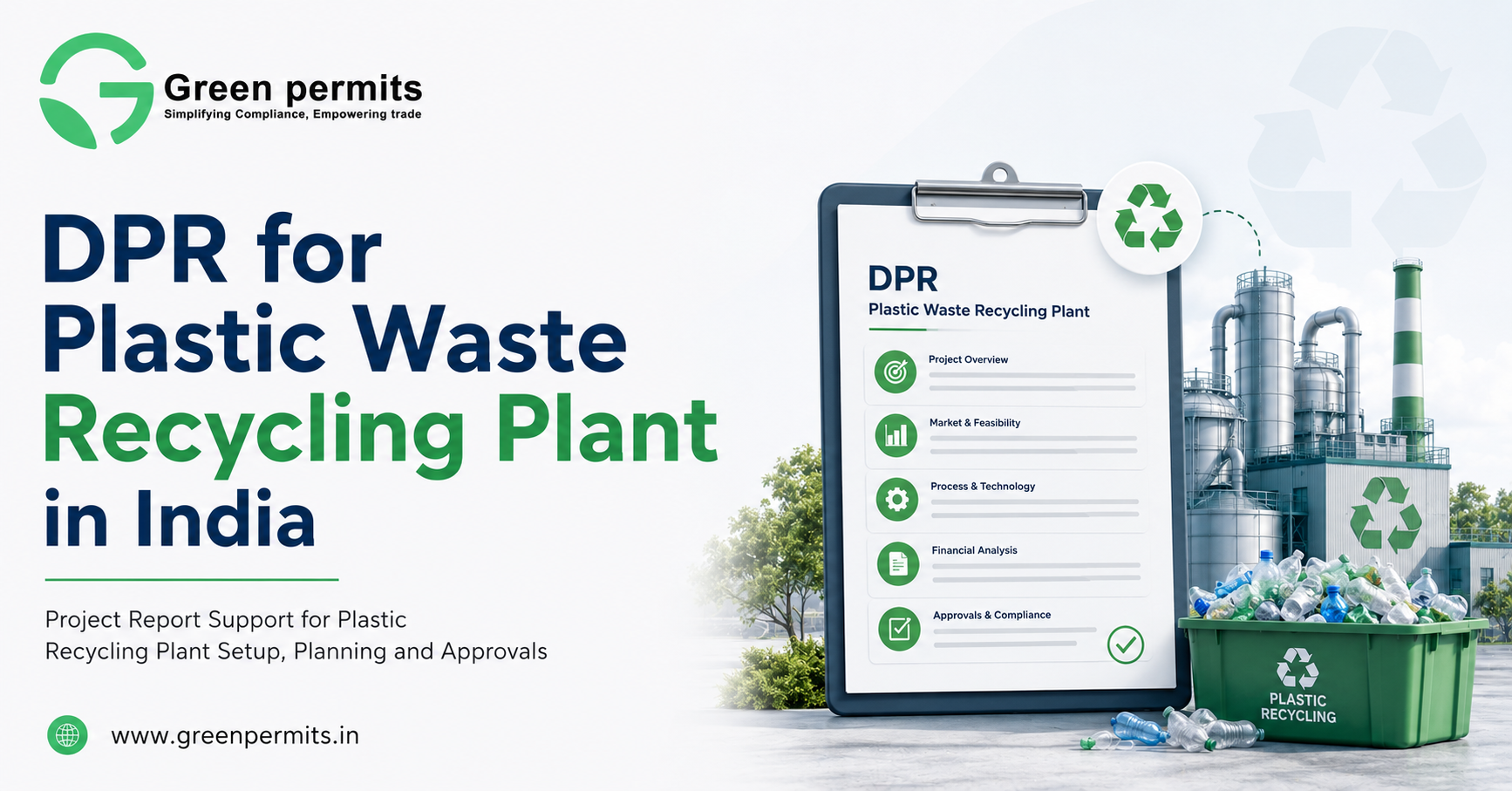
India generates millions of tonnes of plastic waste every year from packaging materials, consumer products, industrial applications, retail activities, and household consumption. With increasing awareness about sustainability and stricter environmental regulations, plastic recycling has become one of the most promising sectors in the waste management industry.
The Government of India is actively promoting plastic recycling through the Plastic Waste Management Rules and Extended Producer Responsibility (EPR) framework. This has created significant opportunities for entrepreneurs, recyclers, investors, manufacturers, and waste management companies looking to establish plastic recycling facilities.
Before setting up a recycling plant, one of the most important documents required is a Detailed Project Report (DPR). A DPR helps investors, financial institutions, government authorities, and project developers understand the technical, financial, and operational aspects of the proposed recycling facility.
Whether the project is being developed for bank funding, investor presentation, Pollution Control Board approval, or business planning, a professionally prepared DPR plays a critical role in the successful implementation of a plastic recycling plant.
What is a DPR for a Plastic Waste Recycling Plant
A Detailed Project Report is a comprehensive document that provides complete information about the proposed recycling project.
The DPR explains how the plant will be established, operated, managed, and made financially viable.
The report generally includes technical details, machinery specifications, land requirements, financial projections, compliance requirements, risk assessments, and operational planning.
It serves as a roadmap for project implementation and helps stakeholders evaluate the feasibility of the business.
A professionally prepared DPR improves planning accuracy and reduces project execution risks.
Why is DPR Important for Plastic Recycling Projects
Many recycling projects fail because of inadequate planning, poor financial estimation, and lack of compliance understanding.
A DPR helps businesses evaluate the project before making major investments.
The report is commonly required for:
- Bank loan applications
- Investor funding
- Pollution Control Board approvals
- Plastic Waste Processor Registration
- Project planning
- Financial feasibility assessment
- Government permissions
A well-structured DPR improves project credibility and supports informed decision-making.
Key Components of a Plastic Recycling Plant DPR
A professional DPR covers all major aspects of the proposed project.
The report generally includes:
- Executive summary
- Industry overview
- Market analysis
- Technical feasibility
- Plant capacity
- Land requirement
- Machinery requirement
- Financial projections
- Compliance requirements
- Risk assessment
Each section provides valuable information for investors, lenders, and authorities evaluating the project.
Project Overview Section
The project overview provides a summary of the proposed recycling facility.
It generally includes:
- Business objective
- Project location
- Proposed capacity
- Recycling process
- Product output
- Estimated investment
- Revenue model
This section gives stakeholders a quick understanding of the project concept and business opportunity.
Market Analysis and Industry Opportunity
A strong DPR includes a detailed assessment of the plastic recycling industry.
The market analysis evaluates:
- Plastic waste generation trends
- Demand for recycled plastic
- Industry growth opportunities
- Competition analysis
- EPR compliance demand
- Future market potential
The increasing demand for recycled plastic granules and flakes has created substantial opportunities for organized recycling businesses.
Growing sustainability requirements are further driving demand for recycling infrastructure.
Land Requirement for Plastic Recycling Plant
Land planning is an important part of project development.
The DPR evaluates land requirements based on plant capacity, machinery layout, storage needs, and future expansion plans.
The facility generally requires space for:
- Raw material storage
- Sorting area
- Washing section
- Processing area
- Finished goods storage
- Administrative office
- Utility infrastructure
Depending on plant capacity, land requirements may range from 5,000 square feet to more than 50,000 square feet.
Selecting suitable industrial land simplifies approvals and operational management.
Machinery Requirement and Cost
Machinery is one of the largest components of project investment.
The DPR identifies equipment required for plastic processing operations.
Typical machinery may include:
- Sorting systems
- Conveyors
- Shredders
- Crushers
- Washing units
- Dryers
- Agglomerators
- Extruders
- Pelletizing machines
- Storage systems
The machinery requirement depends on the type of plastic waste being processed and the planned production capacity.
The DPR also includes estimated machinery costs and installation requirements.
Plastic Recycling Process Included in DPR
The report explains the complete recycling process adopted by the facility.
A typical process may include:
- Plastic waste collection
- Sorting and segregation
- Shredding
- Washing
- Drying
- Extrusion
- Granule or pellet production
- Packaging and dispatch
The process flow helps authorities and investors understand plant operations and material movement.
A clear process description also supports compliance approvals.
Financial Analysis and Project Cost Estimation
Financial analysis is one of the most important sections of the DPR.
This section generally includes:
- Land cost
- Building cost
- Machinery investment
- Utility infrastructure cost
- Working capital requirement
- Operational expenses
- Revenue projections
- Profitability analysis
The financial model helps investors determine project viability and expected returns.
Banks also use this information when evaluating project finance applications.
Pollution Control and Environmental Compliance
Plastic recycling plants require environmental approvals before operation.
The DPR explains compliance requirements related to:
- Consent to Establish (CTE)
- Consent to Operate (CTO)
- Plastic Waste Processor Registration
- Wastewater management
- Air pollution control systems
- Solid waste management
- Worker safety measures
Environmental planning is important because Pollution Control Boards carefully evaluate recycling projects before granting approvals.
A well-prepared DPR improves approval timelines.
Role of DPR in Pollution Control Board Approval
The Pollution Control Board often requires project information before granting environmental approvals.
The DPR provides details regarding:
- Process flow
- Pollution control measures
- Machinery details
- Water consumption
- Wastewater generation
- Emission control systems
- Waste handling arrangements
This information helps authorities assess the environmental impact of the proposed facility.
A detailed report supports smoother approval processing.
Importance of DPR for Bank Loan Approval
Most banks and financial institutions require a DPR before sanctioning loans for recycling projects.
The report helps lenders assess:
- Technical feasibility
- Project cost
- Revenue generation potential
- Risk factors
- Repayment capability
A professionally prepared DPR improves confidence among lenders and increases the chances of project financing.
Many investors also rely on DPR-based financial analysis before committing funds.
Common Mistakes During DPR Preparation
Many project promoters prepare incomplete reports that fail to address critical project aspects.
Common mistakes include:
- Unrealistic financial projections
- Incorrect capacity estimation
- Poor market analysis
- Weak compliance planning
- Incomplete machinery assessment
- Underestimating working capital requirements
These issues can create problems during financing, approvals, and project execution.
Professional DPR preparation helps avoid these risks.
Benefits of Professional DPR Consulting
An experienced consultant helps prepare a technically sound and financially realistic project report.
Professional support generally includes:
- Feasibility study preparation
- DPR development
- Financial modeling
- Compliance planning
- Pollution Control Board support
- Plastic Waste Processor Registration guidance
- Project implementation assistance
Expert guidance helps investors improve project planning and reduce business risks.
Learn the Complete Plastic Recycling Plant Setup Process
Planning to establish a plastic waste recycling plant in India? Understanding DPR preparation, project cost estimation, machinery planning, financial analysis, Pollution Control Board approvals, and compliance requirements is essential before investing.
Read the complete guide here:
👉 https://www.greenpermits.in/06/dpr-for-plastic-waste-recycling-plant-india/
📞 Get Expert Assistance for Plastic Recycling Plant DPR
Need assistance with DPR preparation, feasibility studies, Plastic Waste Processor Registration, Pollution Control Board approvals, financial projections, project financing, or complete recycling plant setup support? The experts at Green Permits Consulting can guide you throughout the complete process.
🌐 Website: https://www.greenpermits.in/
📞 Phone: +91 78350 06182
📧 Email: wecare@greenpermits.in

 English
 Arabic
 French
 Portuguese
 Deutsch
 Turkish
 Dutch
Dutch
 Italiano
 Russian
 Romaian
 Portuguese (Brazil)