
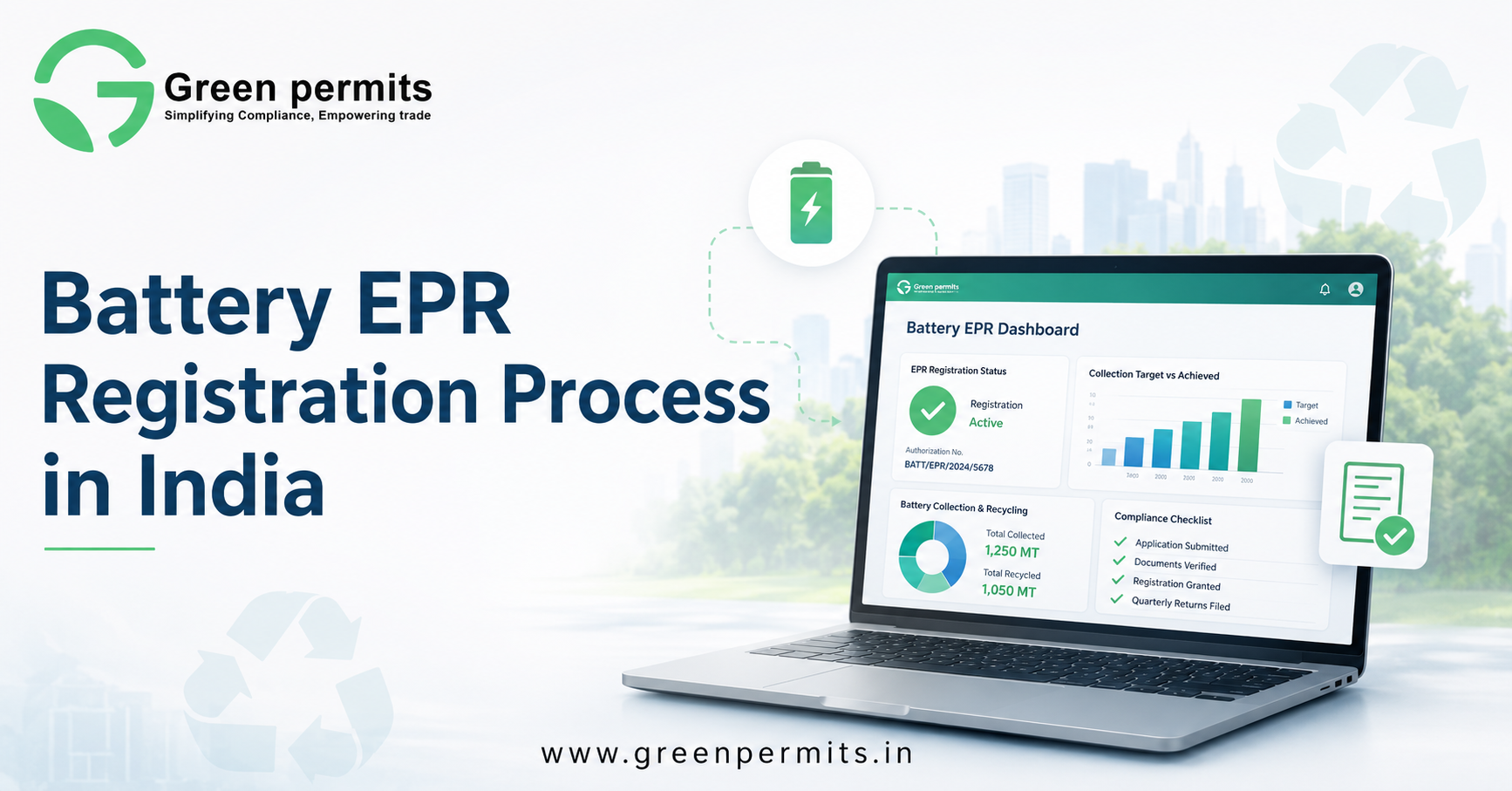
The battery industry in India has witnessed significant growth due to the increasing demand for electric vehicles, energy storage systems, consumer electronics, telecom equipment, solar power systems, and industrial applications. While batteries play a crucial role in supporting modern technology and clean energy solutions, improper disposal of used batteries can create serious environmental and public health risks.
To address these challenges, the Government of India introduced the Battery Waste Management Rules, which place responsibility on producers, importers, manufacturers, and brand owners for the collection, recycling, and environmentally sound management of battery waste. This responsibility is implemented through the Extended Producer Responsibility (EPR) framework.
Battery EPR Registration is mandatory for businesses that manufacture, import, sell, or place batteries on the Indian market. Without EPR registration, companies may face regulatory penalties, restrictions on operations, and non-compliance with environmental regulations.
Understanding the Battery EPR registration process is essential for businesses involved in the battery value chain.
What is Battery EPR Registration
Battery EPR Registration is an approval granted through the Central Pollution Control Board (CPCB) portal under the Battery Waste Management Rules.
The registration makes producers responsible for ensuring that waste batteries generated from their products are collected, recycled, refurbished, or processed through authorized entities.
Under the EPR framework, businesses must fulfill annual waste management obligations based on the quantity of batteries they introduce into the market.
The objective is to create a circular economy where battery materials are recovered and reused instead of being disposed of improperly.
Who Needs Battery EPR Registration
Battery EPR registration is mandatory for entities that introduce batteries into the Indian market.
This generally includes:
- Battery manufacturers
- Importers of batteries
- Battery assemblers
- Brand owners
- Electric vehicle battery suppliers
- Energy storage battery suppliers
- Consumer battery importers
- Industrial battery manufacturers
The registration requirement applies regardless of whether batteries are sold independently or as part of equipment, machinery, vehicles, or electronic products.
Businesses must obtain registration before commencing operations involving covered battery categories.
Types of Batteries Covered Under EPR
The Battery Waste Management Rules apply to various battery categories used across industries.
Common battery categories include:
- Portable batteries
- Electric Vehicle (EV) batteries
- Automotive batteries
- Industrial batteries
These categories cover a wide range of battery chemistries including lithium-ion, lead-acid, nickel-metal hydride, and other battery technologies.
The applicable compliance obligations depend on the category and quantity of batteries placed in the market.
Why Battery EPR Compliance is Important
Battery waste contains valuable materials such as lithium, cobalt, nickel, lead, copper, aluminum, and other metals that can be recovered through recycling.
At the same time, improper disposal can contaminate soil, groundwater, and air while creating health and environmental hazards.
The EPR framework ensures that battery producers contribute to responsible waste management and resource recovery.
For businesses, compliance also provides legal authorization to operate within India's battery market and demonstrates commitment to environmental responsibility.
As electric vehicle adoption and energy storage deployment continue to grow, battery compliance is becoming increasingly important for long-term business sustainability.
Documents Required for Battery EPR Registration
Proper documentation is essential for successful registration.
The documents generally required include:
- Company Incorporation Certificate
- PAN Card
- GST Registration Certificate
- Import Export Code (if applicable)
- Authorized Signatory Documents
- Battery Product Details
- Brand Ownership Documents
- Manufacturing or Import Details
- Business Address Proof
- Sales and Market Placement Data
Additional information may be required depending on the applicant category and business model.
Accurate documentation helps reduce approval delays and compliance issues.
Battery EPR Registration Process
The registration process begins with identifying the battery categories covered under the Battery Waste Management Rules. Businesses must determine the type of batteries they manufacture, import, assemble, or market.
After identifying applicable battery categories, the applicant gathers business information, product details, sales records, and compliance-related documentation.
The application is then submitted through the CPCB Battery EPR Portal. The portal requires detailed information regarding the applicant, battery categories, production or import volumes, and compliance commitments.
Once submitted, CPCB reviews the application and verifies the information provided. Authorities may request additional documents or clarifications if required.
After successful verification, the applicant receives Battery EPR Registration and becomes eligible to undertake battery-related business activities in compliance with regulatory requirements.
Battery EPR Targets and Obligations
After obtaining registration, producers are required to fulfill EPR obligations based on the quantity of batteries placed on the market.
The Battery Waste Management Rules establish collection and recycling targets that increase over time. Producers must ensure that equivalent quantities of waste batteries are processed through registered recyclers or refurbishers.
The compliance system operates through EPR certificates generated by authorized recyclers. These certificates serve as evidence that battery waste has been recycled according to regulatory requirements.
Producers must acquire sufficient certificates to meet their annual obligations and maintain compliance.
Role of Registered Recyclers
Registered recyclers are a key part of the Battery EPR ecosystem.
These facilities collect, process, and recycle waste batteries using approved technologies. During recycling, valuable materials such as lithium, cobalt, nickel, lead, and other metals are recovered and reintroduced into the manufacturing supply chain.
Based on recycling activities, recyclers generate EPR certificates that producers can purchase to fulfill their compliance obligations.
Working with authorized recyclers is essential for maintaining valid EPR compliance.
Compliance After Registration
Obtaining Battery EPR Registration is only the first stage of compliance.
Businesses must continuously monitor battery sales, imports, production volumes, EPR obligations, certificate procurement, and annual reporting requirements.
Regular record maintenance is important because authorities may review compliance performance and supporting documentation.
Failure to meet EPR targets or reporting obligations may result in environmental compensation, notices, penalties, or restrictions on business operations.
A structured compliance management system helps businesses maintain long-term regulatory compliance.
Common Challenges During Battery EPR Registration
Many businesses face difficulties because battery regulations involve technical classifications, target calculations, and ongoing compliance requirements.
Common challenges include incorrect battery categorization, inaccurate sales reporting, incomplete documentation, and lack of understanding regarding EPR obligations.
Importers and EV battery suppliers often encounter additional complexities due to multiple battery categories and changing compliance requirements.
Professional consulting support helps businesses navigate these challenges efficiently and avoid regulatory issues.
Benefits of Professional Battery EPR Consulting
A Battery EPR consultant helps businesses complete registration, understand obligations, and maintain ongoing compliance.
Professional support typically includes:
- Battery category assessment
- CPCB portal registration
- Documentation preparation
- EPR target calculation
- Compliance planning
- Certificate management
- Annual return filing
For businesses with large sales volumes or multiple battery categories, expert guidance can significantly reduce compliance risks.
Learn the Complete Battery EPR Registration Process
Planning to obtain Battery EPR Registration in India? Understanding CPCB registration, battery categories, EPR targets, recycling obligations, certificate requirements, and annual compliance procedures is essential before starting.
Read the complete guide here:
👉 https://www.greenpermits.in/11/epr-battery-registration-in-india/
📞 Get Expert Assistance for Battery EPR Registration
Need assistance with Battery EPR Registration, CPCB portal filing, battery classification, EPR target calculation, recycler coordination, certificate procurement, or annual compliance management? The experts at Green Permits Consulting can guide you throughout the complete process.
🌐 Website: https://www.greenpermits.in
📞 Phone: +91 78350 06182
📧 Email: wecare@greenpermits.in

 English
 Arabic
 French
 Spanish
 Portuguese
 Turkish
 Dutch
Dutch
 Italiano
 Russian
 Romaian
 Portuguese (Brazil)