
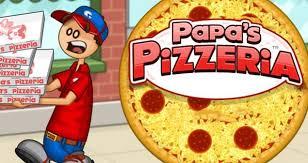
A game built on repetition that somehow doesn’t feel repetitive
On paper, Papa’s Pizzeria should run out of steam quickly. The structure is fixed: take an order, prepare toppings, bake the pizza, slice it, serve it. There are no dramatic shifts, no sprawling world, no long narrative hooks pulling you forward.
And yet the game doesn’t fade the way simple systems usually do.
Instead, it settles into something closer to rhythm than repetition. The same actions happen again and again, but each cycle feels slightly different because your attention is always in a different state. Sometimes you’re fast and precise. Other times you’re rushed, juggling too many orders at once. Sometimes you’re just slightly off, trying to recover efficiency without fully breaking flow.
That variation inside a fixed structure is what keeps it from feeling flat.
The hidden structure of attention management
The game never explicitly tells you that you’re managing attention. It just builds a system where attention is constantly being split.
One pizza is in the oven. Another is being assembled. A third is waiting for instructions. A fourth customer is already standing there, silently increasing pressure.
Nothing is inherently difficult. The challenge comes from distribution—how you divide focus across multiple small tasks that all feel equally important in the moment.
This is where the game quietly becomes more than a cooking simulation. It becomes a test of prioritization under light pressure.
You start developing habits without noticing. Checking the oven more frequently than necessary. Pre-reading orders before finishing current tasks. Planning toppings based on timing rather than sequence.
None of these behaviors are taught. They emerge naturally from repeated exposure.
Why small mistakes feel surprisingly personal
One of the more interesting emotional effects in Papa’s Pizzeria is how noticeable small mistakes feel.
A slightly uneven topping placement. A pizza left in the oven just a bit too long. A slice that isn’t quite symmetrical.
Individually, these are minor. The game doesn’t punish them harshly. But they still register.
That’s because the feedback loop is so direct. You see the result immediately, and you understand exactly what caused it. There’s no ambiguity between action and outcome.
So even small imperfections feel earned—and therefore noticeable.
This creates a subtle emotional pull: not frustration, but awareness. You start noticing your own inconsistencies more clearly. And that awareness pushes you to adjust.
The rhythm of pressure and release
The structure of gameplay naturally forms a rhythm, even without intentional design cues.
There are moments of pressure—multiple orders stacking up, ovens needing attention, customers waiting. Then there are brief moments of release—when things are in motion and nothing new demands immediate action.
That alternating cycle keeps engagement stable. You never stay in stress long enough to feel overwhelmed, but you also never stay idle long enough to lose focus.
It’s a controlled oscillation between urgency and calm.
And because the cycle is so consistent, your mind starts syncing with it. You begin to anticipate when pressure will rise again and when it will ease.
That anticipation becomes part of the experience itself.
Customers as timing pressure, not narrative figures
In Papa’s Pizzeria, customers are less like characters and more like time-based signals.
Each one represents a different kind of pressure. Some are patient, giving you room to manage multiple tasks. Others increase urgency, forcing prioritization. Some bring complex orders that slow down execution, while others are simple enough to stabilize workflow.
Over time, you stop reacting to them emotionally and start reading them structurally.
They become indicators of workload distribution rather than individuals.
That shift is subtle but important. It turns the game into a kind of live system management problem, where every new arrival slightly changes the balance of attention required.
Why the oven stage defines the entire experience
If there’s a single mechanic that quietly holds everything together, it’s baking.
The oven introduces delayed consequences. Unlike toppings or slicing, where actions are immediate, baking happens in the background. You commit, then leave it running while focusing elsewhere.
That creates a persistent mental anchor. Even while doing other tasks, part of your attention stays tied to timing.
This split awareness is where most of the game’s tension lives. Not in fast action, but in delayed responsibility.
You are always slightly aware that something is waiting for you.
And that awareness never fully disappears.
The illusion of control inside controlled chaos
As the game progresses, the number of simultaneous tasks increases, but never beyond manageability. That balance is carefully maintained.
You always feel like you’re slightly behind—but not failing.
That “almost under control” state is powerful. It creates engagement without panic. You’re constantly adjusting, but rarely correcting disaster-level mistakes.
It feels like you are steering a system rather than reacting to collapse.
And that distinction matters. It makes the experience feel skill-based even though the mechanics are simple.
Control becomes something you maintain in degrees, not absolutes.
Why improvement sneaks up on you
Progress in the game doesn’t announce itself. There are no dramatic milestones or sudden unlocks that redefine the experience.
Instead, improvement is incremental.
You notice it in small ways: fewer burnt pizzas, faster order processing, more consistent topping placement, smoother transitions between stations.
At first, these changes feel insignificant. Then, suddenly, the game feels noticeably easier—not because it changed, but because you did.
That realization often comes late, after several sessions of play where nothing felt dramatically different.
It’s a slow accumulation of micro-improvements that only becomes visible in hindsight.
The comfort of predictable systems
One reason the game stays engaging for so long is its predictability. Everything behaves according to stable rules. Nothing surprises you in a disruptive way.
That predictability creates comfort. You don’t need to re-learn systems or adapt to sudden changes. Instead, you refine your understanding of the same structure over and over.
And refinement is inherently satisfying when feedback is immediate.
You always know why something worked or didn’t. There’s no mystery layer obscuring performance.
That clarity keeps attention grounded.
The strange aftereffect of simple gameplay loops
Even after stopping, the structure of Papa’s Pizzeria tends to linger in memory. Not as specific events, but as rhythm.
Order, build, bake, serve. Repeat.
It becomes a kind of mental pattern that’s easy to recall because it’s so consistently structured.
That’s part of why these kinds of games feel memorable in a way that’s hard to explain. They don’t rely on story or spectacle. They rely on repetition with variation.
And repetition, when paired with attention and timing, tends to stick longer than expected.
A final lingering thought
There’s something interesting about how quickly the mind adapts to systems that are simple on the surface but layered in execution.
Why do small loops like this feel so absorbing even when nothing dramatic is happening at all?

 English
 Arabic
 French
 Spanish
 Portuguese
 Turkish
 Dutch
Dutch
 Italiano
 Russian
 Romaian
 Portuguese (Brazil)