
Introduction
Starting a non-governmental organization (NGO) in India requires proper legal steps to ensure that the organization can work smoothly and gain public trust. Many founders begin with a social purpose but are unsure about the legal requirements involved in setting up and maintaining an NGO.
The process to register NGO in India involves choosing the right legal structure and completing formal registration with the government. Along with this, tax-related registrations like 12A and 80G Registration play an important role in helping NGOs receive exemptions and donations legally.
In this blog, we will explain how NGO registration works, the role of Section 8 companies, and why tax registrations are important for non-profit organizations like those guided by NGOExperts.
What is NGO Registration in India?
NGO registration is the legal process of forming a non-profit organization that works for social welfare, education, healthcare, environment, or other public causes.
In India, NGOs can be registered in three main ways:
- Trust Registration
- Society Registration
- Section 8 NGO Registration
Among these, Section 8 companies are widely preferred because they are governed by the Companies Act and offer better transparency and credibility.
Process to Register NGO in India
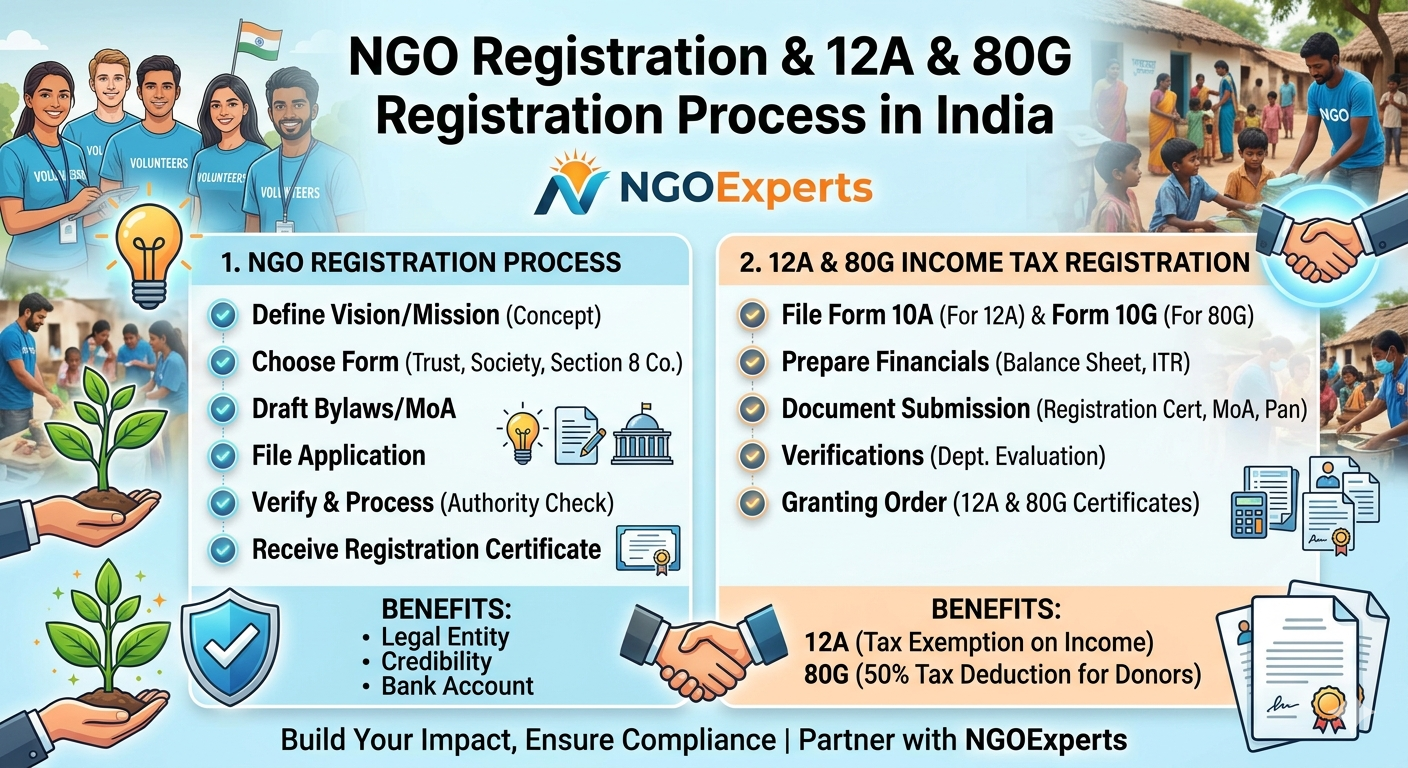
The process to register NGO depends on the type of structure chosen, but the general steps remain similar.
Step 1: Choose the Legal Structure
Before registration, founders must decide whether the NGO will be a Trust, Society, or Section 8 company. Each structure has different legal requirements and governance rules.
Step 2: Name Approval
The organization name should reflect its purpose and should not be similar to existing registered entities.
Step 3: Prepare Documents
Key documents include:
- Identity proof of members
- Address proof
- Memorandum of Association (MOA)
- Rules and regulations or trust deed
- Registered office proof
Step 4: File Application
The application is submitted to the relevant authority such as the Registrar of Companies (for Section 8 companies) or state authorities (for Trusts and Societies).
Step 5: Certificate of Registration
Once approved, the NGO receives a registration certificate, allowing it to function legally.
NGOExperts assists applicants at each stage to ensure documents are properly prepared and submitted without errors.
Section 8 NGO Registration Explained
Section 8 NGO Registration is one of the most preferred forms of non-profit registration in India. It is governed under the Companies Act, 2013 and is designed for organizations working for charitable purposes.
Key Features of Section 8 Companies:
- No profit distribution among members
- Legal recognition under central law
- Better trust among donors and institutions
- Separate legal identity
This structure is often chosen by organizations planning long-term social projects or seeking funding from government and international sources.
Understanding 12A and 80G Registration
After completing NGO registration, the next important step is applying for 12A and 80G Registration.
What is 12A Registration?
12A registration allows an NGO to claim exemption from income tax on its surplus income. This means the organization does not have to pay tax on funds used for charitable activities.
What is 80G Registration?
80G registration allows donors to claim tax deductions on donations made to the NGO. This encourages more individuals and companies to contribute financially.
Why 12A and 80G Registration Matters ?
- Helps reduce tax burden on NGOs
- Increases donor confidence
- Supports fundraising efforts
- Improves financial transparency
Without these registrations, an NGO may face limitations in raising funds and managing tax exemptions.
Documents Required for 12A and 80G Registration
To apply for 12A and 80G Registration, NGOs generally need:
- Registration certificate of NGO
- PAN card of organization
- MOA or trust deed
- Financial statements
- Details of trustees or directors
- Activity report of the NGO
Proper documentation is important for approval without delays.
Role of NGOExperts in NGO Registration
NGOExperts provides legal support for individuals and groups looking to start or manage non-profit organizations in India. The guidance includes:
- Assisting in process to register NGO
- Helping with Section 8 NGO Registration
- Supporting applications for 12A and 80G Registration
- Document preparation and filing
- Compliance-related support
The goal is to make the legal steps clearer and manageable for new founders.
Common Challenges in NGO Registration
Many applicants face issues such as:
- Incorrect documentation
- Delays in government approval
- Lack of clarity in legal structure
- Confusion in tax registration process
These challenges can slow down the formation of an NGO. Proper guidance helps avoid such problems and ensures smoother registration.
Conclusion
Starting an NGO in India requires proper planning and legal understanding. From selecting the right structure to completing the process to register NGO, each step plays an important role in building a strong foundation.
Section 8 NGO Registration offers a structured legal framework for non-profits, while 12A and 80G Registration helps in tax benefits and fundraising support.
With proper guidance from professionals like NGOExperts, individuals and groups can complete the registration process with clarity and move forward with their social initiatives more confidently.

 English
 Arabic
 French
 Spanish
 Portuguese
 Deutsch
 Turkish
 Dutch
Dutch
 Italiano
 Russian
 Romaian