
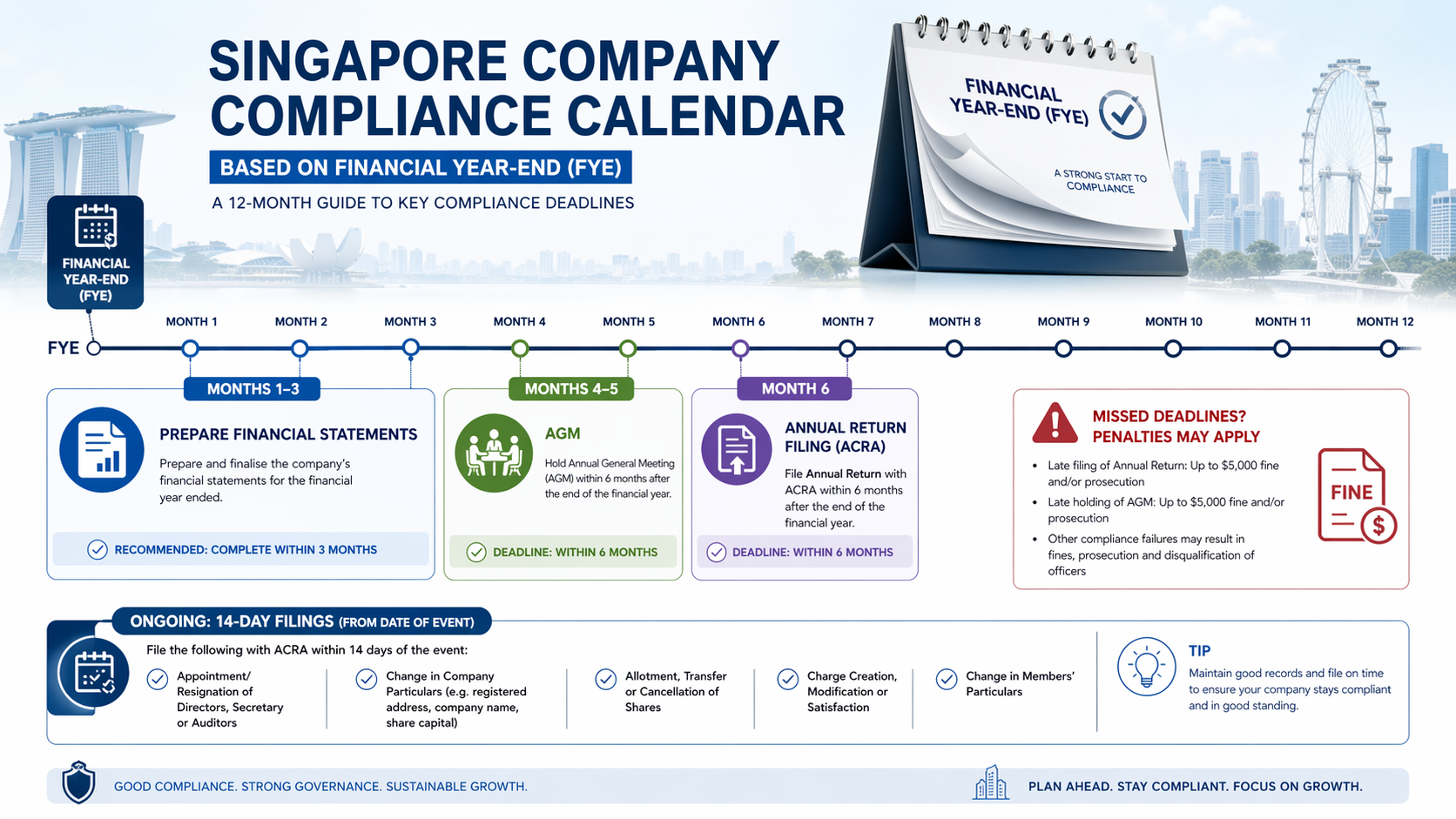
Running a Singapore company means operating within a framework of clear regulatory expectations. The Accounting and Corporate Regulatory Authority does not tolerate missed deadlines. Penalties start at SGD 300. Directors face personal liability for persistent failures. In severe cases, ACRA dissolves the company entirely.
The good news is that compliance is entirely manageable with foresight. It is not a series of surprises. It is a calendar. Your financial year-end sets the tempo. Every obligation that follows can be anticipated and prepared for. This guide is your practical tool. Share it with your team. Build your governance around it. Let us now walk through each stage.
Start with Your Financial Year-End
Your financial year-end (FYE) is the date when your accounting period closes. While December 31 is the standard choice, Singapore allows you to pick any date that fits your business cycle.
This date is the foundation of everything that follows. All deadlines are calculated forward from your FYE. Make sure everyone involved—your finance team, board, and external advisors—knows this date cold. If you need to change it later, ACRA requires formal notification. For now, treat it as your fixed starting point.
The Busy Season: Months 1 to 6 After FYE
The first six months after your books close are your most intense compliance period. Most filings happen here.
Months 1–3: Get Your Financial Statements in Order
Start the moment your accounting period ends. Gather every record. Reconcile all bank accounts. Finalize your profit and loss, balance sheet, and notes. If your company needs an audit, get your auditors engaged now. Even audit-exempt companies must prepare statements for shareholders.
Waiting until the last minute is a mistake. Rushed work leads to errors. Errors need fixing. Fixing things delays your AGM, which squeezes your Annual Return deadline. Give yourself plenty of time from the start.
Months 4–5: Hold Your AGM
Private companies must hold an Annual General Meeting within six months of FYE. Shareholders review the financials. The board may propose dividends. Directors may need re-election.
Your corporate secretarial services provider handles the details. They draft the notice, prepare resolutions, and take the minutes. These are part of your permanent record. Keep them safe.
If all shareholders agree in writing, you can skip the physical meeting. Written resolutions are just as valid and much faster. Your company secretary services advisor makes sure the paperwork is right either way.
Month 6: File Your Annual Return
This is the filing that matters most. Within one month after your AGM, submit your Annual Return through BizFile+. It covers your financial highlights, director details, shareholders, and registered address.
Filing on time costs SGD 60. Miss it, and penalties start at SGD 300 and climb. Directors can be held personally liable for repeated lateness. This is not a deadline to take lightly.
Many business owners find that professional company secretary services make this filing stress-free. A good provider checks everything, pulls it together, and files with time to spare.
The Quiet Season: Months 7 to 12 After FYE
After the Annual Return, things calm down. But do not tune out.
Use this time to keep your statutory registers current. Did you issue shares? Add a director? Change your address? Each change must be recorded and filed with ACRA within the required window.
Catch up on anything you missed earlier. Late filings carry their own penalties. Staying current is easier than catching up.
Also review your compliance setup. Are records organized? Is your team responsive? Have you set reminders for next year? Small fixes now prevent big problems later.
The 14-Day Rule: Changes That Need Immediate Filing
Some changes do not fit the AGM cycle. They must be reported right away.
Look at these examples:
- New director appointed: file within 14 days
- Director resigns: file within 14 days
- Registered address changes: file within 14 days
- Shares issued or transferred: file within 14 days
- Company name changes: file within 14 days
ACRA's systems catch late filings automatically. Each late filing carries its own penalty. When several changes happen, file each separately and quickly. Do not bundle them into one delayed submission.
Your corporate secretarial services partner should track these in real time. But directors are still responsible. Ask for confirmations. Check status. Never assume delegation means it is done.
How Professional Help Makes a Difference
Running a business and keeping up with compliance is genuinely hard. Your focus should be on customers, products, and growth. Compliance is critical, but it is not your core skill.
This is where company secretary services shine. A reliable provider watches your calendar. They draft resolutions. They make filings. They warn you before deadlines hit. You run your business without the worry.
The company secretary does more than push paper. They maintain your statutory registers, ensure your AGM and Annual Return are compliant, and advise on governance. Using professional corporate secretarial services gives you this expertise without a full-time hire.
Growth matters too. As your company expands, adds subsidiaries, or enters new markets, compliance gets more complex. A good provider grows with you. No need to find new vendors. Just adjust your service level.
Habits That Keep You Compliant
Build these into your routine.
Set calendar alerts the day your FYE closes. Mark your AGM deadline and Annual Return due date. Add two weeks of buffer time.
Turn on ACRA BizFile+ alerts. Keep your contact details current. Make sure official emails do not hit spam.
Keep a compliance folder. Store resolutions, minutes, and receipts in one place. Digital works, as long as it is organized and backed up.
Talk to your team. Align your finance person on statement timelines. Get board agreement on AGM dates early.
Review your advisors yearly. Are they proactive? Do they explain clearly? If not, make a change. Reliability beats the cheapest price.
At a Glance: December 31 FYE
For companies closing on December 31:
- January–March: Finalize financial statements
- April–May: Hold AGM or pass written resolutions
- June: File Annual Return with ACRA
- All year: Report changes within 14 days
- July–December: Update registers, plan ahead
Shift the months to match your FYE. The order stays the same.
Final Thoughts
Compliance is not glamorous. But it keeps your company in good standing. It protects you from fines. It builds trust with banks, investors, and partners.
You do not need to memorize every rule. You need a system. Know your FYE. Map your deadlines. Use professional company secretary services where you need help. Set reminders. Stay organized.
If the load feels too heavy, good corporate secretarial services Singapore can take it off your shoulders. They bring order to complexity. They make sure you hit every deadline. They free you to focus on growing your business.
Build the habit now. The benefits add up every year. Your future self will be grateful.

 English
 Arabic
 French
 Spanish
 Portuguese
 Deutsch
 Turkish
 Dutch
Dutch
 Italiano
 Romaian
 Portuguese (Brazil)