
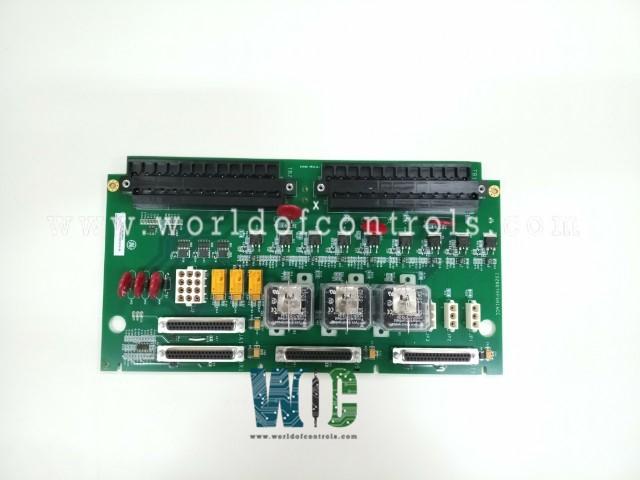
In modern industrial environments—especially in power generation, oil & gas, and heavy manufacturing—system safety is non-negotiable. Equipment operates under extreme conditions, and even minor faults can escalate into catastrophic failures if not addressed immediately. This is where primary trip protection systems play a critical role.
At the center of these safety mechanisms lies a key yet often overlooked component: the Termination Board, such as the IS200TRPSH1A – Termination Board Trip Primary. This board acts as a vital interface between field signals and control logic, ensuring that critical shutdown commands are executed without delay.
This article explores how termination boards enhance primary trip protection, improve system reliability, and contribute to overall industrial safety.
Understanding Primary Trip Protection
Primary trip protection refers to the first line of defense in safeguarding industrial equipment. It is designed to:
- Detect abnormal operating conditions (over-speed, over-temperature, pressure deviations)
- Trigger immediate shutdown procedures
- Prevent damage to critical assets such as turbines, compressors, and generators
These systems must operate with high speed, accuracy, and reliability, as delays or failures can result in equipment damage, safety hazards, or costly downtime.
What Is a Termination Board?
A termination board is a hardware module that connects field wiring—such as sensors, switches, and relays—to the control system. In the context of trip protection, it serves as the signal consolidation and distribution point for all trip-related inputs and outputs.
For example, the IS200TRPSH1A termination board is specifically designed to manage primary trip signals, ensuring they are correctly routed and processed within the control architecture.
Key Functions of the Termination Board in Trip Protection
1. Reliable Signal Interface
Termination boards provide a structured interface for connecting multiple field devices. They ensure that:
- Signals from sensors and protection devices are accurately transmitted
- Noise and interference are minimized
- Wiring errors are reduced through organized terminal layouts
This reliability is crucial for maintaining the integrity of trip signals.
2. Fast and Deterministic Signal Transmission
In a trip scenario, milliseconds matter. The termination board ensures:
- Direct and low-latency signal paths
- Immediate relay of trip conditions to the control system
- Deterministic behavior without processing delays
This enables rapid shutdown actions that prevent damage and ensure safety.
3. Signal Isolation and Protection
Industrial environments are prone to electrical noise, voltage spikes, and grounding issues. Termination boards incorporate:
- Electrical isolation
- Surge protection components
- Filtering mechanisms
These features protect both the control system and field devices while ensuring that trip signals remain unaffected by external disturbances.
4. Redundancy and Fault Tolerance
High-reliability systems often require redundancy. Advanced termination boards support:
- Dual or triple modular redundancy (TMR)
- Independent signal paths
- Fail-safe configurations
This ensures that even if one path fails, the trip function remains operational—an essential requirement for safety-critical applications.
5. Simplified Maintenance and Troubleshooting
Termination boards improve maintainability by:
- Providing clearly labeled terminals
- Allowing easy access for testing and diagnostics
- Supporting modular replacement
Technicians can quickly identify and resolve issues, reducing system downtime.
Role in Turbine and Industrial Safety Systems
In turbine control systems, termination boards like the IS200TRPSH1A are directly involved in handling signals such as:
- Emergency stop (E-Stop)
- Over-speed trip signals
- Flame detection or loss of flame conditions
- Pressure and temperature trip thresholds
By ensuring these signals are transmitted accurately and instantly, the termination board becomes a critical safety enabler within the overall protection system.
Enhancing System Reliability and Performance
The integration of a high-quality termination board contributes to:
- Improved system uptime through reliable signal handling
- Reduced false trips due to noise filtering and signal integrity
- Enhanced safety compliance with industry standards
- Lower maintenance costs due to modular design and easier diagnostics
In essence, the termination board strengthens both operational efficiency and risk mitigation strategies.
Best Practices for Implementation
To maximize the effectiveness of termination boards in trip protection systems:
- Use high-quality, certified components
- Ensure proper grounding and shielding
- Follow manufacturer wiring guidelines
- Regularly inspect and test connections
- Implement redundancy where required
These practices help maintain optimal performance and long-term reliability.
Conclusion
While often operating behind the scenes, termination boards are indispensable to the success of primary trip protection systems. Devices like the IS200TRPSH1A – Termination Board Trip Primary ensure that critical safety signals are transmitted quickly, accurately, and reliably.
By enhancing signal integrity, enabling rapid response, and supporting fault-tolerant designs, termination boards play a pivotal role in protecting industrial assets and ensuring safe operations.
In high-stakes environments where failure is not an option, investing in robust termination board solutions is not just beneficial—it is essential.
Check Also - IS200ERDDH1A - DYNAMICS DISCHARGE GE BOARD

 English
 Arabic
 French
 Portuguese
 Deutsch
 Turkish
 Dutch
Dutch
 Italiano
 Russian
 Romaian
 Portuguese (Brazil)