
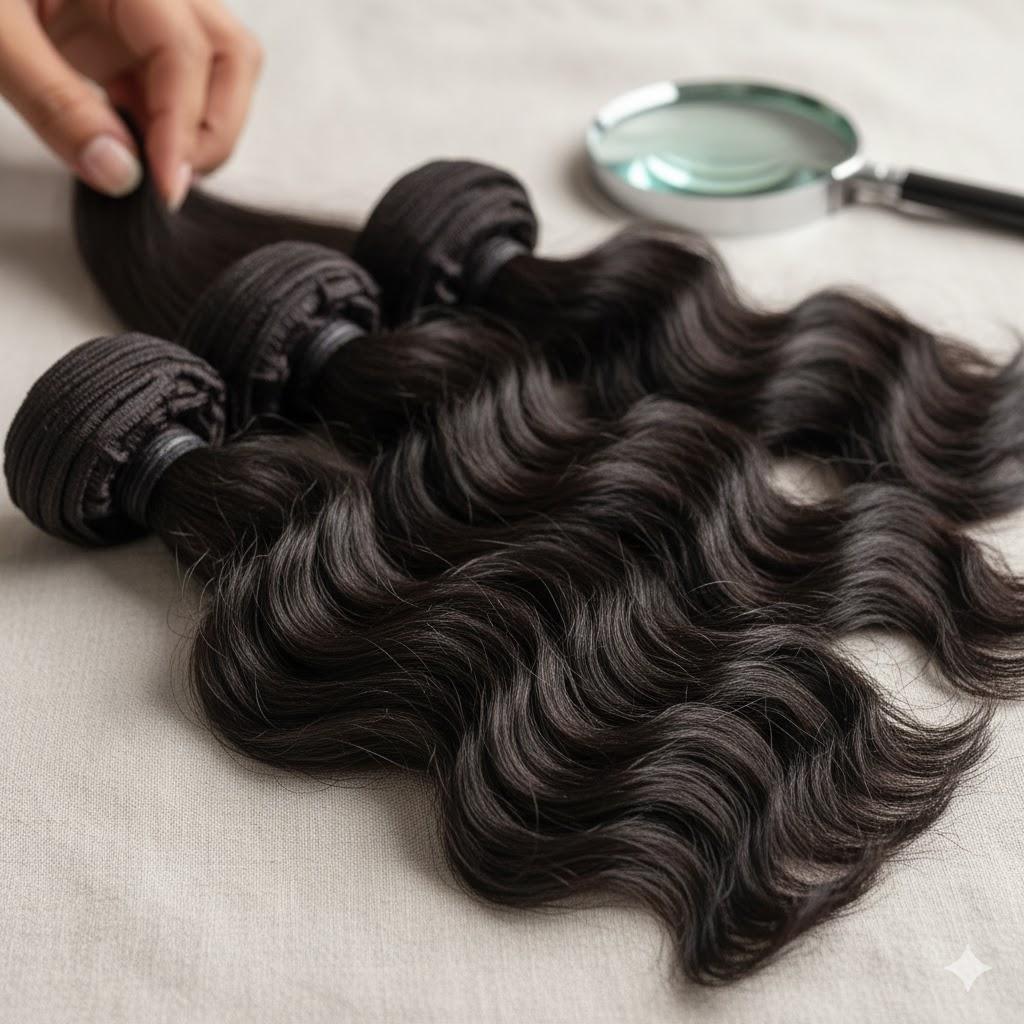
The hair extension industry is a multi-billion dollar world where every vendor claims to offer "100% human hair" or "Grade 12A quality." However, if you have been in the hair game for a while, you know that marketing labels can be incredibly deceptive. The market is currently flooded with hair that has been chemically stripped, coated in silicone, or mixed with synthetic fibers—all while carrying a premium price tag.
Indian Hair Extensions are globally recognized as the gold standard for luxury. Sourced primarily from temples in South India, this hair is coveted for its strength, natural luster, and ability to blend with almost any ethnicity. But how do you separate the authentic gems from the factory-processed fakes?
To ensure your investment lasts for years rather than weeks, you need to look beyond the packaging. Here is your definitive guide on how to spot high-quality Indian Hair Extensions in today’s crowded market.
1. The "A-Grade" Myth: Ignore the Numbers
The first step in spotting quality is unlearning a common marketing tactic. You have likely seen hair labeled as 8A, 10A, or even 12A.
In the world of authentic Indian Hair Extensions, these grading systems do not exist. They are arbitrary numbers created by factories to make processed hair sound premium. Authentic, high-quality Indian hair is usually categorized by its source: Raw or Virgin Remy. If a vendor is pushing "Grade 10A" hair, it is a red flag that the hair has likely been mass-produced in a factory and chemically treated to look uniform.
2. The Smell and Texture Test
Your senses are your best tools when evaluating hair. High-quality Indian Hair Extensions should look and feel like "real" hair, not a manufactured product.
-
The Smell: Open the bundle and take a sniff. Authentic raw Indian hair should smell like… well, hair. It might have a faint scent of clean shampoo or nothing at all. If the hair has a strong, corn-chip-like smell or a harsh chemical odor, it has likely undergone an acid bath to strip the cuticles or has been treated with heavy perming chemicals.
-
The Texture: Run your fingers through the hair. Genuine Indian hair has a distinct "natural" feel. It should have a slight coarseness or "grip" to it. If the hair feels unnaturally slippery or "plastic-smooth," it is almost certainly coated in silicone. While silicone makes hair look great in the package, it will wash off after one or two shampoos, leaving you with dry, tangled hair.
3. Look for Natural Color Variations
Nature is rarely uniform. Because authentic Indian Hair Extensions are sourced from individual donors, each bundle should have its own personality.
When looking at a set of bundles, they should not be identical in color. Even "Natural Black" (1B) hair will have subtle variations—some strands might be lighter brown, while others are darker. You might even find a stray grey hair or two.
If every bundle is a perfect, flat, jet-black color with no variation, it has likely been dyed in a factory. While this isn't always a dealbreaker, it means the hair is no longer "raw," and its lifespan may be shorter because of the chemical processing.
4. The "Friction" Test for Cuticle Alignment
The hallmark of high-quality Indian Hair Extensions is that they are "Remy," meaning the cuticles are intact and all facing the same direction. When cuticles are misaligned, they hook into each other like Velcro, causing catastrophic matting.
How to test it:
-
Take a small section of hair.
-
Slide your fingers down the hair shaft (from top to bottom). It should feel smooth.
-
Now, slide your fingers up the hair shaft (from bottom to top).
-
You should feel a slight bit of resistance or a "raspy" feeling. That resistance is the cuticle.
If the hair feels perfectly smooth in both directions, the cuticles have likely been stripped away in an acid bath. This hair will look shiny initially but will become a tangled mess the moment you get it wet or try to style it.
5. The Burn Test: Detecting Synthetics
In a crowded market, some vendors mix human hair with synthetic "filler" fibers to cut costs. You can’t always see these fibers, but you can definitely smell them if you test them.
If you have already purchased the hair, take a few strands from the bottom and light them with a lighter.
-
Human Hair: It will burn upward, smell like burning feathers or sulfur, and turn into a fine, black ash that crumbles when touched.
-
Synthetic Hair: It will melt into a hard, plastic bead, smell like burning plastic, and may produce black smoke.
Authentic Indian Hair Extensions will always pass the burn test with 100% ash.
6. Observe the Hair's Behavior After Washing
The true test of quality happens in the shower. High-quality Indian Hair Extensions will transform when wet.
Processed hair often loses its "look" after the first wash. If you bought "wavy" hair and it turns straight and frizzy after a wash, the wave was likely a temporary steam-set or chemical perm.
Genuine raw Indian hair has a "natural memory." If it’s naturally wavy, it will revert to that beautiful, soft wave every time it air-dries. It should also expand slightly and look more voluminous once the factory "packaging" look is washed away. If the hair becomes "mushy" or excessively tangled when wet, it’s a sign of poor quality or damaged cuticles.
7. The Price Point vs. The Source
We all love a good deal, but when it comes to Indian Hair Extensions, you truly get what you pay for.
Authentic Indian hair is ethically sourced from temples through a competitive auction process. It is then hand-cleaned and wefted. This labor-intensive process means the hair cannot be sold for "budget" prices. If a vendor is offering a full set of 24-inch Indian hair for the price of a dinner for two, it is almost certainly a blend of low-quality hair or synthetic fibers.
Check the vendor’s transparency. Do they know which temple the hair came from? Do they show videos of the raw, unwashed bundles? Authentic vendors are usually proud to show the "raw" side of their business.
Conclusion: Trust Your Instincts
Spotting high-quality Indian Hair Extensions is about looking for the "perfectly imperfect." Look for the natural color shifts, the slightly coarse texture, and the intact cuticles that provide that famous Indian hair bounce. By avoiding the "12A" marketing traps and using the tests mentioned above, you can ensure that your hair isn't just a temporary fix, but a long-term investment in your beauty.
Quality hair doesn't just look better; it behaves better, styles easier, and lasts longer. Don't be afraid to ask questions, request videos, or perform a strand test. Your hair is an investment make sure it’s a genuine one.

 English
 French
 Spanish
 Portuguese
 Deutsch
 Turkish
 Dutch
Dutch
 Italiano
 Russian
 Romaian
 Portuguese (Brazil)