
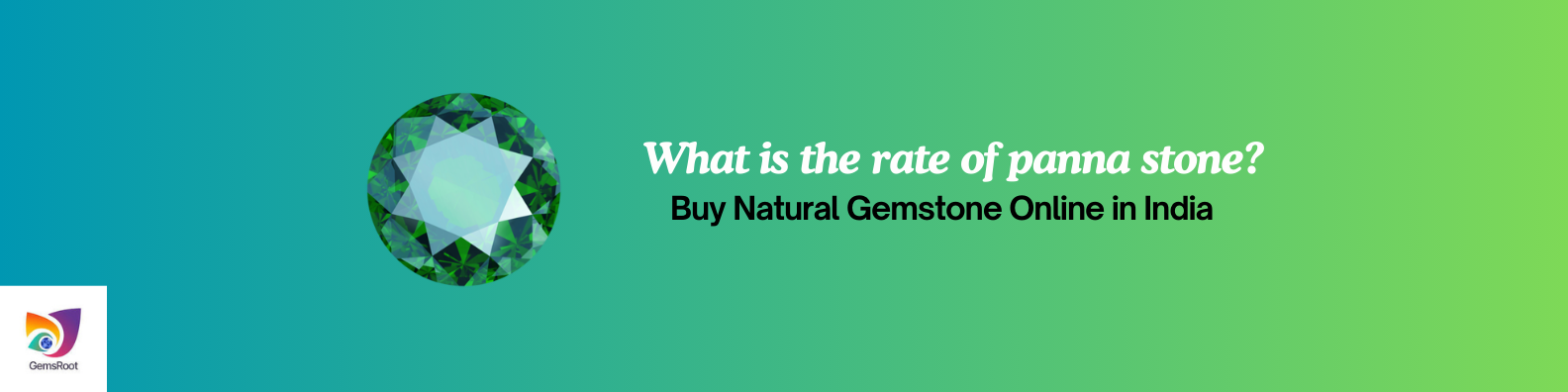
What is “Panna Stone”
“Panna stone” is the Hindi/Urdu/common-Indian term for what is internationally known as an emerald. It belongs to the beryl family (chemical formula roughly Be₃Al₂(SiO₃)₆, with traces of chromium or vanadium giving the green colour).
Emeralds typically range from bluish-green to deep verdant green; the most coveted are those with a vivid, even green color and good transparency. Natural inclusions (so-called “jardin”) are common — and are part of what makes emeralds unique.
Because of their vivid green hue, symbolic associations (in Indian culture, linked to planet Mercury / “Budh”), astrological value, and long history, panna stones remain among the most cherished gemstones in India and globally.
What is the Usual Rate of Panna Stone in India
When people talk about “rate of panna stone,” they usually refer to price per unit weight — either per carat or per ratti (traditional Indian subunit; 1 ratti ≈ 0.20 carat ≈ 180 mg).
Here’s a breakdown of typical panna stone price ranges (as of recent market listings):
-
Low-grade or small-size stones may start from as low as ≈ ₹800–₹1,000 per carat.
-
Mid-quality stones generally fall in the range of ₹2,000 to ₹40,000 per carat, depending on clarity, colour, cut, and size.
-
High-quality, well-coloured, transparent stones — especially large carat weight, fine cut, good clarity — can command ₹1,00,000 to ₹2,00,000 (or more) per carat.
-
Converting to ratti: some sellers list panna stone prices as ₹450 – ₹41,000 per ratti, with lower-quality variants sometimes as cheap as ~₹200 per ratti.
To illustrate with examples, some online listings show a Zambian emerald of ~9.15 carat priced at about ₹38,999 total (which works out to around ₹4,260 per carat).
Given the wide range — from a few hundred rupees to lakhs per carat — the variation is large and strongly dependent on quality factors (clarity, colour, cut, origin, size).
Why Panna Stone Price Varies So Much
The large variation in panna stone (emerald) pricing stems mainly from these factors:
-
Colour: The richest, vivid and evenly saturated green shades with minimal yellow or bluish tint are the most valuable. Stones with pale or uneven green shades are less desirable and cheaper.
-
Clarity & Inclusions (Internal Features): Unlike many other gemstones, emeralds often have natural inclusions (termed “jardin”). A cleaner stone (with fewer visible inclusions and better transparency) commands a much higher price.
-
Cut and Finish: A well-cut, skillfully faceted emerald — even if small — will be more expensive than a poorly cut but slightly larger stone. Cutting green beryl is tricky because of natural fissures; finer cutting means loss of material and high craftsmanship which adds to cost.
-
Carat Weight (Size): Larger stones are rarer and exponentially more valued per carat compared to smaller ones, assuming similar quality.
-
Origin: Stones from reputed origins (Colombia, Zambia, Brazil, etc.) often command premium price — though ultimately quality (color + clarity) matters more than just origin.
-
Treatment / Enhancement: Many emeralds are treated (e.g., oiling fissures) — untreated natural stones with strong colour and clarity are rarer and thus costlier.
Because of these multiple variables, two emeralds of the same carat weight can have drastically different prices depending on their individual characteristics.
Buying Panna Stone Online — What to Know
If you are looking to buy gemstone online, especially panna stone (emerald), keep these points in mind:
-
Price per carat/ratti is only a starting point. Always check colour, clarity, cut, origin, weight — these greatly affect actual value.
-
Prefer vendors who provide clear photos and certifications (or lab reports). Due to natural inclusions and treatments in emeralds, ensuring authenticity and transparency is vital.
-
For astrological/vedic use, sometimes “astral suitability” (color tone, weight, metaphysical quality) matters more than pure clarity, so consult an expert if that’s your goal.
-
Compare per-carat price across multiple sizes — sometimes a small stone is deceptively cheap because of poor quality; a bigger but better stone may cost more overall but be better value per clarity/beauty.
-
Be aware that large, high-quality emeralds are rare — high price for such gems is the norm, and “bargain” emeralds are often lower-grade or treated.
Many Indian gemstone sellers list panna stone with a wide range of rates — making it possible to find something for modest jewelry, or splurge on a top-quality gem.
Why to Buy Emerald (Panna) from GemsRoot
If you are considering buying emerald/panna online, GemsRoot stands out for a few good reasons: they offer a broad range of “natural” panna stones across quality levels, often with transparent pricing (from low-cost to high-end).
Their inventory allows buyers with different budgets to explore — whether you want an affordable stone for jewellery or a premium one for investment/astrology. Also, because they emphasise natural stones (rather than cheap treated ones), you have a better chance of getting a piece that retains value and beauty over time.
Summary
In short: the “rate of panna stone” in India is very variable — from a few hundred rupees per carat/ratti in lower-quality stones to ₹1–2 lakh (or more) per carat for top-quality emeralds. The actual price depends heavily on colour, clarity, cut, carat weight, origin, and whether the gemstone is treated or natural. If you plan to buy gemstone online, you must check quality details carefully, and choose reputable sellers with transparent certifications.
Finally, buying from a seller like GemsRoot makes sense because they offer a wide range of panna stones, from budget-friendly to premium quality, with reasonable transparency — which helps you pick what’s truly worth your money and purpose.

 English
 Arabic
 French
 Spanish
 Portuguese
 Deutsch
 Turkish
 Dutch
Dutch
 Italiano
 Russian
 Romaian