
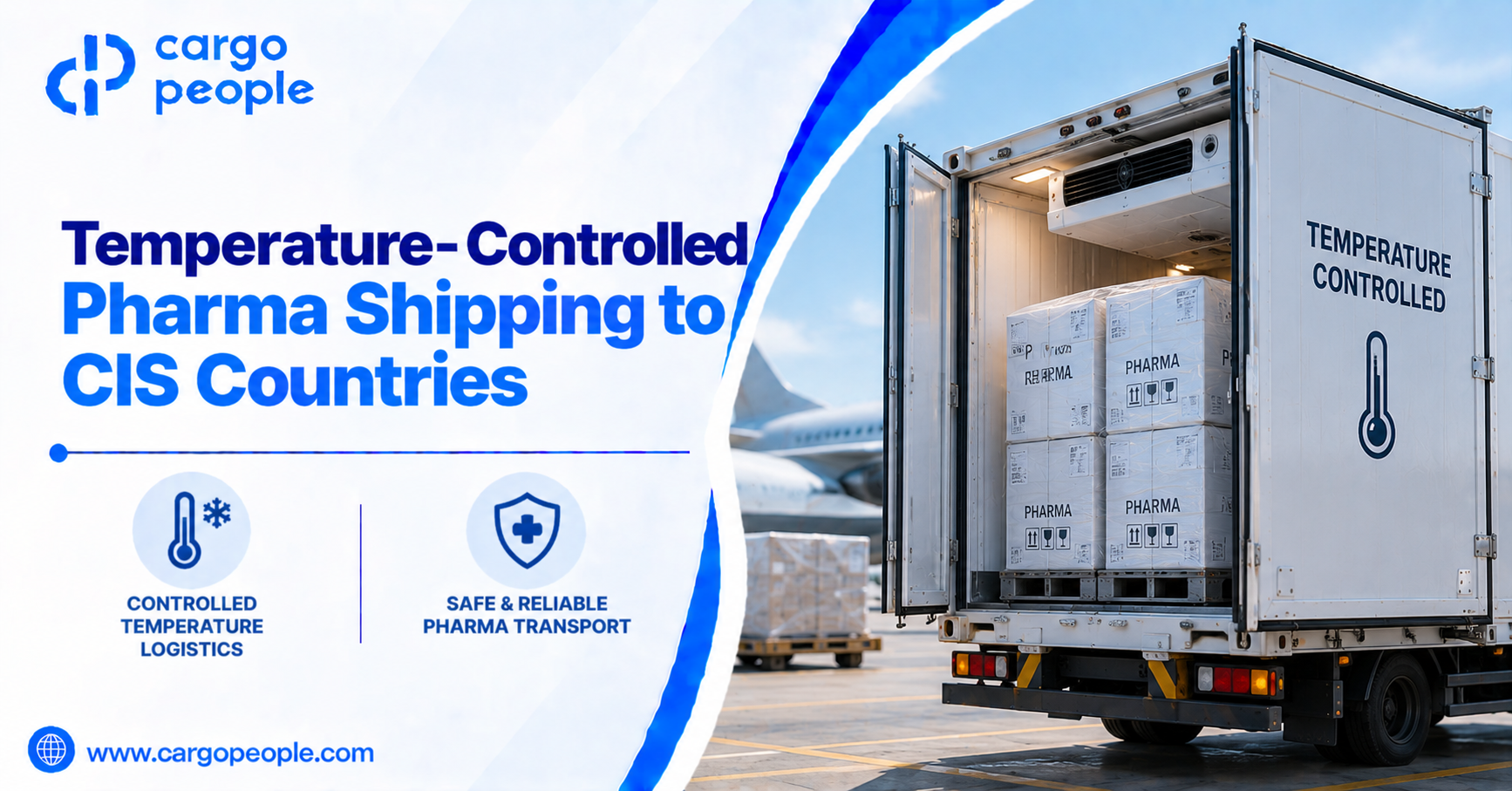
Shipping pharmaceutical products from India to CIS countries requires much tighter logistics control than transporting ordinary commercial cargo. Medicines, vaccines, APIs, diagnostic products, biologics, and other healthcare products may lose quality if they are exposed to temperatures outside their approved storage range during transportation.
Temperature-Controlled Pharma Shipping to CIS Countries therefore requires planning across the complete logistics journey - from pickup at the manufacturing facility in India to airport handling, international air freight, transit connections, customs clearance, temporary storage, and final delivery to the distributor or consignee.
Cargo People Logistics & Shipping Pvt. Ltd. supports pharmaceutical manufacturers, exporters, distributors, and healthcare businesses with temperature-sensitive air freight, cold-chain coordination, customs support, cargo insurance, and door-to-door logistics from India to markets including Russia, Kazakhstan, Uzbekistan, Belarus, Armenia, Kyrgyzstan, and other CIS and Eurasian destinations.
What is Temperature-Controlled Pharma Shipping?
Temperature-controlled pharma shipping is the transportation of pharmaceutical products while maintaining the temperature conditions specified for the product throughout the logistics journey.
Different pharmaceutical products can have very different requirements. Some medicines may move under controlled ambient conditions, while certain vaccines, biologics, diagnostic materials, and other sensitive products may require refrigerated or frozen transportation.
For example, some pharmaceutical products require transportation within 2°C to 8°C, but this range should never be assumed for every shipment. The correct temperature range must come from the manufacturer's approved storage and transportation requirements.
IATA's Temperature Control Regulations cover areas such as packaging, documentation, handling, traceability, transport conditions, critical control points, and temperature management for healthcare cargo.
Why Pharma Shipping to CIS Countries Needs Special Planning
A pharmaceutical shipment may travel through several different environments before reaching the final consignee.
Cargo can move from an Indian factory to an airport warehouse, remain inside a cargo terminal, travel on an aircraft, pass through a transit airport, enter another warehouse, go through customs clearance, and finally travel by road to the consignee.
Every transfer creates another point where the temperature and handling conditions need to be controlled.
This is particularly important for CIS routes because the final destination may be located several hundred kilometres from the arrival airport. The freight plan should therefore consider the complete door-to-door transportation time rather than only the scheduled flight duration.
Temperature Ranges for Pharmaceutical Cargo
Temperature requirements vary according to the medicine, formulation, stability profile, and manufacturer's specifications.
Common transportation categories may include controlled ambient products, refrigerated products, frozen pharmaceutical cargo, and products requiring another specifically validated temperature range.
The freight forwarder should receive the exact transport temperature before selecting packaging or routing.
For example, a shipment approved for 2°C to 8°C transportation may require a very different packaging system from a product that needs controlled ambient handling.
A temperature assumption made during booking can result in the wrong packaging, storage, or handling arrangement. The manufacturer's documented transport conditions should therefore be the starting point for the logistics plan.
Air Freight for Pharma Shipping to CIS Countries
Air freight is commonly used for temperature-sensitive pharmaceutical shipments because it reduces the international transportation time compared with longer surface or sea freight routes.
Indian pharma cargo can originate from manufacturing hubs such as Hyderabad, Ahmedabad, Mumbai, Pune, Bengaluru, Delhi NCR, and other pharmaceutical centres before moving through an international airport.
The most suitable flight should not be selected only according to freight price.
The logistics team should compare total transit time, number of flight connections, airline handling capabilities, airport storage arrangements, connection time, destination customs requirements, and final delivery location.
For temperature-sensitive pharma cargo, fewer uncontrolled handling stages can be more important than saving a small amount on the freight rate.
Direct Flight vs Connecting Route
A direct flight is not always available for every CIS destination. Some shipments may need to move through one or more international transit hubs before reaching the destination country.
Every additional connection increases handling.
Cargo may need to be unloaded, moved between airport facilities, temporarily stored, and loaded onto another aircraft. This creates additional temperature-control and operational risk.
For sensitive pharmaceutical products, exporters should compare a lower-cost multi-connection route against a potentially faster route with fewer handovers.
The route decision should consider product stability, packaging duration, customs readiness, and total delivery time.
Passive Packaging for Pharma Cargo
Passive temperature-controlled packaging uses insulated packaging materials and cooling components to maintain the required temperature range without an externally powered refrigeration system.
Depending on the product and validated packaging design, the system may use insulated boxes, phase-change materials, gel packs, dry ice where appropriate, thermal insulation, or other components.
Passive packaging can be suitable for smaller shipments, but it must be selected according to the expected transportation duration.
For example, if a packaging system has been validated for 72 hours, the shipment plan should provide sufficient buffer for pickup, airport handling, flight delays, transit connections, customs clearance, and final delivery.
The packaging duration should therefore be compared with the complete logistics timeline rather than only flight time.
Active Temperature-Controlled Containers
High-value or highly sensitive pharmaceutical shipments may use active temperature-controlled containers.
These systems can actively maintain a defined internal temperature using powered temperature-management technology rather than relying only on pre-conditioned cooling materials.
Active containers can be particularly useful for larger or highly sensitive shipments, but they require advance booking, airline acceptance, equipment availability, charging or handling arrangements, and proper coordination at the origin and destination.
The correct solution depends on the shipment volume, product value, temperature range, route, and risk profile.
A high-cost active solution is not automatically required for every pharma shipment, just as a basic passive box may not be sufficient for every product.
Temperature Data Loggers
Temperature data loggers can record the conditions experienced by pharmaceutical cargo during transportation.
For sensitive shipments, this provides an important record showing whether the product remained within the required temperature range throughout the journey.
Data logger planning should happen before packing.
Businesses should decide the number of devices required, their location within the shipment, recording interval, temperature range, activation method, and who will retrieve the data after delivery.
IATA also provides guidance on the use of cargo tracking devices and temperature data loggers in air cargo, including devices powered by lithium batteries.
Critical Control Points in Pharma Logistics
A shipment can remain protected during the flight but experience a temperature excursion while waiting on the ground.
Critical control points can occur during manufacturer pickup, airport acceptance, security screening, warehouse storage, aircraft loading, flight connections, destination handling, customs inspection, and final road transportation.
These periods should be identified before the shipment begins.
IATA's pharma handling framework specifically emphasises critical control points, route-risk assessment, packaging technologies, temperature management, SOPs, and handling procedures for time- and temperature-sensitive healthcare shipments.
For exporters, this means cold-chain planning should extend beyond the aircraft itself.
Documents for Pharma Export from India to CIS Countries
Pharmaceutical exports usually require commercial, customs, shipping, and product-related documentation.
The exact documents vary according to the product and destination country, but a shipment may require:
- Commercial Invoice
- Packing List
- Shipping Bill
- Air Waybill
- Certificate of Origin where applicable
- Certificate of Analysis where applicable
- Batch details
- Product registration documents
- Import permission where required
- Temperature-handling instructions
- Product-specific regulatory documentation
Destination requirements should be confirmed by the consignee before shipment because rules can differ between Russia, Kazakhstan, Uzbekistan, and other CIS markets.
A document accepted for one destination should not automatically be assumed to satisfy another country's requirements.
Customs Clearance for Temperature-Sensitive Pharma
Customs clearance is a particularly important stage when the product has a limited validated transportation window.
A shipment may successfully complete international air freight but still face temperature risk if it remains in destination customs or airport storage longer than planned.
The consignee should therefore prepare the customs file before the cargo arrives.
Commercial documents should clearly describe the pharmaceutical product, quantity, value, HS Code, manufacturer information, and other required details. Product registrations, import permissions, and other destination-side documents should also be ready before dispatch.
Customs readiness is therefore part of cold-chain planning, not simply an administrative step after arrival.
Temperature-Controlled Pharma Shipping to Russia
Russia is an important destination for Indian pharmaceutical exports and can require careful route and final-delivery planning.
Cargo may move by air to a major gateway and then continue by road to a distributor, warehouse, healthcare company, or another destination.
For temperature-sensitive products, the final road journey should receive the same attention as the international flight.
The exporter should confirm whether temperature-controlled transportation and suitable warehouse handling are available after customs clearance.
Seasonal weather conditions should also be considered because extreme cold can be just as relevant as excessive heat for products that must remain within a defined temperature range.
Temperature-Controlled Pharma Shipping to Kazakhstan
Pharmaceutical shipments to Kazakhstan may involve air freight followed by domestic road transportation depending on the consignee's location.
If the destination is outside the main arrival city, the final road movement can add several hours or more to the overall logistics timeline.
This additional time should be included when evaluating packaging duration.
A passive packaging solution should not be selected based only on India-to-airport transit. The complete journey through customs and onward delivery should fit within the validated performance of the packaging system.
Temperature-Controlled Pharma Shipping to Uzbekistan
Uzbekistan is another market where Indian pharmaceutical exporters may need reliable air freight and final-mile coordination.
Before dispatch, the exporter should confirm destination product documentation, importer readiness, expected customs procedure, and the location of the final delivery point.
For temperature-sensitive cargo, the logistics plan should also confirm what happens immediately after the cargo is released from customs.
If refrigerated or controlled transportation is required, the vehicle should be ready when the shipment becomes available instead of being arranged only after clearance.
This reduces unnecessary waiting at the destination airport.
APIs and Pharmaceutical Raw Materials
Temperature-controlled pharma logistics is not limited to finished medicines.
Certain APIs, pharmaceutical ingredients, diagnostic materials, intermediates, and healthcare products may also require defined storage or transportation conditions.
The exporter should provide the freight forwarder with the exact cargo name, number of packages, gross weight, dimensions, storage conditions, packaging configuration, and applicable safety information.
For example, an API shipment packed in 25 drums may require a different handling plan from 10 insulated boxes containing temperature-sensitive finished medicines.
The transport solution should always follow the actual cargo profile.
Pharma Shipping During Extreme Winter
Several CIS destinations can experience very low temperatures during winter.
This creates an important but sometimes overlooked cold-chain risk.
Exporters often focus on preventing cargo from becoming too warm, but some pharmaceutical products can also be damaged if temperatures fall below their permitted range.
Exposure can occur during aircraft loading, unloading, warehouse transfers, customs examination, or final road transportation.
The logistics team should therefore understand both the maximum and minimum temperature limits of the product and select packaging that provides protection against the expected seasonal conditions.
Pharma Shipping During Summer
High summer temperatures can create the opposite challenge.
Cargo may be exposed to heat during factory pickup, airport transportation, ramp handling, transit connections, or final delivery.
Even a short period on an airport apron can be important for a highly temperature-sensitive product.
The transport plan should therefore identify where the cargo could leave temperature-controlled storage and how long those periods might last.
Thermal covers, validated packaging, pre-conditioned cooling materials, and suitable airport handling can all form part of the risk-control strategy depending on the product.
Time and Temperature-Sensitive Labelling
Correct shipment labelling helps handlers identify pharmaceutical cargo that requires special treatment.
IATA specifies a Time and Temperature Sensitive Label for healthcare shipments booked as time- and temperature-sensitive cargo. The label identifies the external transportation temperature range and is part of IATA's healthcare cargo handling framework.
However, a label alone does not create temperature control.
The shipment still needs appropriate packaging, booking instructions, airline acceptance, warehouse handling, and destination arrangements.
Labels should therefore support a complete cold-chain process rather than replace it.
Pharma Cargo Insurance
Temperature-controlled pharmaceutical shipments can have a high commercial value even when they occupy relatively little cargo space.
A few pallets of specialised medicines, biologics, vaccines, APIs, or diagnostic products can represent several lakh or crores of rupees in inventory.
Businesses should therefore consider cargo insurance as part of the logistics plan.
The shipper should accurately disclose the nature and value of the cargo and understand the policy terms, conditions, exclusions, and coverage.
Insurance does not replace appropriate cold-chain management, but it can help reduce financial exposure to covered transit risks.
What Happens During a Temperature Excursion?
A temperature excursion occurs when a product is exposed to conditions outside its approved transportation or storage range.
If a data logger indicates an excursion, the shipment should not automatically be considered usable or unusable solely based on the logistics team's opinion.
The manufacturer or appropriate quality team normally needs to review the temperature data, duration of exposure, product stability information, and applicable procedures before determining the product disposition.
This is another reason why accurate temperature monitoring and shipment records are important.
A complete record provides the quality team with better information for assessment if an unexpected event occurs.
Common Cold-Chain Shipping Mistakes
One of the most common mistakes is selecting packaging only according to the scheduled flight duration. A 7-hour flight does not mean the complete logistics journey lasts 7 hours.
Pickup, airport handling, customs procedures, connections, weekends, and final delivery can significantly increase the actual transportation time.
Another mistake is choosing the cheapest routing without analysing transfer points. Multiple connections may add handling and increase the possibility of delay.
Exporters should also avoid incomplete temperature instructions, destination documentation that is not ready, missing data loggers, insufficient packaging buffer, and poor final-mile coordination.
Cold-chain logistics should be planned from factory pickup to consignee delivery.
How to Plan Temperature-Controlled Pharma Shipping to CIS Countries
The logistics team should receive complete information before preparing the final freight route and quotation.
Exporters should confirm:
- Exact pharmaceutical product
- Approved transportation temperature
- Number of packages
- Gross weight and dimensions
- Shipment value
- Packaging configuration
- Required packaging duration
- Pickup location in India
- Destination country and city
- Product documentation
- Import permissions where applicable
- Required delivery timeline
Once these details are available, the freight forwarder can evaluate routing, airline handling, packaging, monitoring, customs coordination, and final-mile requirements more accurately.
Why Choose Cargo People for Temperature-Controlled Pharma Shipping?
Cargo People Logistics & Shipping Pvt. Ltd. supports pharmaceutical manufacturers, exporters, distributors, and trading businesses with international pharma logistics from India to CIS and Central Asian markets.
Our services include temperature-sensitive air freight, pharma cargo coordination, cold-chain handling, customs support, cargo insurance coordination, warehousing, and door-to-door international delivery.
Cargo People can coordinate shipments from pharmaceutical manufacturing facilities in India through international transportation and onward to consignees in Russia, Kazakhstan, Uzbekistan, and other CIS markets.
Our focus is to connect pickup, temperature requirements, packaging, air freight, customs coordination, monitoring, and final delivery through one structured logistics process.
Learn More About Temperature-Controlled Pharma Shipping to CIS Countries
Planning to export medicines, APIs, biologics, diagnostic products, healthcare supplies, or other temperature-sensitive pharmaceutical cargo from India to CIS countries?
The process should begin with product temperature requirements, packaging validation, route planning, documentation, customs readiness, monitoring, and final-mile delivery arrangements.
Cargo People Logistics & Shipping Pvt. Ltd. can support businesses with pharmaceutical air freight, temperature-controlled cargo coordination, customs support, cargo insurance, and door-to-door logistics from India to CIS markets.
👉 https://cargopeople.com/blog/temperature-controlled-pharma-shipping-cis-countries/
📞 Get Expert Assistance for Temperature-Controlled Pharma Shipping
If you are looking for Temperature-Controlled Pharma Shipping to CIS Countries or need support with pharma air freight, cold-chain cargo, APIs, temperature monitoring, customs coordination, cargo insurance, or door-to-door delivery, Cargo People Logistics & Shipping Pvt. Ltd. can help coordinate the complete shipment.
🌐 Website: https://www.cargopeople.com/
📞 Phone: +91 97174 65454
📧 Email: wecare@cargopeople.com

 English
 Arabic
 French
 Spanish
 Portuguese
 Turkish
 Dutch
Dutch
 Italiano
 Russian
 Romaian
 Portuguese (Brazil)