
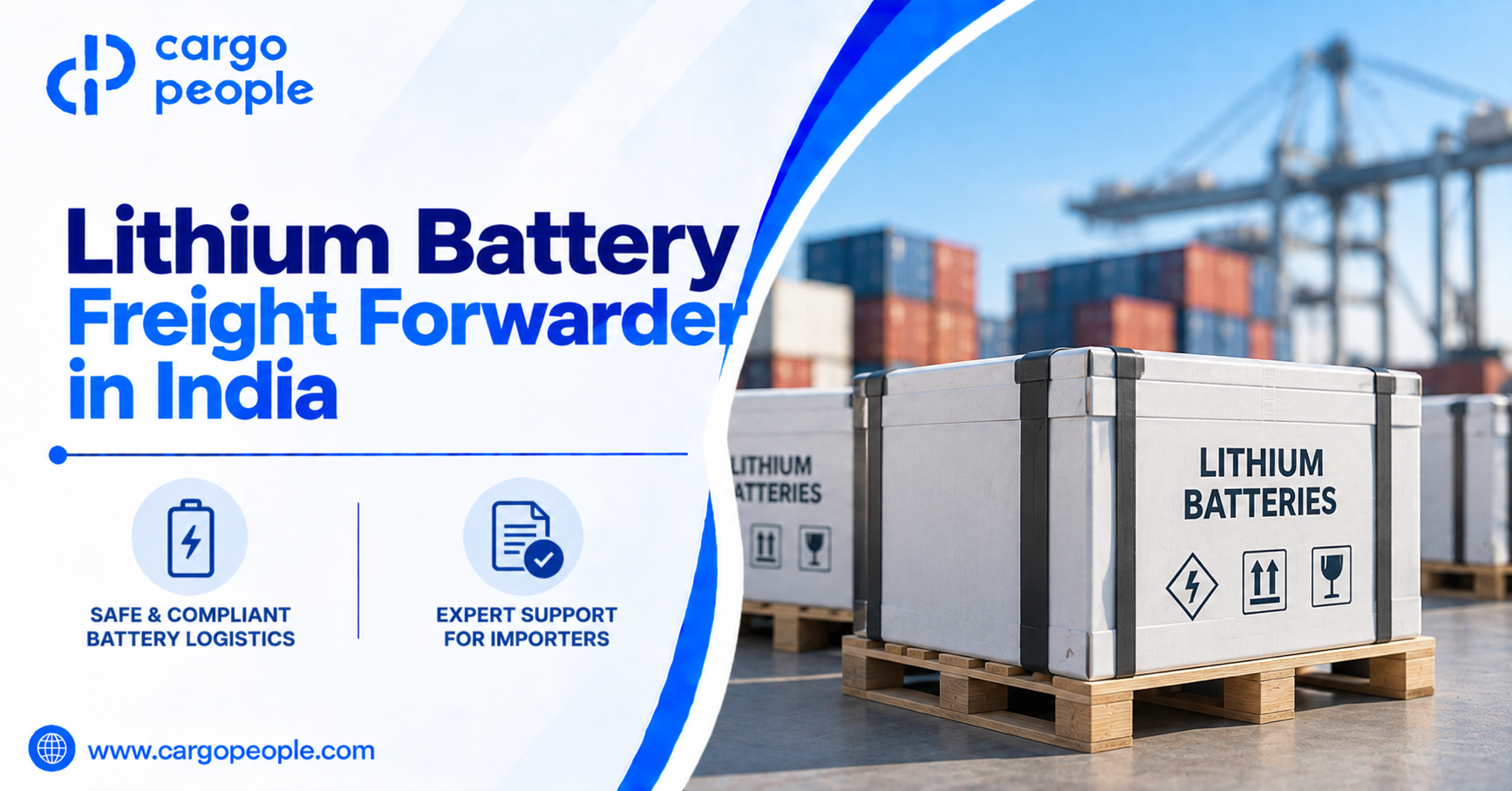
Importing or exporting lithium-ion batteries requires much more planning than moving ordinary commercial cargo. Lithium batteries are treated as dangerous goods during international transportation because damaged, defective, incorrectly packed, or short-circuited batteries can create serious fire and thermal risks.
A reliable Lithium Battery Freight Forwarder in India helps businesses coordinate battery classification, dangerous goods documentation, packaging requirements, carrier acceptance, air or sea freight, customs clearance, warehousing, and final delivery.
This is particularly important for companies dealing with lithium-ion cells, EV battery packs, energy storage system batteries, electronics batteries, power-tool batteries, industrial batteries, and equipment containing lithium cells.
Cargo People Logistics & Shipping Pvt. Ltd. supports manufacturers, importers, distributors, traders, and corporate businesses with lithium battery freight forwarding, DG cargo handling, air freight, sea freight, customs clearance, warehousing, cargo insurance coordination, and door-to-door delivery.
Why Lithium Battery Freight Forwarding Needs Special Expertise
Lithium batteries cannot simply be packed into cartons and handed over to an airline or shipping line like general cargo. The transport requirements depend on battery chemistry, configuration, Watt-hour rating, quantity, packaging, whether the batteries are standalone or packed with equipment, and the chosen transport mode.
The freight forwarder should receive accurate battery information before providing the final shipping plan. If important details are discovered only after cargo reaches an airport, port, or consolidation warehouse, the shipment may be rejected or require repacking.
For this reason, lithium battery logistics should begin with technical cargo review rather than only freight-rate comparison.
UN 3480 and UN 3481 Classification
Correct UN classification is one of the first requirements when shipping lithium-ion batteries.
Standalone lithium-ion cells and batteries are generally transported under UN 3480, while lithium-ion batteries packed with equipment or contained in equipment fall under UN 3481.
The distinction affects packing instructions, airline acceptance, marking, documentation, and other transportation requirements. IATA's 2026 lithium battery guidance provides separate requirements for standalone batteries, batteries packed with equipment, and batteries contained in equipment.
An importer should therefore tell the freight forwarder exactly how the battery is being shipped rather than simply stating that the cargo contains "lithium batteries."
Air Freight for Lithium Batteries
Air freight is commonly considered when batteries are high-value, urgently required, or moving in smaller commercial quantities. However, airline dangerous goods requirements can be strict, and carrier acceptance should be confirmed before the supplier dispatches the shipment.
Standalone UN 3480 lithium-ion batteries cannot normally travel as cargo on passenger aircraft and are subject to Cargo Aircraft Only requirements under the applicable IATA framework.
The 2026 IATA guidance also includes important state-of-charge requirements. For example, lithium-ion batteries shipped under certain packing instructions must generally be offered for air transportation at a state of charge not exceeding 30% of rated capacity unless the relevant approvals or exceptions apply.
Businesses should therefore confirm battery configuration and state of charge with the supplier before booking air freight.
Sea Freight for Lithium Batteries
Sea freight is often more suitable for larger lithium battery shipments where the delivery timeline allows a longer transit period.
Commercial quantities of cells, battery packs, industrial batteries, and energy-storage products can be transported by sea subject to the applicable dangerous goods requirements and carrier acceptance.
The International Maritime Dangerous Goods Code governs the carriage of packaged dangerous goods by sea. The 2024 edition incorporating Amendment 42-24 became mandatory from January 1, 2026, and includes requirements relevant to UN 3480 and UN 3481 lithium batteries.
Before booking, the freight forwarder should receive details about the battery type, UN number, package count, gross weight, packaging, and supporting DG documents.
UN 38.3 Test Summary
One of the most important documents in lithium battery transportation is the UN 38.3 test information.
Lithium cells and batteries intended for transport generally need to meet the applicable testing requirements under the UN Manual of Tests and Criteria. The battery manufacturer or subsequent distributor should be able to provide the relevant test summary where required.
Importers should request this documentation from the supplier before finalising a commercial order.
A statement from the supplier saying the battery is "safe for shipping" or "export quality" should not be considered a substitute for proper technical documentation.
The freight forwarder should review the available battery documents before carrier booking.
Documents Required for Lithium Battery Shipping
Lithium battery cargo generally requires standard commercial documents along with additional dangerous goods and battery information.
Depending on the shipment, documentation may include:
- Commercial Invoice
- Packing List
- Bill of Lading or Air Waybill
- IEC details for Indian imports
- HS Code and product description
- UN number and proper shipping information
- UN 38.3 test summary
- Battery technical datasheet
- Dangerous Goods Declaration where applicable
- Applicable product compliance documents
The exact requirements depend on the battery type, transport mode, packaging configuration, and carrier.
Providing complete documents at the beginning can prevent repeated clarification during booking.
Packaging Requirements for Lithium Batteries
Lithium battery packaging must be suitable for the applicable transport rules and should protect the cells or batteries against physical damage and unintended movement.
The packaging arrangement may need to prevent battery terminals from contacting conductive material or each other. Depending on the shipment, suitable inner packaging, cushioning, strong outer packaging, marks, labels, and other prescribed measures may be required.
IMO's current IMDG provisions include specific packing requirements for lithium batteries, including protection against damage caused by movement within the packaging.
Importers should not ask the supplier to reduce packaging simply to save freight volume if doing so affects dangerous goods compliance.
Carrier Acceptance for Lithium Battery Cargo
Not every airline or shipping line accepts every lithium battery shipment.
Even when a shipment complies with the general international dangerous goods framework, individual carriers can impose additional operating restrictions.
The forwarder therefore needs to check actual carrier acceptance based on the UN number, Watt-hour rating, package quantity, state of charge, origin, destination, and packaging method.
Businesses should obtain carrier confirmation before arranging supplier pickup.
Sending DG cargo to an airport or port before acceptance can result in additional warehouse, handling, repacking, or return costs.
Lithium Battery Imports into India
For imports into India, freight planning should be connected with customs clearance from the beginning.
The customs team should receive accurate information about the battery type, chemistry, capacity, intended application, model, quantity, value, and HS classification.
A description such as "battery" may not be detailed enough for proper product review. Technical datasheets, photographs, specifications, and product catalogues can help explain the actual goods.
Importers should also calculate the expected customs duties, port or airport charges, DG handling costs, and domestic transportation before finalising the landed cost of the shipment.
BIS Compliance for Lithium Batteries
Some categories of lithium batteries may fall under Indian product certification requirements depending on their use and product configuration.
BIS currently lists IS 16046 under its compulsory registration framework for specified sealed secondary cells and batteries used in portable applications.
However, not every lithium battery should be assumed to have identical certification requirements.
An EV battery, industrial battery, portable electronics battery, or energy storage battery may need to be assessed according to the exact product and applicable standard.
Importers should therefore confirm BIS applicability before shipping rather than waiting until the cargo reaches Indian Customs.
Battery EPR Requirements in India
Lithium battery importers may also need to consider Extended Producer Responsibility under India's Battery Waste Management framework.
The Battery Waste Management Rules apply broadly to different battery types and create obligations for producers. Current CPCB rules require producers to obtain registration through the centralised portal and fulfil applicable EPR responsibilities for batteries introduced into the market.
Businesses planning regular lithium battery imports should therefore evaluate CPCB registration and EPR requirements separately from freight and customs clearance.
DG transport compliance, BIS requirements, customs procedures, and EPR obligations are different compliance areas and should not be treated as one single approval.
Lithium Battery Shipping from China to India
China is a major sourcing market for lithium cells, battery packs, EV batteries, and energy-storage products imported into India.
Before collecting cargo from a Chinese supplier, Indian importers should confirm that the supplier can provide the required battery specifications, UN classification, UN 38.3 test documentation, compliant packaging, and shipping documents.
This should ideally happen before the purchase order is finalised, particularly when sourcing from a supplier that does not regularly export dangerous goods.
If the supplier cannot prepare the shipment according to the required DG standards, changing the logistics arrangement after manufacturing can become expensive and time-consuming.
Warehousing for Lithium Batteries
Battery warehousing should also be planned according to the nature and quantity of the cargo.
Lithium batteries should not automatically be treated like ordinary cartons simply because the shipment has completed customs clearance.
The warehouse may need appropriate safety controls, segregation, handling procedures, emergency arrangements, and inventory tracking depending on the type and quantity of batteries being stored.
Businesses should confirm warehouse acceptance before cargo arrives, particularly for larger commercial battery consignments.
This avoids situations where a shipment clears customs but cannot immediately be received by the planned warehouse.
Cargo Insurance for Lithium Battery Shipments
Lithium battery shipments can have significant commercial value, especially when importing EV packs, energy-storage systems, industrial battery assemblies, or high-capacity cells.
Cargo insurance should therefore be considered when planning the complete transportation risk.
The importer should disclose the correct nature of the cargo to the insurer and review the policy conditions, insured value, exclusions, and coverage period.
Insurance does not replace proper DG packaging or carrier compliance, but it can help manage financial exposure against covered transit risks.
Common Lithium Battery Shipping Mistakes
A frequent mistake is requesting a general freight rate without informing the forwarder that the cargo contains lithium batteries. A general cargo rate cannot automatically be applied to dangerous goods.
Another common problem is booking the shipment before obtaining the UN 38.3 test information or technical battery specifications. Incorrect UN classification, poor packaging, incomplete DG declarations, and missing labels can also delay carrier acceptance.
Importers should also avoid separating logistics from Indian compliance. A shipment may be acceptable for transportation but still require BIS, EPR, customs, or other product-related preparation before it can be commercially imported into India.
These checks should happen before dispatch.
How to Plan Lithium Battery Freight
The most efficient process begins with complete battery information.
Before requesting the final freight booking, businesses should confirm:
- Battery chemistry and application
- UN 3480 or UN 3481 classification
- Watt-hour rating and capacity
- Number of batteries and packages
- Gross weight and dimensions
- UN 38.3 documentation
- DG packaging method
- Required state of charge
- Air or sea freight preference
- BIS and EPR applicability
- Customs documentation
- Final delivery location
Providing these details helps the freight forwarder evaluate carrier acceptance and prepare a more accurate logistics plan.
Why Choose Cargo People as Your Lithium Battery Freight Forwarder?
Cargo People Logistics & Shipping Pvt. Ltd. supports importers, manufacturers, battery distributors, EV businesses, energy-storage companies, traders, SMEs, and corporate customers with lithium battery logistics.
Our services include dangerous goods cargo coordination, air freight, sea freight, FCL shipping, customs clearance, warehousing, cargo insurance coordination, and door-to-door delivery.
Cargo People can coordinate shipments from overseas suppliers through international transportation, Indian customs clearance, warehousing, and onward delivery to the factory, distributor, project site, or final destination.
Our focus is to connect DG documentation, carrier booking, international freight, customs clearance, and domestic logistics through one coordinated shipment process.
Learn More About Lithium Battery Freight Forwarding in India
Planning to import or export lithium-ion cells, battery packs, EV batteries, industrial batteries, or energy-storage systems?
The process should begin with battery classification, technical documentation, UN 38.3 review, DG packaging, carrier acceptance, product compliance, customs planning, and final delivery arrangements.
Cargo People Logistics & Shipping Pvt. Ltd. can support businesses with lithium battery air freight, sea freight, DG cargo handling, customs clearance, warehousing, cargo insurance coordination, and door-to-door logistics.
👉 https://cargopeople.com/blog/lithium-battery-freight-forwarder-india/
📞 Get Expert Assistance for Lithium Battery Freight
If you are looking for a Lithium Battery Freight Forwarder in India or need support with DG air cargo, sea freight, UN 3480 or UN 3481 shipments, customs clearance, battery warehousing, or door-to-door delivery, Cargo People Logistics & Shipping Pvt. Ltd. can help coordinate the complete shipment.
🌐 Website: https://www.cargopeople.com/
📞 Phone: +91 97174 65454
📧 Email: wecare@cargopeople.com

 English
 Arabic
 French
 Spanish
 Portuguese
 Deutsch
 Turkish
 Dutch
Dutch
 Italiano
 Romaian
 Portuguese (Brazil)