
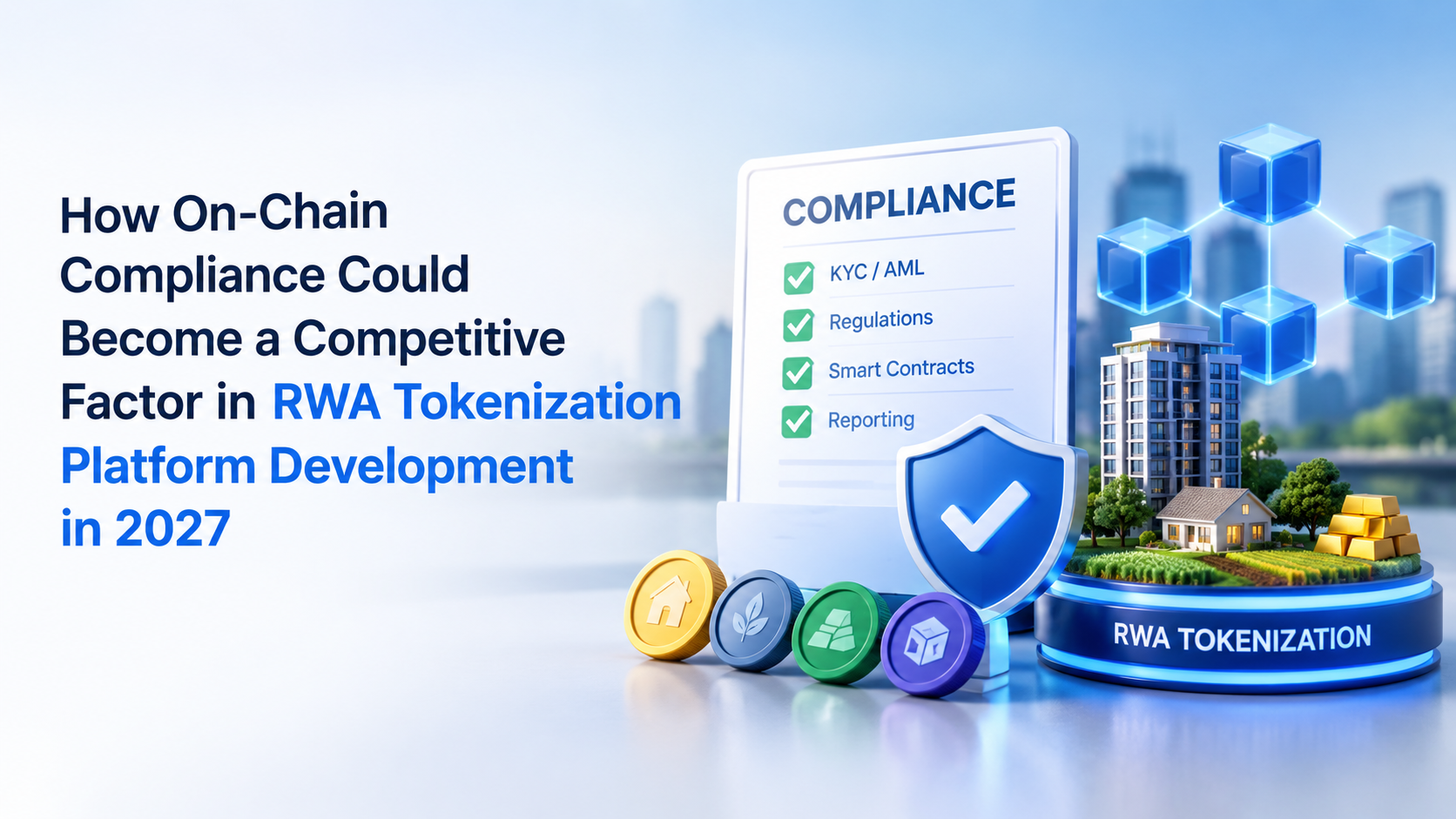
Real-world assets are moving into digital markets as businesses look for new ways to represent property, private credit, commodities, funds, invoices, collectibles, and other assets on blockchain networks. As this market develops, the discussion is moving beyond token creation and fractional ownership. Investors, financial institutions, asset managers, and businesses are increasingly concerned about how tokenized assets follow legal rules throughout their lifecycle.
This is where on-chain compliance could become an important consideration in RWA tokenization platform development in 2027. Instead of treating compliance as a process that happens mainly outside the blockchain, platforms can place certain compliance rules directly into token contracts and transaction systems. This can affect who can hold a token, where it can be transferred, when transactions can happen, and how ownership records are maintained.
For an RWA tokenization company, this approach could also influence how its platform is positioned in the market. Businesses may compare platforms based not only on token creation features, wallet support, or marketplace functions, but also on how compliance requirements are represented and monitored across token activity.
What Is On-Chain Compliance?
On-chain compliance refers to the use of blockchain-based rules, smart contracts, identity systems, permission controls, and transaction monitoring mechanisms to apply selected regulatory requirements to digital assets.
Traditional compliance often depends on external databases, manual checks, legal reviews, and operational teams. These processes can remain important, particularly for regulations that require human judgment. However, certain rules can be represented within blockchain systems.
For example, a token contract may restrict transfers to wallets that have completed identity verification. It may also check whether an investor belongs to an approved jurisdiction or whether an asset has reached its permitted investor limit.
This does not mean that every legal requirement can be placed directly on a blockchain. Laws differ across countries and asset classes, while regulatory interpretations can change. A practical RWA tokenization platform therefore needs a combination of smart contract rules, identity verification, compliance systems, legal procedures, and human oversight.
Why Compliance Could Matter More in 2027
The RWA sector is expected to involve a wider range of participants by 2027, including asset managers, financial institutions, private market businesses, property companies, fintech firms, and investment platforms. As participation increases, regulatory requirements may become more significant in platform selection.
A platform that only creates tokens may have limited value for institutions dealing with regulated assets. Businesses may instead look for systems that can manage investor eligibility, transfer restrictions, jurisdiction rules, transaction records, reporting, and other compliance functions.
For an RWA tokenization development company, this creates an opportunity to treat compliance architecture as part of the product rather than as a separate operational layer.
The exact requirements will depend on the jurisdiction, asset category, investor type, and applicable securities or financial regulations. Therefore, platforms should be designed around configurable compliance rules rather than assuming that one compliance model will work for every market.
1. Identity Verification Could Become Part of Token Transfers
Know Your Customer and Anti-Money Laundering procedures are already important in many financial activities. In tokenized markets, these checks can become connected more closely with blockchain wallets and token transfers.
A tokenization platform could maintain a record showing whether a wallet has completed the required verification. A smart contract can then check the wallet's eligibility before permitting a transaction.
For example, a property-backed token may only be available to verified investors in selected jurisdictions. If an investor attempts to transfer the token to an unverified wallet, the smart contract could reject the transaction.
This model can reduce the possibility of unrestricted transfers for assets that have legal ownership limitations. It can also give operators a more structured way to manage investor eligibility.
2. Transfer Restrictions Could Be Written Into Smart Contracts
Many tokenized assets will not behave like unrestricted cryptocurrencies. Securities, private credit instruments, property interests, and fund interests may have restrictions regarding who can purchase or receive them.
RWA token development can therefore involve permission-based transfer logic. Rules may include holding periods, investor categories, geographical restrictions, maximum ownership percentages, and other conditions.
For instance, a token representing an interest in a private fund could be transferred only between approved investors. The smart contract could check the receiving wallet before completing the transaction.
Such restrictions could become an important platform feature in 2027 because they connect legal requirements with actual token activity.
3. Wallet Whitelisting Could Support Regulatory Controls
Wallet whitelisting is another area where on-chain compliance may become useful. After completing identity and eligibility checks, an investor's wallet can be added to an approved list.
When a transaction takes place, the token contract checks whether the sender and receiver meet the required conditions. If either wallet does not qualify, the transfer can be rejected.
A Real-world asset tokenization company serving institutional clients may use this structure for assets where unrestricted wallet-to-wallet movement is not permitted.
The system still requires off-chain processes for identity checks and legal documentation. Blockchain controls simply provide a way to connect those verified records with token transactions.
4. Compliance Data Could Become Part of Token Lifecycle Management
Tokenization does not end when an asset is issued. Investors may need to receive distributions, vote on asset-related decisions, transfer ownership, redeem tokens, or participate in corporate actions.
Each stage can involve different compliance requirements.
A platform could therefore maintain compliance conditions throughout the token lifecycle. An investor who was eligible at the time of purchase may later become subject to a different restriction because of a change in jurisdiction, account status, or regulatory classification.
RWA tokenization development may increasingly involve systems that can update eligibility information and apply those changes to future transactions.
This creates a more dynamic compliance environment compared with simply checking an investor once during onboarding.
5. Real-Time Transaction Monitoring Could Gain Importance
Blockchain transactions create a permanent record of activity on the network. This information can be used by compliance systems to monitor token movements and identify unusual patterns.
A platform could monitor transaction frequency, wallet relationships, transfer values, geographic indicators, and other available data points. Suspicious activity could then be sent for additional review.
This does not automatically determine whether a transaction is illegal. Compliance teams may still need to examine the circumstances and follow applicable reporting procedures.
For an RWA tokenization company, transaction monitoring can therefore become part of a wider compliance framework rather than functioning as an isolated blockchain feature.
6. Regulatory Reporting Could Become More Connected to Blockchain Records
Financial businesses often need to maintain transaction records and produce reports for internal teams, auditors, regulators, or other authorized parties.
Tokenized assets can generate transaction information directly from blockchain activity. A platform can organize this information into records that support reporting workflows.
For example, the system may track token issuance, transfers, redemptions, investor categories, and distribution activity. This information can then be combined with off-chain records such as identity data, legal agreements, asset valuations, and tax information.
An RWA tokenization platform development company may therefore focus on reporting dashboards that bring these different data sources together while following applicable privacy requirements.
7. Privacy Will Need to Be Considered Alongside Compliance
Putting compliance information on a public blockchain creates an important challenge. Regulatory processes may require certain records, but sensitive personal information should not simply be exposed through public transactions.
Platforms may therefore use approaches such as permissioned networks, off-chain identity storage, cryptographic proofs, tokenized credentials, or other privacy-preserving mechanisms.
The blockchain may store a verification result rather than the investor's full personal information. For example, a wallet could be recognized as belonging to an eligible investor without publicly displaying their identity documents.
This distinction could become increasingly important as RWA tokenization development expands into regulated financial markets.
8. Multi-Jurisdiction Compliance Could Affect Platform Architecture
RWA markets are likely to involve investors and assets from multiple jurisdictions. However, a token that is legally available in one country may be subject to restrictions in another.
A platform operating across multiple markets may therefore need jurisdiction-specific compliance rules.
For example, the same token could have different transfer conditions depending on the investor's location or legal classification. Smart contracts and compliance services may need to recognize these differences.
This makes rule management an important consideration for an RWA tokenization development company serving international businesses.
9. Compliance Could Influence Platform Differentiation
As more companies enter the tokenization sector, many platforms may offer similar basic functions such as token issuance, wallet integration, investor dashboards, payment processing, and secondary trading.
Compliance capabilities could become one area where platforms differ.
A business evaluating an RWA tokenization platform may ask questions such as:
- Can investor eligibility rules be connected with token transfers?
- Can restricted wallets be blocked?
- Can jurisdiction-based rules be applied?
- Can compliance records be audited?
- Can rules be updated when regulations change?
- Can the platform support different asset classes?
- Can compliance information connect with existing financial systems?
These questions may influence purchasing decisions as businesses move toward regulated tokenized markets.
10. Smart Contracts May Need Greater Compliance Flexibility
Smart contracts traditionally operate according to predetermined conditions. However, regulatory requirements can change over time.
A token contract that cannot accommodate legitimate rule changes may create operational problems. This is why upgrade mechanisms, governance procedures, emergency controls, and permission management may become important parts of RWA token development.
At the same time, contract changes need careful governance. A platform should not allow unrestricted modifications that could undermine investor protections.
In 2027, businesses may therefore pay closer attention to how compliance rules are updated, who can approve changes, and how those changes are recorded.
11. Compliance Could Affect Secondary Markets
Secondary trading is one of the areas where RWA platforms face a major compliance challenge. Traditional assets may have restrictions on who can buy or sell them. Simply placing those assets on a blockchain does not remove those restrictions.
A compliant token marketplace can use investor verification, wallet permissions, asset-specific rules, and transaction monitoring before allowing trades.
For example, if a token is available only to qualified investors, the marketplace needs a method for checking the buyer's eligibility before the trade takes place.
This means secondary-market functionality may need to be designed alongside compliance rather than added after token issuance.
12. Oracles Could Connect External Compliance Information
Some compliance conditions depend on information outside the blockchain. An oracle can provide external data to a smart contract when appropriate.
For example, an oracle could supply information relating to an investor's eligibility status, jurisdiction, asset valuation, or other approved data sources.
However, external data introduces another dependency. Platforms must consider data accuracy, update frequency, source reliability, and security when connecting external information to token contracts.
RWA tokenization platforms may therefore use several data sources rather than relying on a single external feed.
13. Institutional Adoption Could Increase Compliance Expectations
Banks, asset managers, private equity firms, real estate businesses, and other institutions generally operate within established legal and compliance frameworks. When such organizations enter tokenized markets, they may expect blockchain platforms to fit into existing processes.
An RWA tokenization company working with institutional clients may therefore need features for audit records, access permissions, compliance reviews, reporting, investor onboarding, and transaction monitoring.
This does not mean every platform needs the same system. Requirements will vary depending on the asset, jurisdiction, business model, and regulatory structure.
14. Compliance Could Become a Business Proposition
In 2027, businesses may increasingly present compliance functionality as part of their platform offering. Instead of discussing token creation alone, an RWA tokenization company may describe how its system handles investor verification, permissioned transfers, reporting, monitoring, and regulatory workflows.
This could influence how companies position RWA tokenization services in competitive markets.
For businesses selecting an RWA tokenization platform development company, compliance may become one factor among technology architecture, asset support, security, user experience, integrations, transaction costs, and operational requirements.
How Businesses Can Prepare for 2027
Companies planning RWA tokenization should begin by identifying the legal structure of the asset and the markets where tokens will be offered. The compliance model should then be mapped against the token lifecycle.
The process may include identifying investor categories, defining transfer conditions, selecting identity verification methods, determining which information remains off-chain, establishing monitoring procedures, and planning reporting workflows.
Businesses should also involve legal and compliance professionals early in the project. Technical teams can implement rules, but the rules themselves should come from the applicable legal and regulatory framework.
A platform should also have a method for updating compliance policies as regulations change. This is particularly important for businesses operating across several jurisdictions.
What This Means for RWA Tokenization Development
RWA tokenization development in 2027 may increasingly involve a combination of blockchain engineering, financial infrastructure, identity systems, compliance technology, data services, and legal processes.
The role of a development partner may therefore extend beyond writing smart contracts. Businesses may need support with token standards, permission systems, wallet integration, investor management, compliance modules, dashboards, APIs, marketplace functions, and asset-specific workflows.
An RWA tokenization platform development company can use these components to create systems where compliance requirements are connected with actual token activity.
The exact implementation will depend on the asset class and jurisdiction. There is no universal compliance architecture for every RWA project, so the platform design needs to reflect the applicable legal framework and business model.
Conclusion
On-chain compliance could become an important competitive factor in RWA tokenization platform development in 2027 as tokenized markets expand toward regulated financial assets and institutional participation. Investor verification, wallet permissions, transfer restrictions, transaction monitoring, reporting, privacy controls, jurisdiction rules, and compliance-aware smart contracts may become increasingly relevant when businesses compare tokenization platforms. Compliance alone does not determine the suitability of a platform, but it can influence how effectively a system fits into regulated asset markets and existing financial operations. Businesses planning RWA tokenization should therefore consider legal requirements, technology architecture, investor workflows, data privacy, and ongoing rule management from the early stages of development. Blockchain App Factory provides RWA tokenization development services.
FAQs
1. What is on-chain compliance in RWA tokenization?
On-chain compliance refers to applying selected regulatory and eligibility rules through blockchain-based systems, smart contracts, wallet permissions, identity verification, and transaction controls.
2. Why could on-chain compliance matter in 2027?
As tokenized assets expand into regulated markets, businesses may need stronger systems for investor eligibility, restricted transfers, monitoring, reporting, and jurisdiction-based rules.
3. Can all regulatory requirements be placed on a blockchain?
No. Some requirements depend on legal reviews, off-chain records, human decisions, and regulatory interpretation. Blockchain systems can support selected compliance processes but do not replace legal and compliance functions.
4. How can smart contracts support RWA compliance?
Smart contracts can check conditions such as approved wallets, investor eligibility, holding periods, transfer restrictions, and other predefined rules before allowing certain token transactions.
5. What role does KYC play in RWA tokenization?
KYC can verify investor identity before token ownership is granted. The resulting eligibility status can then be connected with wallet permissions and token transfer rules.
6. Can RWA tokens be restricted from certain investors?
Yes. Depending on the legal structure, smart contracts and platform controls can restrict ownership or transfers based on investor category, jurisdiction, verification status, or other applicable conditions.
7. Does on-chain compliance expose investor information?
It does not have to. Platforms can keep sensitive identity information off-chain and use permission systems or cryptographic verification methods to confirm eligibility without publishing personal documents on a public blockchain.
8. What should businesses look for in an RWA tokenization platform?
Businesses can examine token standards, investor management, identity verification, transfer controls, compliance monitoring, reporting, security, wallet integration, asset support, marketplace functions, and the ability to manage changing regulatory requirements.
9. What is the role of an RWA tokenization development company?
An RWA tokenization development company can provide technical services for token issuance, smart contracts, wallets, investor management, compliance modules, dashboards, marketplaces, APIs, and other platform components required for a tokenization project.
10. How could compliance affect RWA token development?
Compliance requirements can influence token design, transfer logic, wallet permissions, investor onboarding, smart contract functions, marketplace access, and the overall architecture of the tokenization platform.

 English
 Arabic
 French
 Spanish
 Deutsch
 Turkish
 Dutch
Dutch
 Italiano
 Russian
 Romaian
 Portuguese (Brazil)