
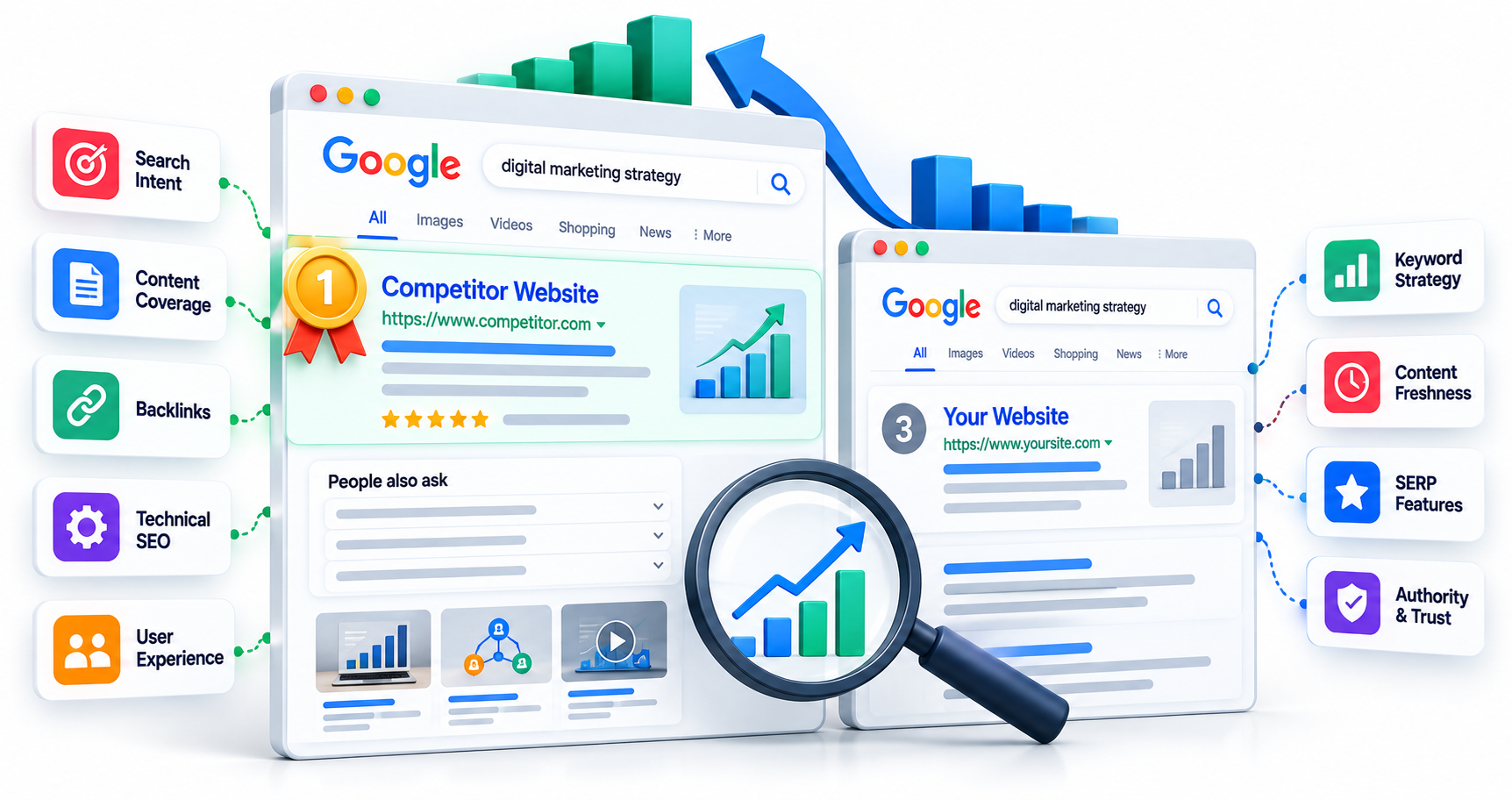
Seeing a competitor rank above your website on Google can be frustrating, especially when you believe your page has better content. But search rankings are influenced by many signals, not just content length or the number of backlinks.
A competitor may rank higher because its page matches search intent better, covers the topic more completely, has stronger relevant links, provides a better user experience, or has fewer technical problems. The most useful way to understand the difference is to compare the exact pages ranking against each other rather than looking at your website in isolation.
Why Is My Competitor Ranking Higher Than Me?
There may be a gap in one or several areas:
- Search intent
- Content coverage
- Keyword targeting
- Topical authority
- Backlinks
- Internal linking
- Technical SEO
- Page experience
- Content freshness
- Expertise and trust signals
- SERP features
- AI search visibility
The important question is not simply “What does my competitor have more of?” Instead, ask “What specific advantage helps the competing page satisfy this search better?”
12 Reasons Your Competitor May Be Ranking Above You
1. Their Page Matches Search Intent Better
Search intent describes what a user expects to find after entering a query. Two pages can target the same keyword but provide very different experiences.
For example, someone searching for “best project management software for small businesses” may expect comparisons, features, pricing, pros and cons, and recommendations—not just a definition.
Compare the content type, purpose, questions answered, format, depth, and commercial or informational intent of both pages.
2. Their Content Covers the Topic More Completely
Your competitor may not necessarily have better writing. It may simply answer more of the important questions behind the search.
A content gap analysis helps identify useful information your page is missing. Look beyond keywords and compare topics, questions, examples, and practical information.
Adding every keyword your competitor ranks for is not the goal. The goal is to cover the information that genuinely helps the reader.
3. They Have Stronger Topical Authority
A ranking page rarely exists completely on its own. Your competitor may have related content covering connected subjects and linking those pages together.
For example, a site covering technical SEO might also have useful pages about crawlability, indexing, canonical tags, site architecture, internal links, and Core Web Vitals.
This broader topical coverage can provide stronger context around the subject.
4. They Target More Relevant Keywords and Search Variations
Your competitor may naturally rank for the primary query along with related searches, long-tail keywords, entities, questions, and subtopics.
Review these variations to find meaningful gaps in your content. However, avoid keyword stuffing. The objective is to satisfy the complete search need rather than mention every possible keyword.
5. They Have Stronger Backlinks and Referring Domains
Backlinks can contribute to a competitor's advantage, but simply counting links is not enough.
Compare:
- Links to the exact ranking page
- Relevant referring domains
- Quality of linking websites
- Link context
- Anchor text
- Links to supporting pages
- Recently acquired links
A smaller number of relevant, quality referring domains can be more useful for comparison than a large number of weak or unrelated links.
6. Their Internal Linking Is Stronger
Your competitor may have a better internal linking structure connecting its ranking page to related articles, topic hubs, category pages, and relevant service or product pages.
Check which important pages link to the competing URL and what anchor text they use.
A page supported by relevant contextual links can be easier for users and search engines to navigate and understand.
7. Your Page Has Technical SEO Problems
Even strong content can struggle when technical problems interfere with crawling, indexing, rendering, or accessibility.
Check for:
- Crawlability problems
- Indexing issues
- Canonical problems
- Duplicate URLs
- Mobile rendering issues
- HTTPS
- JavaScript rendering
- Site architecture
- Internal links
- Structured data
Focus first on issues that actually affect accessibility, crawling, indexing, or page experience.
8. Their Page Provides a Better User Experience
Compare your page with the competing result for:
- Mobile readability
- Navigation
- Content structure
- Page speed
- Intrusive elements
- Visual stability
- Ease of finding answers
Core Web Vitals are part of Google's ranking systems, but good scores alone do not guarantee top rankings. Page experience should be evaluated as a whole.
9. Their Content Is Fresher and Better Maintained
Freshness can matter when users need current information.
Compare publication and update dates, statistics, examples, screenshots, product information, broken links, industry changes, and newly emerging questions.
However, changing the date without improving the content is not the goal. A useful update should make the information more accurate and valuable.
10. They Show Stronger Expertise and Trust Signals
Another possible advantage is stronger evidence supporting the content.
Look for:
- Clear authorship
- Relevant experience
- First-hand information
- Original research
- Reliable sources
- Transparent business information
- Accurate claims
- Consistent brand and entity information
The focus should be on the evidence behind the content rather than treating E-E-A-T as a score that can simply be increased by adding an author bio.
11. They Capture SERP Features You Do Not
Your competitor may gain additional visibility through featured snippets, image results, videos, local results, or other SERP features.
For example, a competitor could rank below your page in the traditional results but also appear in a featured snippet for a related question.
That is why competitor analysis should examine the whole SERP, not just the blue organic listings.
12. They Have Stronger Visibility Across AI Search
Modern search visibility also extends beyond traditional organic results. Google includes AI features such as AI Overviews and AI Mode.
Compare:
- Brand mentions
- AI citations
- Frequently cited pages
- Entity associations
- Questions your competitor answers
- Questions where your brand is absent
AI search visibility adds another layer to traditional SEO analysis rather than replacing it.
How to Find the Ranking Gap
Instead of guessing, start with the exact keyword where your competitor is ahead.
Record your ranking URL, the competitor's URL, both positions, and the SERP features appearing for that query.
Then compare:
- Search intent
- Content format and topic coverage
- Keyword and entity coverage
- Topical authority
- Internal links
- Relevant referring domains
- On-page SEO
- Technical SEO
- Page experience
- Content freshness
- SERP features
- AI search visibility
Prioritize gaps based on their likely impact and the effort required to address them. The source framework specifically recommends fixing proven high-impact gaps rather than trying to optimize every possible SEO signal simultaneously.
Don't Simply Copy Your Competitor
Competitor research should provide clues, not a blueprint.
Copying another page can lead to repetitive content, irrelevant keyword targeting, outdated approaches, and a loss of your own expertise.
Instead, ask:
What does the searcher still need that neither page explains well?
That question can help you create something more useful instead of simply producing another version of the same result.
Final Takeaway
If you are asking “Why is my competitor ranking higher than me?”, start with evidence rather than assumptions.
Find the exact competing page and compare its search intent, content coverage, keywords, topical authority, internal links, backlinks, technical SEO, page experience, freshness, SERP visibility, and AI search presence.
The goal is not to become a copy of the competitor. It is to identify the gaps that matter, improve your page, and provide information or experience that better serves the searcher.
Frequently Asked Questions
1. Why is my competitor ranking higher than me?
Possible differences include search intent, content coverage, relevant backlinks, internal linking, technical SEO, freshness, page experience, and SERP visibility. A page-to-page comparison is the best way to identify the specific gap.
2. Why is my competitor ranking higher even though my content is longer?
Content length does not guarantee better rankings. A shorter page can satisfy search intent more directly, provide clearer answers, have stronger authority, or offer a better experience.
3. Can a competitor rank higher with fewer backlinks?
Yes. Backlink quantity alone does not provide a complete comparison. Relevance, referring-domain quality, page-level authority, and content relevance also matter.
4. Can internal linking help my page compete?
Strong internal linking can help search engines discover pages and understand relationships between them. It can also help users navigate related content, although internal links alone do not guarantee higher rankings.
5. How do I find out why a competitor outranks my website?
Start with the exact keyword and identify the URLs ranking above yours. Then compare search intent, content, keywords, internal links, backlinks, technical SEO, page experience, freshness, and SERP features.

 English
 Arabic
 French
 Spanish
 Portuguese
 Deutsch
 Turkish
 Dutch
Dutch
 Italiano
 Romaian
 Portuguese (Brazil)