
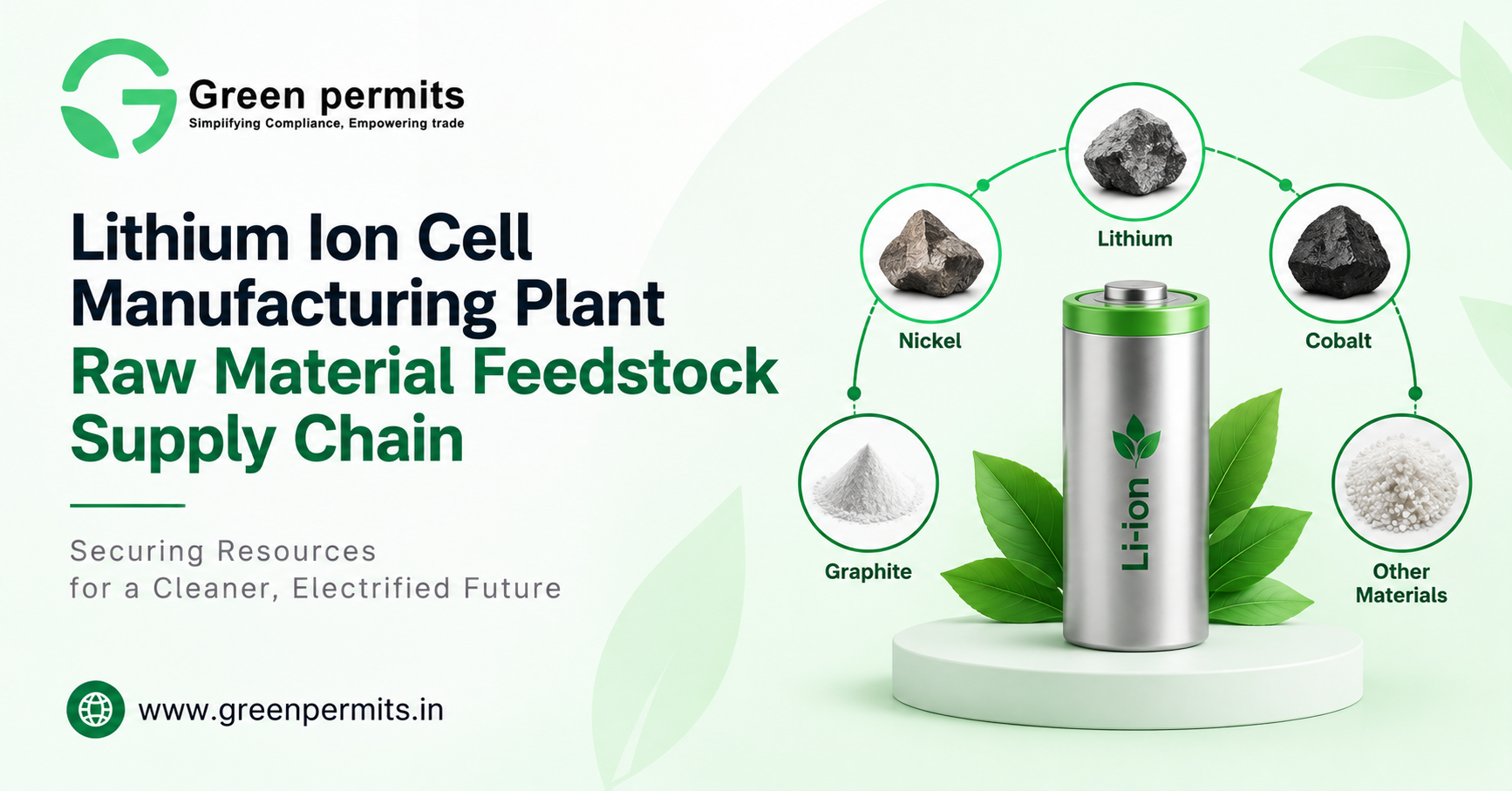
A Lithium-Ion Cell Manufacturing Plant Raw Material & Feedstock Supply Chain study helps investors and battery manufacturers understand whether the required battery materials can be sourced consistently, at the right quality and at a commercially workable cost before a cell manufacturing plant is established.
Lithium-ion cell manufacturing depends on a tightly controlled supply chain. A shortage or quality variation in cathode material, graphite, electrolyte, separator or metal foils can directly affect production, cell performance and customer acceptance.
For investors, the project should therefore begin with cell chemistry, annual capacity, raw material requirement, supplier qualification, logistics and working capital, not only machinery selection.
Green Permits Consulting supports investors with battery cell manufacturing feasibility studies, raw material supply-chain assessment, DPR preparation, plant-capacity planning, CAPEX and OPEX modelling and project implementation support.
Raw Materials Required for Lithium-Ion Cell Manufacturing
A lithium-ion cell contains several important material groups.
The main inputs typically include cathode active material, anode active material, electrolyte, separator, copper foil, aluminium foil, binders, conductive additives and cell packaging components.
The basic material structure is:
Cathode Material + Anode Material + Separator + Electrolyte + Current Collectors → Lithium-Ion Cell
Each input has different technical specifications and supply-chain risks.
A cell plant cannot simply purchase generic battery materials. Suppliers need to meet the exact specification required for the selected cell chemistry and manufacturing process.
Cell Chemistry Comes Before Feedstock Planning
The first decision is the type of cell the project intends to manufacture.
Common lithium-ion chemistries include LFP, NMC, NCA and LCO, depending on the target application.
An LFP cell plant needs a different cathode-material supply chain from an NMC cell plant.
Therefore, the planning sequence should be:
Target Market → Cell Chemistry → Cell Format → Raw Material Specification → Supplier Network
For example, an EV cell, stationary energy-storage cell and consumer-electronics cell may have different requirements for energy density, cycle life, safety and cost.
Raw material planning should therefore follow product design.
Cathode Active Material Supply
Cathode active material is one of the most important inputs in lithium-ion cell manufacturing.
For LFP cells, the project typically needs lithium iron phosphate cathode material.
For NMC cells, the cathode contains nickel, manganese and cobalt in proportions determined by the selected chemistry.
The investor should evaluate whether cathode material will be purchased as finished CAM or whether the project will integrate part of the cathode-material manufacturing process.
Purchasing finished CAM reduces process complexity, while backward integration can provide greater control over cost and supply but requires significantly higher investment and technical capability.
The supply-chain study should evaluate:
Specification → Monthly Requirement → Supplier Capacity → Lead Time → Delivered Cost
Anode Material Supply
Graphite is the most widely used anode material in commercial lithium-ion cells.
Depending on the product, the plant may use natural graphite, synthetic graphite or advanced graphite blends.
Anode material quality affects charging behaviour, cycle life and cell consistency.
The manufacturer should therefore qualify suppliers based on particle size, purity, moisture, surface characteristics and electrochemical performance.
A low-cost graphite source may not actually be economical if it produces lower cell yield or inconsistent performance.
For this reason, anode-material procurement should be linked directly with cell-testing results.
Electrolyte Supply Chain
Electrolyte allows lithium ions to move between the cathode and anode.
Commercial lithium-ion cells generally use lithium salts in suitable organic solvents along with performance additives.
Electrolyte is highly sensitive to moisture and contamination.
The supply chain therefore requires controlled packaging, storage and handling.
The plant should plan:
Qualified Supplier → Controlled Transport → Dry Storage → Production Consumption
Long storage periods should be avoided where material stability or supplier specifications impose limits.
Because electrolyte quality has a direct impact on cell safety and performance, supplier qualification becomes a critical part of plant commissioning.
Separator Material
The separator is positioned between the cathode and anode to prevent electrical contact while allowing ion movement.
Lithium-ion cell separators are commonly based on specialised polymer films.
Even though the separator is lightweight compared with cathode or anode material, its quality is critical for battery safety.
The plant should evaluate thickness, porosity, mechanical strength, thermal behaviour and compatibility with the cell design.
The separator supply chain should therefore be treated as a strategic input rather than a simple packaging material.
Copper and Aluminium Foils
Lithium-ion cells use thin metal foils as current collectors.
Copper foil is commonly used on the anode side, while aluminium foil is generally used for the cathode.
These materials need controlled thickness, surface quality and cleanliness.
Poor-quality foil can create coating problems and reduce electrode manufacturing yield.
The project should evaluate supplier consistency and rejection levels because even small production losses become financially important in a high-volume gigawatt-hour-scale cell plant.
Binders and Conductive Additives
Cell manufacturing also requires binders and conductive materials.
Depending on the electrode chemistry and process, binders may include materials such as PVDF or suitable water-based systems.
Conductive carbon materials help improve electrical conductivity within the electrode.
Although these inputs represent a smaller share of the total cell weight, a shortage can stop the entire production line.
The procurement strategy should therefore avoid focusing only on high-volume materials.
Minor but critical chemicals should also have qualified backup suppliers.
Imported vs Domestic Raw Material Supply
A new battery-cell manufacturer may need to source some materials domestically and others internationally depending on availability, specification and commercial terms.
Imports can create additional risks including longer lead times, foreign-exchange exposure, shipping delays and higher inventory requirements.
Domestic suppliers may offer shorter lead times, but the manufacturer still needs to verify whether the required battery-grade specification and volume can be supplied consistently.
The right sourcing strategy is usually:
Primary Supplier + Approved Backup Supplier + Safety Inventory
rather than depending completely on one supplier.
For strategically important materials, dual sourcing can reduce production risk.
Raw Material Quality Control
Battery cell manufacturing requires strict incoming-material inspection.
Materials should not move directly from receiving to production without quality checks.
The plant may need to test parameters such as moisture, purity, particle size, viscosity, thickness or chemical composition depending on the material.
The process should be:
Material Receipt → Sampling → Laboratory Testing → Approval → Production Release
Supplier certificates are useful, but the manufacturer should maintain its own incoming quality-control system.
Raw material traceability is also important because any cell-quality issue may need to be traced back to a specific material batch.
Storage Requirements
Different battery materials require different storage conditions.
Cathode and anode powders need protection from contamination and moisture.
Electrolyte requires controlled storage and appropriate safety systems.
Foils, separators and chemicals should also be protected from dust, moisture and physical damage.
The warehouse design should therefore separate material categories and maintain suitable environmental conditions.
A battery plant cannot treat raw material storage like a general industrial warehouse.
Storage conditions can directly affect product quality.
Working Capital and Inventory
Cell manufacturing requires significant working capital because battery-grade materials can be high value.
The financial model should calculate how much raw material inventory must be maintained based on supplier lead time and production demand.
Cash can remain tied up in:
Raw Materials → Electrode Production → Cell Assembly → Formation & Ageing → Finished Cells → Customer Payment
Imported materials may require higher inventory buffers because replenishment takes longer.
However, excessive inventory increases working-capital requirements.
The DPR should therefore optimise inventory rather than simply maintaining large safety stocks.
Supplier Qualification Before Commercial Production
Supplier qualification should begin before the plant reaches mass production.
Material should first be tested at laboratory or pilot scale, followed by electrode production and cell testing.
Only after performance is validated should the supplier be approved for regular commercial supply.
Changing raw material suppliers after mass production begins can require significant testing because even small variations may affect cell behaviour.
This makes long-term supplier relationships important for battery manufacturers.
Raw Material Supply Chain Risk
A lithium-ion cell plant should identify potential supply disruptions before investment.
Risks can include material shortages, price volatility, import delays, inconsistent quality and dependence on a single supplier.
The DPR should evaluate alternatives for each critical input.
A stronger supply chain is:
Multiple Suppliers → Defined Specifications → Quality Testing → Safety Stock → Long-Term Procurement Strategy
Raw material security can be as important as plant machinery for achieving stable capacity utilisation.
DPR for Lithium-Ion Cell Manufacturing Plant
A Detailed Project Report - DPR should connect raw material planning with cell capacity and financial performance.
The DPR can include cell chemistry, annual production capacity, raw material consumption, supplier mapping, machinery, utilities, land, environmental requirements, CAPEX and working capital.
The financial model should evaluate raw material cost, production yield, rejection rate, energy consumption, cell selling price and plant utilisation.
A practical project-development sequence is:
Market Study → Cell Chemistry → Raw Material Supply Chain → Technology → DPR → Approvals → Machinery → Commercial Production
How Green Permits Helps
Green Permits Consulting supports investors and battery manufacturers with Lithium-Ion Cell Manufacturing Plant feasibility studies, raw material and supplier assessments, DPR preparation, plant-capacity planning, machinery evaluation, CAPEX and OPEX modelling and project implementation support.
The objective is to ensure that the proposed cell plant has a reliable material supply chain before large-scale investment begins.
Learn More About Lithium-Ion Cell Manufacturing Plant Supply Chain
If you are planning a lithium-ion cell manufacturing facility, the project should first evaluate cathode material, anode material, electrolyte, separator, current collectors, supplier reliability and working-capital requirements.
Read more about plant feasibility and DPR consulting services here:
👉 https://www.greenpermits.in/09/li-ion-cell-raw-materials-cost-sourcing-in-india/
📞 Get Expert Assistance for Lithium-Ion Cell Manufacturing Plant
If you need help with a Lithium-Ion Cell Manufacturing Plant raw material study, supplier mapping, feasibility report, DPR preparation or project implementation, Green Permits Consulting can assist you.
🌐 Website: www.greenpermits.in
📞 Phone: +91 78350 06182
📧 Email: wecare@greenpermits.in

 Arabic
 French
 Spanish
 Portuguese
 Deutsch
 Turkish
 Dutch
Dutch
 Italiano
 Russian
 Romaian
 Portuguese (Brazil)