
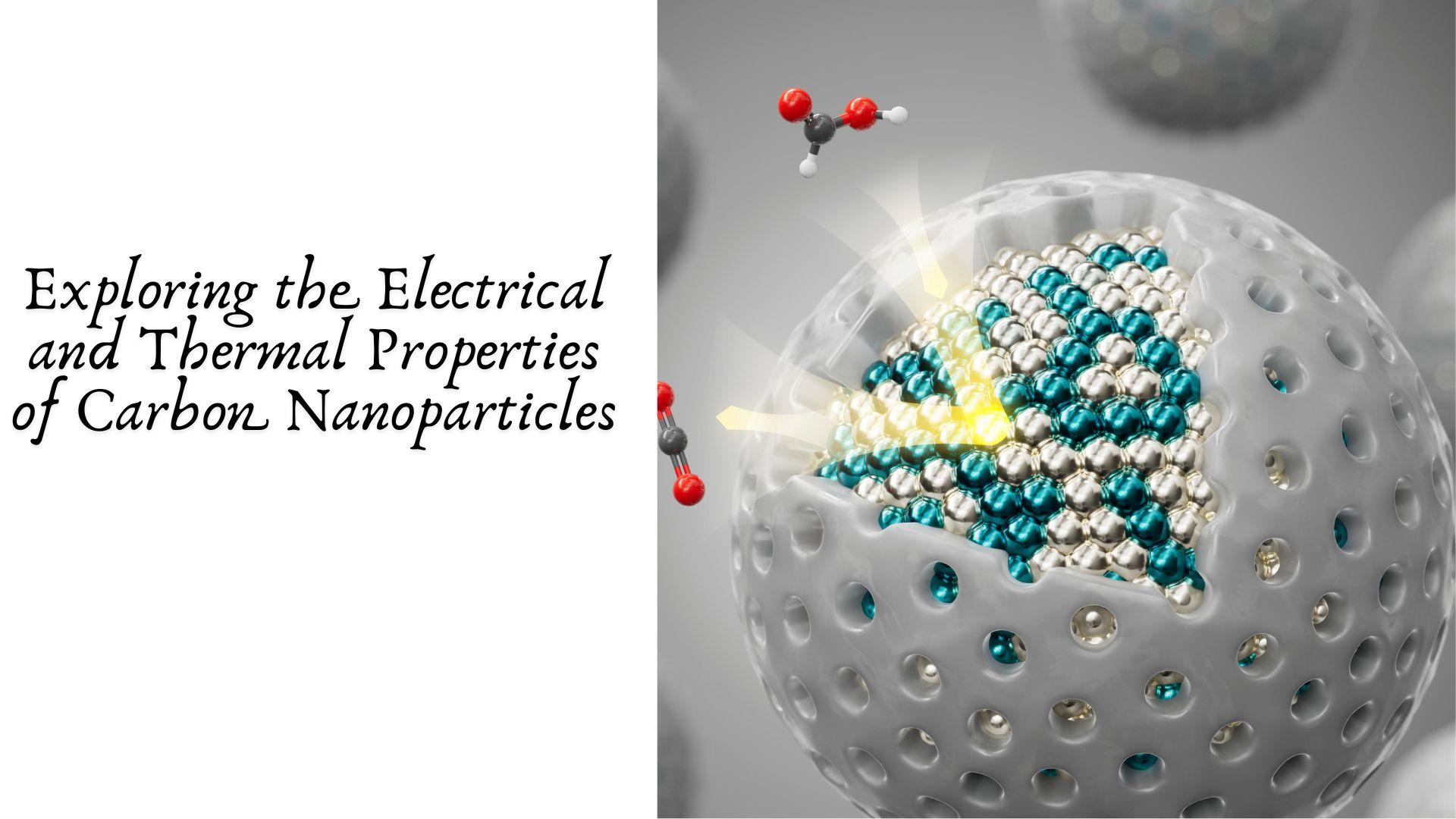
Carbon nanoparticles have attracted significant attention in nanotechnology because of their distinctive electrical, thermal, mechanical, and surface properties. Their nanoscale dimensions can produce characteristics that differ substantially from those of bulk carbon materials, making them useful in areas ranging from electronics and energy storage to thermal management, sensors, coatings, and advanced composites.
The electrical and thermal behavior of carbon nanoparticles depends on several factors, including particle size, morphology, crystallinity, surface chemistry, defects, synthesis method, and the type of carbon structure present. Understanding these properties is therefore important when selecting carbon nanoparticles for specific research, industrial, or technological applications.
What Are Carbon Nanoparticles?
Carbon nanoparticles are carbon-based materials with dimensions generally within the nanoscale range. Depending on their structure and production method, they can occur in different forms, including carbonaceous nanoparticles, graphitic nanoparticles, carbon nanospheres, carbon dots, and other nanoscale carbon structures.
Carbon can exist in different bonding configurations, particularly sp² and sp³ hybridization. Materials with a greater proportion of sp²-bonded carbon often demonstrate enhanced electrical conductivity because of the availability of delocalized electrons. In contrast, structures containing more sp³ bonding may exhibit different electrical and thermal characteristics.
At the nanoscale, the properties of carbon materials are strongly influenced by their structure. This makes carbon nanoparticles an adaptable class of materials for applications requiring specific combinations of conductivity, heat transfer, chemical stability, and lightweight performance.
Electrical Properties of Carbon Nanoparticles
One of the most important characteristics of many carbon nanomaterials is their ability to conduct electricity. Electrical conductivity can vary significantly depending on the carbon structure, degree of graphitization, particle morphology, and connectivity between particles.
Electrical Conductivity
In carbon nanoparticles containing graphitic or highly ordered sp² structures, electrons can move through interconnected carbon networks. This can contribute to useful electrical conductivity.
However, conductivity in a nanoparticle powder or composite is not determined solely by the conductivity of individual particles. The way nanoparticles contact one another is also important. When incorporated into a polymer, for example, carbon nanoparticles may form conductive pathways once their concentration reaches a sufficient level.
This concentration is commonly associated with the concept of the percolation threshold. Below this threshold, individual conductive particles may remain isolated. Above it, interconnected pathways can develop throughout the material, significantly improving electrical transport.
Influence of Particle Size
Particle size can influence electrical behavior by changing surface area, particle interactions, and the distance electrons must travel between conductive regions.
Smaller nanoparticles provide a greater surface-area-to-volume ratio. This can improve interactions with surrounding materials but may also increase the influence of surface defects, functional groups, and interfaces.
Consequently, particle size must be considered together with morphology and surface chemistry rather than treated as an independent factor.
Role of Carbon Structure
The arrangement of carbon atoms plays an important role in electrical performance.
Graphitic regions generally provide pathways for electron transport, while structural defects and amorphous regions can interrupt or modify those pathways. A higher degree of graphitic ordering can therefore influence conductivity, although the exact relationship depends on the material's morphology and processing conditions.
Electrical Properties in Composite Materials
Carbon nanoparticles are frequently incorporated into polymers, ceramics, coatings, and other matrices to modify electrical behavior.
Adding conductive carbon nanoparticles can create electrically conductive or antistatic composites. Such materials may be used in:
-
Electromagnetic interference shielding
-
Antistatic coatings
-
Conductive polymers
-
Flexible electronics
-
Sensors
-
Heating elements
-
Energy-storage components
-
Electronic packaging
The final electrical performance depends on nanoparticle loading, dispersion, particle-to-particle contact, matrix properties, and processing conditions.
Thermal Properties of Carbon Nanoparticles
Carbon-based nanomaterials are also studied for their thermal characteristics. Thermal behavior becomes particularly important in technologies where controlling heat generation and dissipation is essential.
Thermal Conductivity
Some highly ordered carbon nanostructures can exhibit excellent thermal conductivity. However, thermal transport in nanoparticle systems is complex and depends on particle structure, interfaces, defects, particle size, and contact resistance.
When carbon nanoparticles are dispersed within a polymer or another matrix, heat must pass through multiple interfaces. These interfaces can introduce thermal resistance and therefore affect the effective thermal conductivity of the final composite.
Good dispersion and strong interfacial interactions can help create more effective heat-transfer pathways.
Phonon Transport
In many solid carbon materials, thermal energy is transported primarily through lattice vibrations known as phonons.
At the nanoscale, phonon movement can be affected by boundaries, defects, interfaces, and structural disorder. When nanoparticles are extremely small, boundary scattering can become increasingly significant.
This means that nanoscale dimensions can modify thermal transport compared with bulk carbon materials.
Effect of Defects
Defects can influence both electrical and thermal transport. While certain defects may introduce useful surface characteristics or improve interactions with a surrounding matrix, excessive structural disorder can interrupt pathways for electron and phonon transport.
The balance between defect density, surface functionality, and structural order is therefore important when designing carbon nanoparticle materials.
Relationship Between Electrical and Thermal Conductivity
Electrical and thermal properties are often interconnected in conductive carbon materials.
Materials that efficiently transport electrical charge may also contribute to thermal transport, although electrical conductivity and thermal conductivity are not necessarily proportional. Their relationship depends on the material's structure and the mechanisms responsible for transporting energy and charge.
In composite materials, both properties can be engineered by adjusting:
-
Carbon nanoparticle concentration
-
Particle morphology
-
Degree of graphitization
-
Surface functionalization
-
Dispersion quality
-
Matrix composition
-
Processing conditions
This ability to tune properties makes carbon nanoparticles attractive for multifunctional materials.
Carbon Nanoparticles in Thermal Management
Electronic devices continue to become smaller and more powerful, increasing the importance of thermal management. Excessive heat can affect performance, reliability, and service life.
Carbon nanoparticles can be investigated as components of thermally conductive composites and coatings designed to improve heat dissipation.
Potential applications include:
-
Electronic packaging
-
Thermal interface materials
-
Heat-spreading composites
-
LED thermal management
-
Battery components
-
Power electronics
-
Industrial thermal coatings
The effectiveness of a carbon nanoparticle-based thermal material depends not only on the intrinsic thermal properties of the carbon but also on the quality of nanoparticle dispersion and interfaces within the composite.
Applications in Electronics
The electrical properties of carbon nanoparticles make them relevant to numerous electronic technologies.
Conductive Inks and Coatings
Carbon nanoparticles can be incorporated into conductive formulations for coatings and printed electronic components. Their nanoscale dimensions can support the development of thin and functional conductive layers.
Sensors
Changes in electrical resistance can occur when carbon-based materials interact with gases, chemicals, biological molecules, pressure, or mechanical deformation. These responses can be used in sensor development.
Carbon nanoparticles can therefore contribute to the design of lightweight and potentially flexible sensing platforms.
Electromagnetic Interference Shielding
Electronic devices can generate electromagnetic radiation that may interfere with nearby components. Conductive carbon-based composites can help attenuate electromagnetic interference by mechanisms such as reflection, absorption, and multiple internal interactions.
The effectiveness of a shielding material depends on factors including conductivity, thickness, structure, frequency range, and material composition.
Energy Storage Applications
Carbon nanomaterials are widely investigated for energy-storage technologies because of their electrical conductivity, surface characteristics, chemical stability, and structural versatility.
Carbon nanoparticles can be incorporated into electrode formulations for batteries and supercapacitors.
Batteries
In battery electrodes, conductive carbon materials can improve electrical connectivity between electrochemically active particles. They may help create conductive networks that facilitate electron transport.
Carbon nanoparticles can also be combined with other nanomaterials to develop composite electrode architectures.
Supercapacitors
High surface area and electrical conductivity are valuable characteristics for supercapacitor electrodes. Carbon-based nanostructures can provide conductive frameworks and surfaces for charge storage.
Research into carbon nanomaterials continues to explore ways of improving energy density, power capability, cycling performance, and electrode stability.
Carbon Nanoparticles in Polymer Composites
One of the most important areas of carbon nanoparticle research is the development of nanocomposites.
Adding carbon nanoparticles to a polymer can change several properties simultaneously, including:
-
Electrical conductivity
-
Thermal conductivity
-
Mechanical strength
-
Stiffness
-
Surface characteristics
-
Wear resistance
-
Electromagnetic shielding
However, achieving consistent performance requires effective nanoparticle dispersion.
Poor dispersion can lead to particle agglomeration. Instead of forming a uniform network, nanoparticles may cluster together, reducing the efficiency of the conductive or thermal pathways.
Surface modification and appropriate processing techniques can be used to improve compatibility between carbon nanoparticles and polymer matrices.
Factors Affecting Electrical and Thermal Performance
Several parameters should be considered when evaluating carbon nanoparticles.
Particle Size
Particle size affects surface area, interparticle interactions, and interface density.
Morphology
Spherical, irregular, graphitic, and other morphologies can produce different transport characteristics.
Crystallinity
Greater structural ordering can influence electron and phonon transport.
Defect Concentration
Defects can modify charge transport, phonon scattering, and surface reactivity.
Surface Chemistry
Functional groups can affect dispersion and interaction with surrounding materials.
Concentration
The concentration of nanoparticles can determine whether interconnected electrical or thermal pathways develop within a composite.
Dispersion
Uniform dispersion is particularly important in polymer and coating applications.
Interface Quality
Interfaces between nanoparticles and matrix materials can strongly influence thermal and electrical transport.
Importance of Nanoparticle Dispersion
Dispersion is a critical consideration when carbon nanoparticles are incorporated into a host material.
Agglomeration can reduce the effective surface area and prevent nanoparticles from forming uniform networks. In electrical applications, this may increase resistance. In thermal composites, poorly connected particles may create additional barriers to heat flow.
Researchers therefore investigate different approaches to improve dispersion, including surface functionalization, optimized mixing procedures, solvent-based processing, and compatibility modifications.
The appropriate method depends on the type of carbon nanoparticle and the intended application.
Characterizing Electrical Properties
A variety of analytical techniques can be used to evaluate the electrical behavior of carbon nanoparticles and carbon-based composites.
Electrical resistance and conductivity measurements can provide information about charge transport. More advanced techniques can investigate frequency-dependent electrical behavior, charge-transfer mechanisms, and interfacial effects.
For composite materials, measurements are often performed at different nanoparticle concentrations to identify changes associated with conductive-network formation.
Characterizing Thermal Properties
Thermal properties can be evaluated using techniques designed to measure thermal conductivity, diffusivity, heat capacity, and thermal stability.
Thermal analysis can help researchers understand how carbon nanoparticles behave during heating and how they interact with surrounding materials.
For composite development, thermal measurements are particularly useful because the performance of the finished material may differ substantially from the properties of the nanoparticles themselves.
Future Potential of Carbon Nanoparticles
Research into carbon nanoparticles continues to expand as scientists develop increasingly sophisticated methods for controlling nanoscale structure.
Future research may focus on:
-
More efficient conductive networks
-
Advanced thermal management materials
-
Flexible and wearable electronics
-
High-performance sensors
-
Energy-storage systems
-
Multifunctional nanocomposites
-
Electrically conductive coatings
-
Lightweight electromagnetic shielding
-
Advanced electronic packaging
One important direction is the development of multifunctional materials in which electrical, thermal, mechanical, and chemical properties are optimized simultaneously.
Challenges and Considerations
Despite their potential, carbon nanoparticles also present challenges.
Achieving consistent particle size, morphology, purity, and surface chemistry can be difficult. Differences in synthesis and processing conditions can lead to variations in material performance.
Another challenge is controlling aggregation. Nanoparticles have high surface energy and may naturally form clusters, making processing and dispersion important considerations.
For industrial applications, researchers must also consider scalability, cost, reproducibility, material compatibility, and appropriate health and safety practices when handling nanoscale powders.
Conclusion
Carbon nanoparticles offer a versatile platform for developing advanced materials with tunable electrical and thermal characteristics. Their nanoscale dimensions, carbon bonding structures, surface properties, and ability to form interconnected networks make them valuable for research in electronics, energy storage, sensors, thermal management, coatings, and nanocomposites.
Electrical performance is influenced by factors such as graphitic structure, particle connectivity, concentration, and defects, while thermal behavior depends strongly on phonon transport, interfaces, structural order, and particle dispersion. Understanding these relationships allows researchers and engineers to design carbon-based materials for specific performance requirements.
As nanotechnology continues to develop, carbon nanoparticles are likely to remain an important area of research for creating conductive, thermally functional, lightweight, and multifunctional advanced materials.
For researchers and manufacturers exploring nanoscale carbon materials, selecting nanoparticles with appropriate structural, electrical, thermal, and surface characteristics is an important step toward achieving reliable performance in the intended application.

 English
 Arabic
 French
 Portuguese
 Deutsch
 Turkish
 Dutch
Dutch
 Italiano
 Russian
 Romaian
 Portuguese (Brazil)