
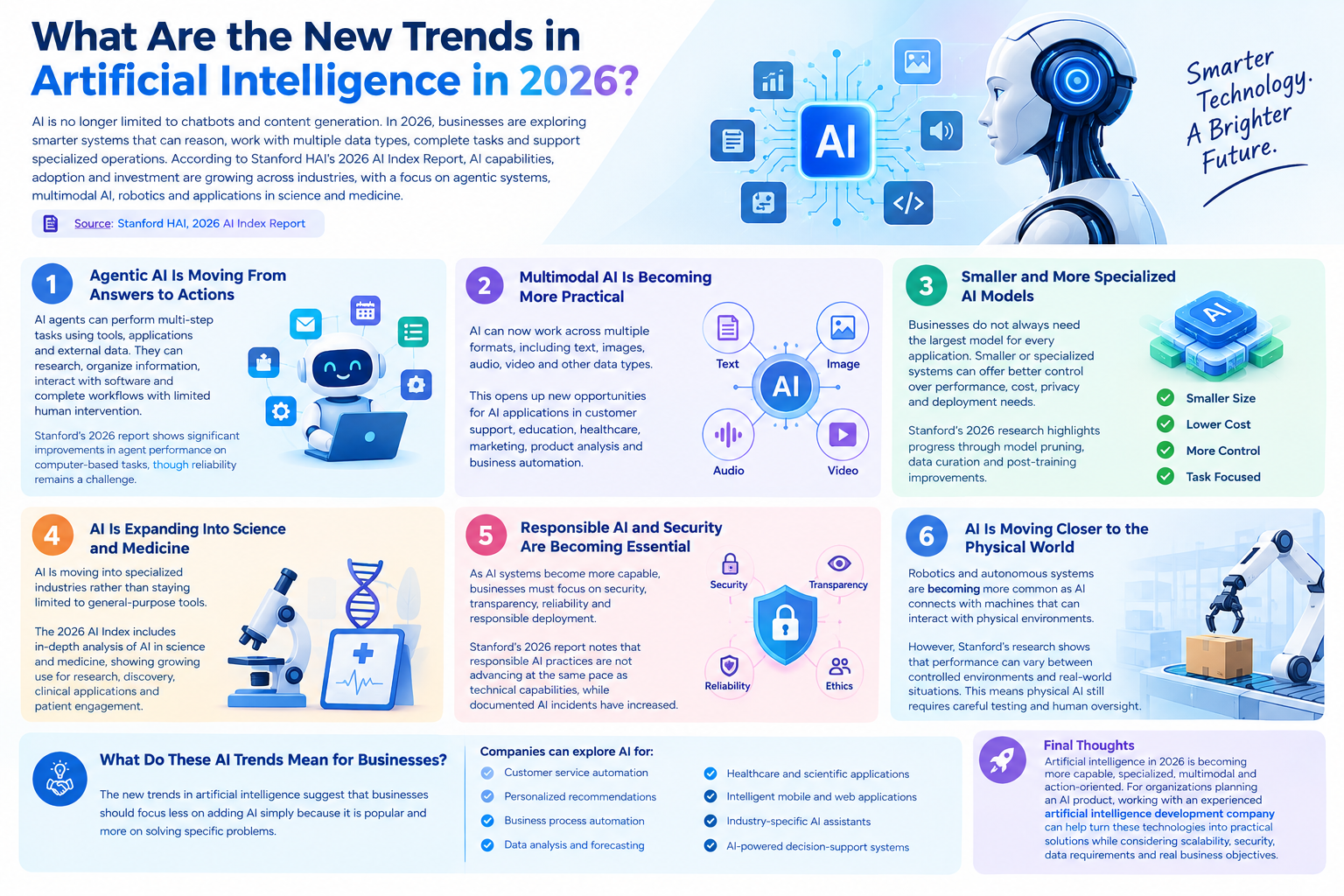
Artificial intelligence is moving beyond simple chatbots and content generation. In 2026, businesses are increasingly exploring AI systems that can reason, work with different types of data, complete tasks, and support specialized business operations. According to Stanford HAI's 2026 AI Index Report, AI capabilities continued to advance rapidly, while adoption and investment also expanded across industries. The report also highlights the growing role of agentic systems, multimodal AI, robotics, and AI applications in areas such as science and medicine.
For businesses considering new trends in artificial intelligence, these developments can influence how future products and digital services are designed.
1. Agentic AI Is Moving From Answers to Actions
One of the most important developments is the growth of AI agents. Unlike traditional AI tools that mainly respond to prompts, AI agents are designed to perform multi-step tasks using tools, applications, and external data.
For example, an agent could potentially research information, organize data, interact with software, and complete a workflow with limited human intervention. Stanford's 2026 report shows significant improvement in AI agent performance on computer-based tasks, although reliability remains an important challenge.
2. Multimodal AI Is Becoming More Practical
AI is no longer limited to text. Modern systems can work across multiple formats, including text, images, audio, video, and other data types.
This creates opportunities for artificial intelligence applications in customer support, education, healthcare, marketing, product analysis, and business automation. Instead of using separate tools for every format, organizations can increasingly build experiences that combine different types of information.
3. Smaller and More Specialized AI Models
Another important direction is the development of AI models designed for specific tasks. Businesses do not always need the largest possible model for every application.
Smaller or specialized systems can be useful when organizations need greater control over performance, cost, privacy, or deployment requirements. Stanford's 2026 research also highlights progress achieved through techniques such as model pruning, data curation, and post-training improvements.
4. AI Is Expanding Into Science and Medicine
AI development is increasingly moving into specialized industries rather than remaining limited to general-purpose productivity tools.
The 2026 AI Index includes dedicated analysis of AI in science and medicine, reflecting the growing use of AI for scientific research, discovery, clinical applications, and patient engagement.
This trend creates opportunities for businesses to develop specialized AI products designed around specific industry workflows.
5. Responsible AI and Security Are Becoming Essential
As AI systems become more capable, businesses also need to consider security, transparency, reliability, and responsible deployment. Stanford's 2026 report notes that responsible AI practices are not advancing at the same pace as technical capabilities, while documented AI incidents have increased.
Therefore, organizations should not evaluate new AI technology only by its features. Businesses should also consider how the system protects data, handles errors, and manages sensitive decisions.
6. AI Is Moving Closer to the Physical World
Robotics and autonomous systems represent another major direction. AI is increasingly being connected with machines that can interact with physical environments.
However, Stanford's research shows that performance can vary significantly between controlled environments and unpredictable real-world situations. This means physical AI still requires careful testing and human oversight.
What Do These AI Trends Mean for Businesses?
The new trends in artificial intelligence suggest that businesses should focus less on adding AI simply because it is popular and more on solving specific problems.
Companies can explore AI for:
- Customer service automation
- Personalized recommendations
- Business process automation
- Data analysis and forecasting
- Healthcare and scientific applications
- Intelligent mobile and web applications
- Industry-specific AI assistants
- AI-powered decision-support systems
Final Thoughts
Artificial intelligence in 2026 is becoming more capable, specialized, multimodal, and action-oriented. Agentic AI, specialized models, industry-focused applications, robotics, and responsible AI are shaping the next stage of development.
For organizations planning an AI product, working with an experienced artificial intelligence development company can help turn these technologies into practical solutions while considering scalability, security, data requirements, and real business objectives.

 English
 French
 Spanish
 Portuguese
 Deutsch
 Turkish
 Dutch
Dutch
 Italiano
 Russian
 Romaian
 Portuguese (Brazil)