
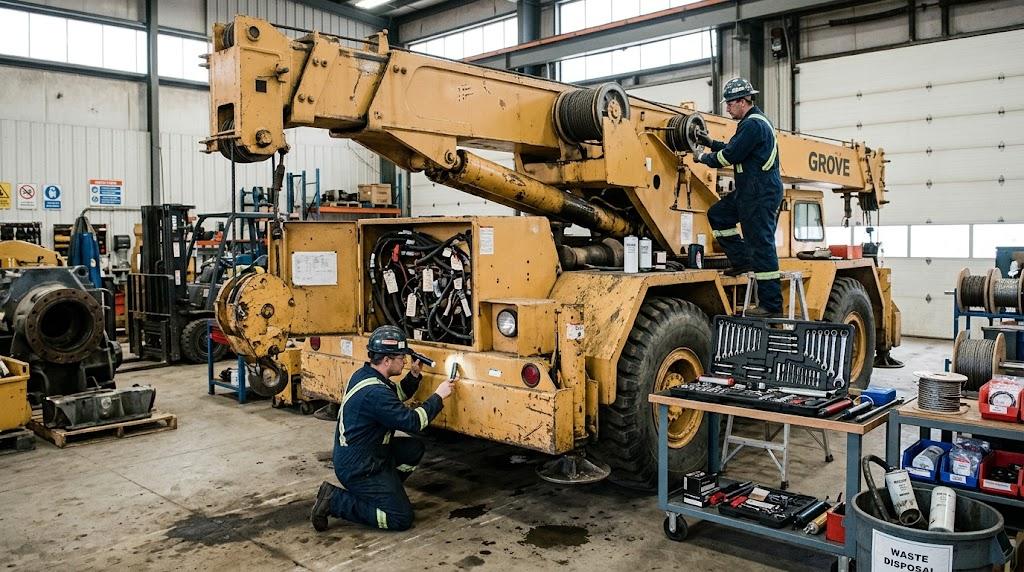
Your Grove mobile crane has earned its place on the jobsite. It has logged thousands of lifts and countless hours of swing, boom, and travel. But lately the service calls are more frequent. A hydraulic hose needs replacing again. The slewing feels rough. The load indicator gives inconsistent readings. At some point the tally of small problems pushes you toward a bigger decision.
Upgrading a seasoned crane is not about cosmetically restoring it to showroom condition. The aim is to reinforce the areas where age has weakened the machine. Targeted improvements can restore years of dependable operation. Scattershot spending, by contrast, can introduce unnecessary complexity without meaningfully changing the crane's output.
Start With an Unbiased Walkdown
Before ordering replacement components, put your hands on the machine. Inspect every boom segment for fatigue cracking, corrosion, deformed plating, and ovalized pin bores. Check the swing bearing, brake assemblies, wire rope, sheave condition, hook block, and all hydraulic hose paths. Look at cylinder rods for scoring, pitting, and external weeping. Walk through the wiring harness, battery connections, ground paths, relays, and switches.
Older cranes commonly develop faults that feel complicated but trace to simple origins. A single loose ground can make gauges read erratically. A corroded connector can interrupt a sensor feed under vibration. A blocked filter can starve an entire hydraulic circuit of flow. Identify the root cause before purchasing Grove parts. Separate what requires immediate action from what can be planned for a later window.
Address Safety-Critical Wear Before Anything Else
A hairline crack in a boom chord is a repair, not an upgrade candidate. Deteriorated brakes, fatigued load-indicating pins, damaged swing bearings, and compromised hook assemblies are likewise structural concerns. These items must be properly corrected before you invest in performance or comfort improvements.
A machine can present a clean exterior and still carry hidden fatigue damage. Internal cracking, weld degradation, and enlarged bores may develop gradually over years of service. Whenever structural integrity is in question, bring in qualified inspection personnel. A quick visual pass and a test pick do not constitute a structural clearance.
Make Operator Inputs More Precise
The quality of the control system directly shapes both productivity and machine longevity. Older Grove cranes may rely on mechanical lever linkages, early joystick designs, or basic electronic valve drivers. Worn spools and loose mechanical joints produce vague, inconsistent movement. Operators compensate with abrupt inputs, which extends cycle times and accelerates wear on hydraulic and structural components.
A wholesale control system overhaul is rarely warranted. Better proportional valves, reconditioned joystick assemblies, cleaned signal wiring, and adjusted linkages can transform how the crane handles. The objective is proportional, repeatable response from zero to full stroke. When an operator can feather a load into position without second-guessing, the whole operation runs more smoothly.
Restore Lost Hydraulic Power
Hydraulic degradation is one of the most persistent challenges on aging cranes. Worn cylinder seals, degraded pump internals, contaminated fluid, and chronically elevated temperatures all reduce effective output. Heat deserves special attention because it attacks seals and oil simultaneously, creating a cycle of compounding wear.
Replacing fatigued cylinders with assemblies built from quality crane parts can recover capacity that has quietly eroded. Better hose routing eliminates abrasion points that cause premature failures. Upgraded filtration is a relatively low-cost change that protects pumps, motors, and valves over the long term. On machines with variable displacement pumps, check pilot lines, solenoid coils, and control pressure readings. A feeble pilot signal alone can make a healthy pump seem unresponsive.
Give Wire Rope and Sheaves the Attention They Deserve
Wire rope condition deserves far more scrutiny than it typically receives. A rope that looks acceptable during a casual walk-around may conceal internal wire breaks, crushed lays, or corrosive damage beneath the outer strand layer. On a crane in active service, proactive rope replacement costs far less than managing a failure during a live lift.
Examine each sheave for bearing looseness and groove wear. Damaged sheaves chew through rope at an accelerating pace. Inspect the hook block, swivel, safety latch, and all retention hardware. If the block is substantially worn, sourcing reliable crane parts for a complete rebuild or replacement is the more responsible approach. All hoist components should rotate freely and track correctly. A minor misalignment at one point can generate much larger damage downstream.
Add Safety Instrumentation Where It Counts
Many older cranes have only basic overload protection. Installing current-generation load moment indicators, anti-two-block devices, boom angle sensors, and higher-resolution displays meaningfully improves operator awareness. This is not about adding technology for novelty. It delivers real data at the moment the operator must make a critical judgment call.
Well-chosen monitoring systems help prevent side loading, overtravel, and unbalanced rigging configurations. When sourcing these devices, use compatible Grove parts or components designed specifically for the machine platform. Mixed-manufacturer electronics frequently generate spurious fault codes. A sensor or display that does not align with the crane's control architecture can cause more unplanned downtime than it prevents.
Rebuild Electrical Reliability
Electrical faults are easy to defer but expensive in lost time. Flickering work lights, wandering gauges, intermittent alarms, and unpredictable control inputs plague many aging machines. Begin with fundamentals: battery condition, alternator output, starter draw, ground path resistance, and relay panel health. Corroded terminals and brittle wire insulation cause a disproportionate share of recurring operational problems.
Aged harness sections crack and expose conductors. Connectors lose their environmental seals and allow moisture ingress. Switch contacts arc and erode through repeated cycling. Replacing a deteriorated harness section or installing sealed connectors can end faults that have resisted years of troubleshooting. When wiring new safety devices, use fused circuits with clean routing and proper strain relief. Random splices convert a worthwhile upgrade into a persistent troubleshooting headache.
Improve the Cab to Sustain Operator Focus
Fatigue in the operator seat is a real safety hazard on a machine that handles heavy loads. Weak heating or cooling, excessive cabin noise, limited outward visibility, and a worn seat all contribute to declining alertness over a full shift. Small daily discomforts accumulate into meaningful performance deficits over time.
Practical cab improvements deliver strong returns. Fresh door and window seals, clearer glazing, refreshed HVAC components, modern interior lighting, and a properly adjusted seat all ease daily workload. LED work lights are a smart, practical addition — they draw less current while producing broader and brighter illumination. Verify that any added electrical load remains within the alternator and battery capacity.
Preserve the Boom and Frame
Grove boom and carrier structures are generally well engineered, but long service hours accumulate fatigue damage in any design. If the boom carries evidence of prior repair, verify that the work followed proper procedures with correct materials. Welds in high-stress zones require certified welders, approved filler metals, and post-weld inspection. Pin bores, weld toes, bolted joints, and wear pads should fall within a scheduled inspection rotation.
Grease points in difficult locations can be converted to remote fittings or served by automatic lubrication systems. This work lacks visual appeal, but it directly protects pivot interfaces from accelerated wear. Pins and bushings running dry deteriorate quickly under load. A disciplined lubrication routine prevents avoidable structural damage and reduces future labor costs.
Source Components With Discipline
The market for Grove parts spans machines from many production decades. Quality, fitment accuracy, and material integrity vary significantly across suppliers. For any component involved in load bearing, rely on established vendors with traceable sourcing. Request material certifications when the application warrants it. Verify every part number against the machine's serial number and original factory build records.
Superseded numbers are common on older models. A part reference from an original manual may no longer correspond to current supply. Generic crane parts can serve adequately in non-critical positions, but load-bearing items require exact verification. Measure carefully, compare dimensions, and confirm all specifications before finalizing an order.
Customize Upgrades to the Specific Crane
No universal upgrade plan works for every Grove crane. A rough terrain model may require different interventions than a crawler or all-terrain variant. Boom length, rated capacity, counterweight layout, tire specification, and emissions tier all influence which modifications are appropriate and safe.
Swapping a hydraulic pump demands matching flow rates, working pressures, and electronic control signals. Upgrading electronic modules may require calibration routines or proprietary software versions. If any modification could alter rated capacity, obtain an engineering review before proceeding. A crane is only as dependable as its weakest load-bearing link.
Compile Records and Test in Sequence
Once upgrades are finished, build a thorough documentation file. Retain every invoice, part number, installation note, inspection finding, and test result. Quality crane parts combined with detailed records simplify every future service interaction. Complete documentation also supports resale position — buyers want evidence of systematic, deliberate maintenance.
Testing should proceed in stages. Start with no-load function checks across all operating modes. Listen for unusual noise, watch for leaks, observe response behavior, and track fluid temperatures. Validate safety limit switches under controlled conditions. If any capacity-related component was replaced, verify against published load charts before returning to full duty. Then resume normal operation and watch carefully. Small problems surface quickly during real work conditions.
Know When Further Upgrading Is No Longer Justified
Older Grove cranes can remain productive assets for years when maintained with discipline and improved with thoughtful upgrades. Each improvement should target a known weakness, enhance reliability, or protect the people who work around the machine. Start with a genuine condition assessment. Prioritize structural integrity, hydraulic function, and safety systems. Select quality Grove parts that match the crane's specifications precisely. Document thoroughly. Test methodically.
Eventually, the economics shift. If breakdowns keep multiplying and each round of upgrades delivers diminishing returns, replacement becomes the more rational choice. The goal is not to preserve an aging machine for sentimental reasons. It is to keep it working safely, predictably, and cost-effectively for as long as the investment makes sound sense.

 English
 Arabic
 French
 Spanish
 Portuguese
 Deutsch
 Turkish
 Dutch
Dutch
 Italiano
 Russian
 Portuguese (Brazil)