
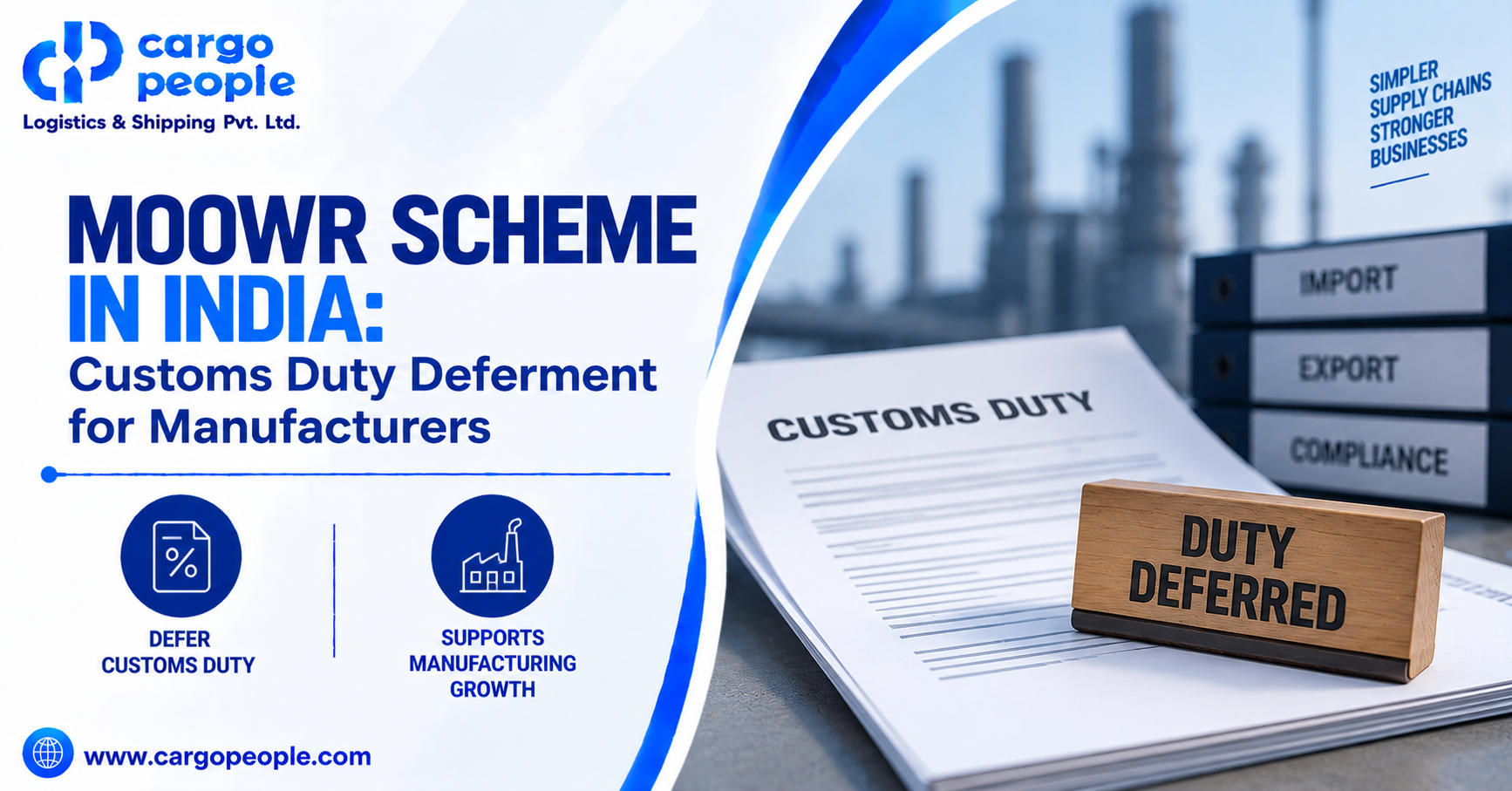
Manufacturers in India that depend heavily on imported machinery, raw materials, components, or other inputs can face significant working-capital pressure because customs duties add to the upfront cost of imports.
The MOOWR Scheme in India, based on Section 65 of the Customs Act, 1962 and the Manufacture and Other Operations in Warehouse Regulations, 2019, allows eligible businesses to carry out manufacturing or other operations in a licensed bonded warehouse while deferring customs duty on eligible imported goods.
This can be particularly useful for electronics manufacturers, battery manufacturers, engineering companies, automotive component businesses, machinery manufacturers, and other businesses that regularly use imported inputs or capital goods.
Cargo People Logistics & Shipping Pvt. Ltd. supports manufacturers with international freight, customs clearance, bonded cargo movement, warehousing coordination, and door-to-door logistics.
What is the MOOWR Scheme?
MOOWR stands for Manufacture and Other Operations in Warehouse Regulations.
Under this framework, eligible businesses can obtain a private warehouse licence under Section 58 and permission to undertake manufacturing or other operations under Section 65 of the Customs Act.
Imported raw materials, inputs, and capital goods can then be brought into the licensed premises with customs duty deferred according to the applicable warehousing provisions.
The business can use these imported goods for manufacturing while they remain under the bonded framework.
How Customs Duty Deferment Works
One of the main advantages of MOOWR is customs duty deferment.
A licensed unit can import eligible capital goods and inputs without immediately paying the applicable import duties.
For imported capital goods, both Basic Customs Duty and IGST can remain deferred while the goods remain within the applicable bonded framework. Invest India's bonded manufacturing guidance states that this duty deferment can continue without a specified time limit under the scheme.
This can reduce the amount of working capital blocked at the time of import.
MOOWR for Imported Raw Materials
Manufacturing businesses often import raw materials several months before finished products are actually sold.
Without a bonded manufacturing structure, import duties can become an upfront cost.
Under MOOWR, eligible imported inputs can be warehoused and used for manufacturing while customs duty remains deferred.
If the resultant goods are ultimately cleared into the Indian domestic market, the applicable customs duty treatment on imported inputs must be completed according to the relevant provisions.
If the finished goods are exported, the applicable customs framework provides for remission of the deferred duty on imported inputs used in exported goods, subject to compliance.
MOOWR for Imported Machinery
MOOWR can also be attractive for manufacturers investing in imported production machinery.
For example, a company establishing a new manufacturing facility may import machinery worth ₹5 crore, ₹10 crore, or more.
Immediate payment of customs duty on high-value capital equipment can put pressure on project cash flow.
Under the bonded manufacturing framework, eligible import duties on capital goods can remain deferred until the machinery itself is cleared for home consumption or otherwise dealt with under the applicable customs procedure.
This can help businesses allocate more capital toward plant installation, production, manpower, and working requirements.
Who Can Consider the MOOWR Scheme?
MOOWR may be useful for manufacturers that rely significantly on imported inputs or capital equipment.
Businesses that may evaluate the scheme include:
- Electronics manufacturers
- Lithium-ion battery manufacturers
- Automotive component manufacturers
- Engineering companies
- Machinery manufacturers
- Electrical equipment manufacturers
- Export-oriented manufacturers
- Businesses serving both Indian and overseas markets
An existing Domestic Tariff Area manufacturing unit can also apply, subject to the applicable licensing and customs requirements.
No Fixed Export Obligation Under MOOWR
A major operational feature of the MOOWR framework is that it is not limited only to export manufacturing.
A bonded manufacturing unit can manufacture for the domestic market as well as export markets, subject to the applicable customs and GST treatment.
Invest India's bonded manufacturing guidance specifically identifies the absence of a prescribed export obligation as one of the advantages of the framework.
This provides flexibility for manufacturers whose domestic and international sales may change over time.
MOOWR and Domestic Sales
Goods manufactured inside a bonded facility can be sold in the Indian market.
However, MOOWR should not be understood as a general exemption from customs duty.
When goods are cleared for domestic consumption, the applicable duties and taxes must be discharged according to the Customs Act and the relevant MOOWR provisions. Section 68 of the Customs Act requires applicable import duty, interest, fines, or penalties to be paid before warehoused goods are cleared for home consumption.
The commercial benefit primarily comes from the timing of duty payment and, in appropriate export situations, the treatment available for imported inputs.
MOOWR and Export Manufacturing
Manufacturers exporting finished products may find MOOWR particularly relevant when production depends heavily on imported components.
For eligible imported inputs used in finished goods that are exported, the deferred customs duty can be remitted according to the applicable bonded manufacturing rules.
For example, an Indian manufacturer importing electronic components and manufacturing finished systems for overseas customers may be able to operate through a bonded manufacturing structure rather than paying customs duty upfront on those inputs.
The exact benefit should be calculated according to the company's import volume, export percentage, product classification, and manufacturing process.
Manufacturing Inside a Bonded Warehouse
The premises used under MOOWR function both as a manufacturing facility and a customs bonded warehouse.
Businesses therefore need appropriate systems for identifying, storing, consuming, and accounting for imported goods.
Records should clearly show what goods entered the facility, what quantities were used for manufacturing, what finished products were produced, and how goods were eventually cleared or exported.
Units are also required to comply with prescribed inventory and customs record requirements.
This makes inventory discipline an important part of MOOWR operations.
MOOWR Application and Licensing
Businesses seeking to use MOOWR generally need the relevant warehouse licence and permission for manufacturing or other operations under Sections 58 and 65 of the Customs Act.
The application process requires information about the business, premises, manufacturing activities, imported goods, proposed operations, record systems, and other prescribed details.
Customs authorities may also examine whether the premises are suitable for secure storage and manufacturing operations.
Businesses should prepare their operational structure before applying rather than treating MOOWR only as a tax-saving registration.
Importance of Inventory Records
MOOWR requires strong inventory management.
A manufacturer may have domestic inputs, imported bonded inputs, capital equipment, finished goods, scrap, and waste within the same facility.
These movements need to be properly recorded.
For example, if a business imports 100 tonnes of raw material, customs records should be able to track how the material was received, consumed, converted into finished products, exported, cleared domestically, or generated as waste.
Weak inventory controls can create customs compliance problems.
MOOWR and Waste or Scrap
Manufacturing processes naturally generate scrap or waste.
Under the bonded manufacturing framework, the treatment of such waste depends on whether the resultant goods are exported or cleared domestically and on the applicable customs provisions.
The MOOWR permission conditions require businesses to account for inputs, resultant goods, waste, and refuse arising from manufacturing operations.
Manufacturers should therefore estimate expected input-output ratios and waste generation before beginning operations.
Logistics Planning Under MOOWR
MOOWR is not only a customs or finance decision.
Imported raw materials and machinery still need to move from overseas suppliers to the bonded manufacturing facility.
A typical movement may involve:
Overseas Supplier - Sea or Air Freight - Indian Port/Airport - Customs Bonded Movement - MOOWR Facility - Manufacturing - Domestic Clearance or Export
Freight, customs, bonded transportation, warehouse receiving, and inventory records should therefore be planned together.
Common MOOWR Planning Mistakes
One common mistake is evaluating MOOWR only on the basis of customs duty savings.
The business should also consider import volume, domestic sales, export sales, inventory cycles, compliance costs, accounting requirements, and operational processes.
Another mistake is beginning imports before the warehouse licensing and bonded movement process has been properly structured.
Businesses should complete a financial and operational assessment before implementing the scheme.
Is MOOWR Suitable for Your Business?
MOOWR can be particularly useful when imported machinery or raw materials represent a significant part of a manufacturer's cost.
Before applying, businesses should review:
- Annual import value
- Customs duty exposure
- Imported machinery requirements
- Imported raw material consumption
- Domestic sales
- Export sales
- Inventory holding period
- Manufacturing process
- Record-keeping capability
A detailed calculation can help determine whether the working-capital benefit justifies the compliance structure.
Why Choose Cargo People for MOOWR Logistics?
Cargo People Logistics & Shipping Pvt. Ltd. supports manufacturers and importers with the logistics activities connected with bonded manufacturing operations.
Our services include sea freight, air freight, customs clearance, FCL and LCL shipping, bonded cargo movement coordination, warehousing, project cargo handling, and door-to-door delivery.
Cargo People can coordinate imported machinery, raw materials, and components from overseas suppliers through Indian ports or airports and onward to the manufacturing facility.
Our focus is to connect international freight, customs clearance, bonded movement, and domestic transportation through one coordinated logistics process.
Learn More About the MOOWR Scheme in India
Planning to import machinery or raw materials for manufacturing in India?
The process should begin with MOOWR eligibility assessment, customs duty analysis, warehouse licensing, inventory planning, international freight, bonded cargo movement, and domestic or export clearance planning.
Cargo People Logistics & Shipping Pvt. Ltd. can support businesses with international freight, customs clearance, bonded movement coordination, project cargo, and door-to-door logistics.
👉 https://cargopeople.com/blog/moowr-scheme-india-customs-duty-deferment/
📞 Get Expert Assistance for MOOWR Logistics
If you are exploring the MOOWR Scheme in India and need support with imported machinery, raw materials, sea freight, air freight, customs clearance, bonded transportation, or project cargo logistics, Cargo People Logistics & Shipping Pvt. Ltd. can help coordinate your shipments.
🌐 Website: https://www.cargopeople.com/
📞 Phone: +91 97174 65454
📧 Email: wecare@cargopeople.com
Contact Cargo People for MOOWR-related freight, customs, and bonded logistics support in India.

 English
 French
 Spanish
 Portuguese
 Deutsch
 Turkish
 Dutch
Dutch
 Italiano
 Russian
 Romaian
 Portuguese (Brazil)