
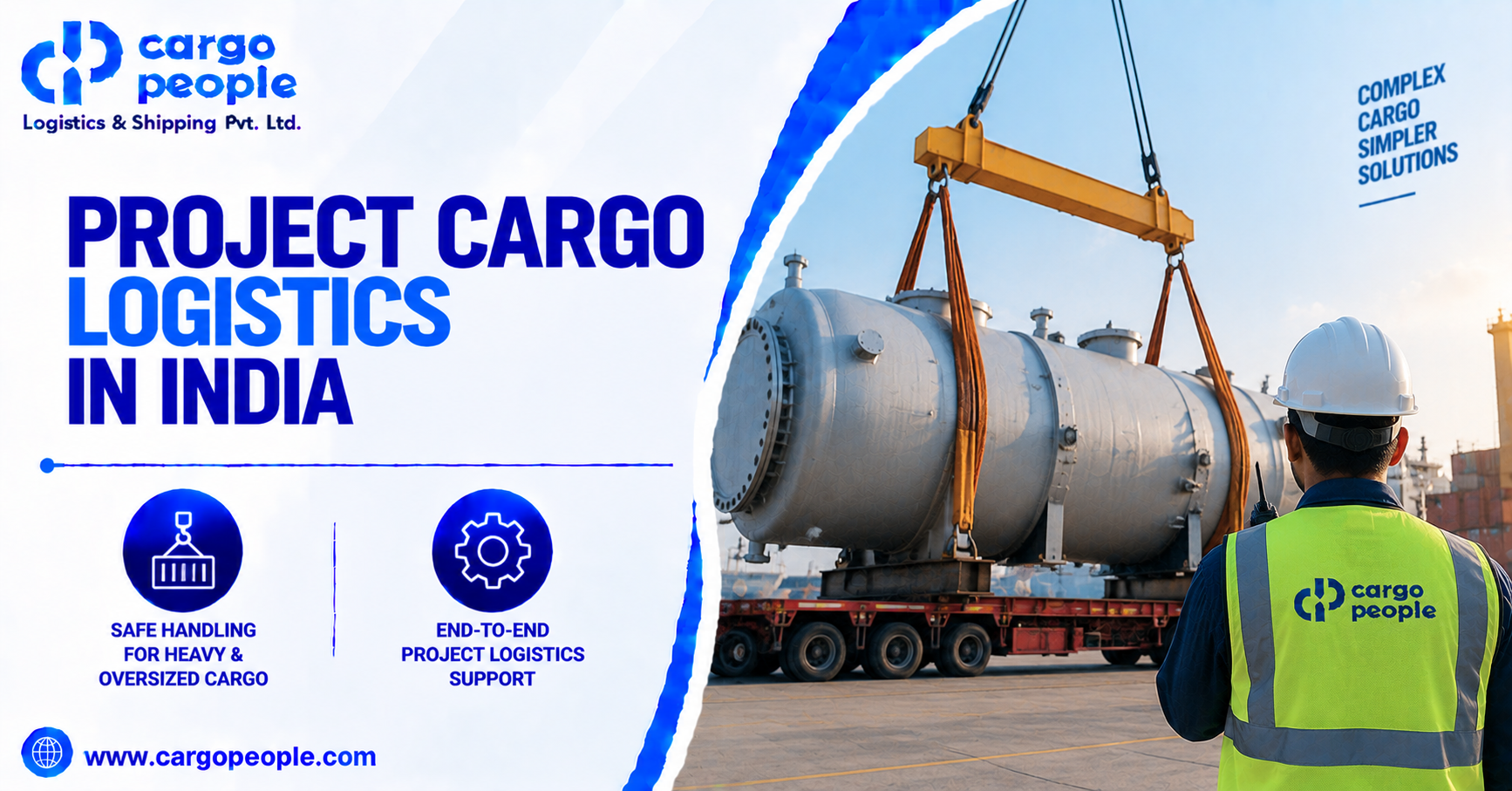
Moving heavy machinery, oversized equipment, industrial systems, and large commercial cargo requires far more planning than a normal container shipment.
Project Cargo Logistics in India involves the movement of cargo that may be too large, heavy, valuable, or technically complex for standard transportation.
Such shipments can require specialised containers, cranes, heavy-duty trailers, route surveys, customs coordination, lifting plans, and final-site delivery arrangements.
Cargo People Logistics & Shipping Pvt. Ltd. supports importers, exporters, manufacturers, contractors, and project companies with project cargo handling, sea freight, customs clearance, specialised transportation, warehousing, and door-to-door delivery across India.
What is Project Cargo Logistics?
Project cargo logistics refers to the transportation of heavy, oversized, high-value, or technically sensitive equipment that needs specialised planning and handling.
Typical project cargo may include industrial machinery, generators, transformers, manufacturing equipment, production lines, construction equipment, large electrical systems, commercial machinery, and infrastructure components.
Unlike normal cargo, project shipments are generally planned individually.
The logistics team needs to understand the cargo dimensions, weight, lifting points, packaging, transport route, and delivery-site conditions before movement begins.
Why Project Cargo Requires Special Planning
Large equipment cannot always be moved using standard containers or normal trucks.
A machine may weigh 15 tonnes, exceed normal container width, or require crane loading.
The shipment may also need to reach a factory or project site where road access is restricted.
For this reason, project cargo planning should begin before the equipment leaves the manufacturer.
Early planning helps determine the correct shipping method, handling equipment, route, and final delivery arrangement.
Cargo Dimensions and Weight
Accurate measurements are one of the most important parts of project cargo planning.
The shipper should provide the exact length, width, height, and gross weight of every package.
Incorrect dimensions can affect vessel booking, container selection, trailer requirements, permits, and transportation costs.
Important information may include:
- Cargo dimensions
- Gross weight
- Number of packages
- Centre of gravity
- Lifting points
- Packaging type
- Final delivery location
Photographs and technical drawings can also help the logistics team plan the movement.
FCL Shipping for Project Cargo
Some machinery and equipment can still move inside standard 20-foot or 40-foot containers.
If the cargo dimensions and weight are suitable, FCL shipping can provide dedicated container space and reduce handling.
However, heavy equipment must be properly loaded and secured inside the container.
The loading plan may require forklifts, cranes, wooden skids, blocking, bracing, and lashing to prevent the cargo from shifting during sea transportation.
Flat Rack and Open Top Containers
Oversized machinery may not fit inside a standard container.
In these situations, flat rack or open top containers may be considered.
Open top containers can be useful when equipment needs to be loaded from above using a crane.
Flat rack containers can be suitable for cargo that exceeds normal container width or height.
The correct container depends on the equipment dimensions, weight, route, shipping line acceptance, and loading requirements.
Breakbulk and ODC Cargo
Very large equipment may need to move as breakbulk or ODC cargo.
ODC means Over Dimensional Cargo.
This may include transformers, heavy industrial equipment, manufacturing systems, generators, pressure vessels, or other large project components.
These shipments may require specialised trailers, cranes, route surveys, escorts, or permits depending on the cargo and transportation route.
The movement should therefore be planned from the port to the final project site before the shipment arrives.
Customs Clearance for Project Cargo
Customs clearance for project cargo can require detailed product information.
The customs team may need the Commercial Invoice, Packing List, Bill of Lading, IEC details, HS Code, technical specifications, equipment catalogues, country of origin information, and applicable regulatory documents.
The product description should be accurate.
Using general descriptions such as "machine" or "equipment" may not provide enough information for efficient assessment.
Importers should provide model numbers, technical specifications, intended use, and supporting documents where required.
Packaging for Heavy and Oversized Cargo
Project cargo packaging should protect equipment during international transportation and repeated handling.
Depending on the equipment, packaging may include wooden crates, steel frames, heavy-duty skids, protective wrapping, moisture barriers, or customised structures.
For machinery moving by sea, protection against moisture and corrosion can also be important.
Sensitive electrical components may require additional protection during long transit periods.
The packaging method should be selected according to the value, weight, and sensitivity of the equipment.
Loading, Lashing and Securing
Heavy cargo must remain stable throughout transportation.
Equipment that is not properly secured can shift during vessel movement, road transportation, or handling.
The logistics team should therefore review weight distribution, lifting points, lashing requirements, and securing arrangements before loading.
A 10-ton machine, for example, cannot be treated like normal palletised cargo.
Proper blocking, bracing, and securing help reduce the risk of movement or damage during transit.
Route Survey for Project Cargo
The final road journey can be one of the most difficult stages of project cargo logistics.
Oversized cargo may face restrictions because of narrow roads, low bridges, sharp turns, overhead cables, weak structures, or limited entry points.
A route survey may therefore be required before dispatch.
The survey can review:
- Road width
- Bridge clearance
- Turning radius
- Height restrictions
- Factory gate dimensions
- Site access
- Unloading area
This helps identify potential problems before the equipment begins its final journey.
Crane and Heavy-Lift Planning
Many project cargo shipments require cranes or specialised lifting equipment.
The crane capacity should be selected according to cargo weight, lifting radius, site conditions, and unloading requirements.
The logistics team should also confirm whether the port, warehouse, or final project site has the required lifting equipment available.
For example, if a 20-ton machine reaches the site but the available crane can safely handle only 10 tonnes, delivery may be delayed and additional costs may arise.
Heavy-lift planning should therefore be completed before the cargo arrives.
Project Cargo Transportation in India
After customs clearance, the cargo may need specialised road transportation.
Depending on the size and weight, equipment may move on low-bed trailers, hydraulic axle trailers, flatbed vehicles, or other suitable transport equipment.
The vehicle should be selected according to the cargo specification and delivery route.
For oversized cargo, transport planning may also need to consider road restrictions, movement timing, escorts, or other operational requirements.
Final Delivery and Site Coordination
Project cargo logistics does not end at the port.
The final objective is to deliver the equipment safely to the factory, construction site, warehouse, plant, or installation location.
The transporter should coordinate with the site team before dispatch.
The site should confirm unloading space, crane availability, access route, manpower, and installation schedule.
Good coordination helps reduce vehicle waiting time and unnecessary handling.
Common Project Cargo Mistakes
One of the most common mistakes is booking freight before confirming final cargo dimensions.
Another is planning the sea freight but ignoring the road movement after customs clearance.
Other common issues include inadequate packaging, incorrect lifting information, missing technical documents, and lack of unloading arrangements at the destination.
Project cargo should therefore be planned as one complete movement from supplier pickup to final delivery.
How to Plan Project Cargo Logistics
Project cargo planning should start as early as possible.
Businesses should confirm:
- Cargo dimensions and weight
- Packaging requirements
- Container or shipping method
- Port of loading and discharge
- Customs documentation
- Heavy-lift requirements
- Final transport route
- Crane requirements
- Site readiness
Early planning gives the shipper, freight forwarder, customs team, transporter, and project site enough time to coordinate the movement.
Why Choose Cargo People for Project Cargo Logistics in India?
Cargo People Logistics & Shipping Pvt. Ltd. supports manufacturers, importers, exporters, contractors, project companies, SMEs, and corporate businesses with specialised cargo movement.
Our services include project cargo handling, sea freight, air freight, FCL shipping, flat rack and open top coordination, ODC movement, customs clearance, specialised transportation, warehousing, cargo insurance coordination, and door-to-door delivery.
Cargo People can coordinate the shipment from the overseas supplier through the Indian port or airport and onward to the factory, warehouse, project site, or final destination.
Our focus is to manage freight, customs, heavy handling, specialised transportation, and final delivery through one coordinated logistics process.
Learn More About Project Cargo Logistics in India
Planning to import or export heavy machinery, oversized equipment, industrial systems, or complex commercial cargo?
The process should begin with cargo measurement, equipment selection, packaging, freight planning, customs documentation, route assessment, and final delivery arrangements.
Cargo People Logistics & Shipping Pvt. Ltd. can support businesses with project cargo logistics, sea freight, customs clearance, heavy cargo transportation, warehousing, and door-to-door delivery.
👉 https://cargopeople.com/blog/project-cargo-logistics-india/
📞 Get Expert Assistance for Project Cargo Logistics
If you are looking for Project Cargo Logistics in India or need support with heavy machinery shipping, oversized cargo, ODC transportation, flat rack shipping, customs clearance, or final-site delivery, Cargo People Logistics & Shipping Pvt. Ltd. can help coordinate the complete movement.
🌐 Website: https://www.cargopeople.com/
📞 Phone: +91 97174 65454
📧 Email: wecare@cargopeople.com
Contact Cargo People for project cargo and complete heavy equipment logistics support in India.

 Arabic
 French
 Spanish
 Portuguese
 Deutsch
 Turkish
 Dutch
Dutch
 Italiano
 Russian
 Romaian
 Portuguese (Brazil)