
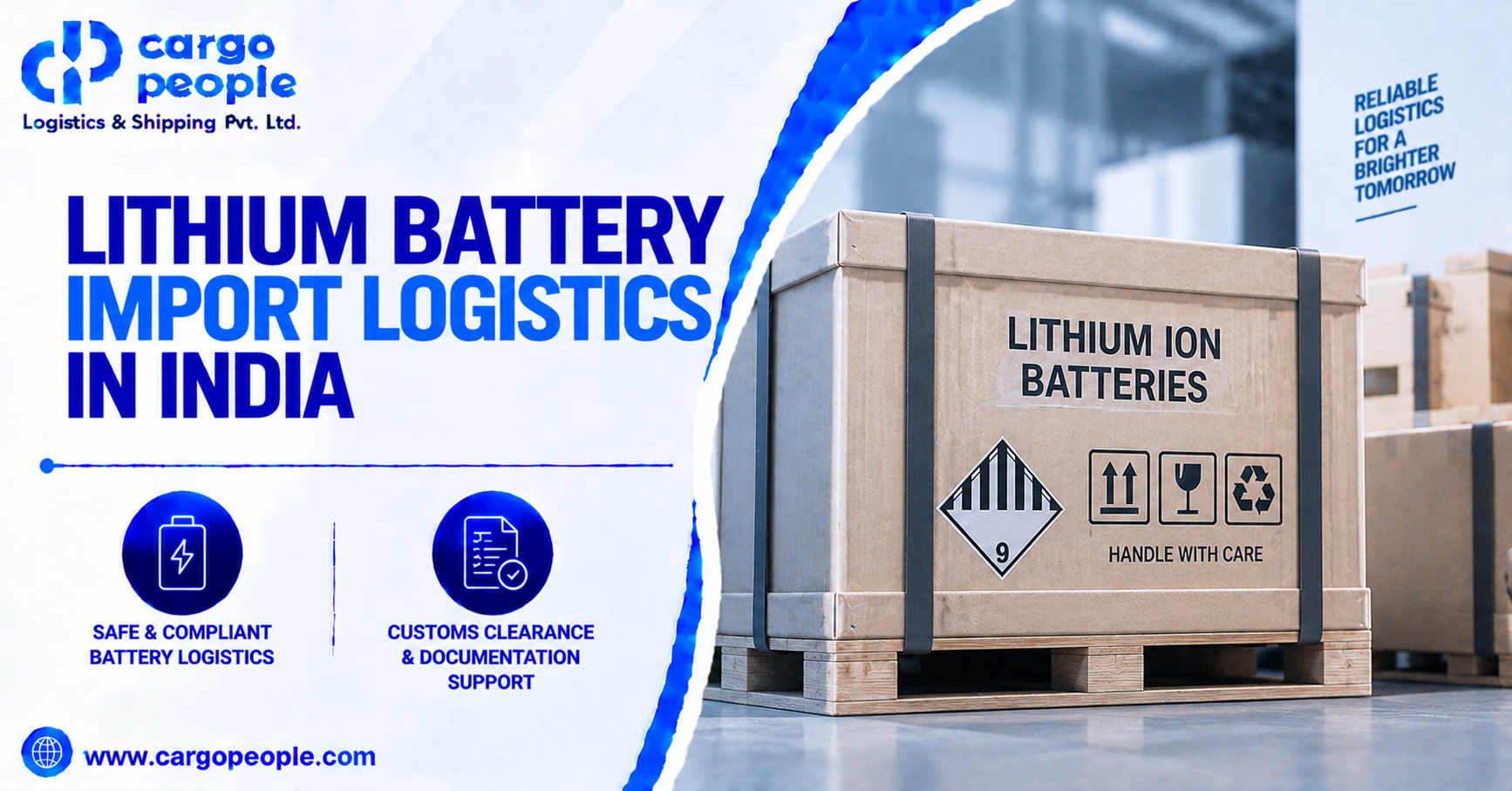
India imports lithium-ion cells and batteries for electronics, electric vehicles, energy storage systems, power tools, industrial equipment, telecom applications, and many other commercial uses.
However, Lithium Battery Import Logistics in India requires more planning than ordinary cargo because lithium batteries are treated as dangerous goods for transportation and can be subject to specific packaging, marking, documentation, safety, customs, and environmental compliance requirements.
For businesses importing batteries from China, South Korea, Vietnam, Europe, the USA, or other manufacturing markets, the logistics process should be planned before the supplier dispatches the shipment.
Cargo People Logistics & Shipping Pvt. Ltd. supports businesses with lithium battery freight forwarding, DG cargo handling, air freight, sea freight, customs clearance, warehousing, and door-to-door delivery in India.
Why Lithium Battery Logistics Needs Special Handling
Lithium batteries store a large amount of energy in a relatively small space.
If batteries are damaged, incorrectly packed, short-circuited, or exposed to unsuitable conditions, they can create safety risks during transportation.
IATA classifies lithium batteries as dangerous goods for air transport and applies specific requirements for identification, packaging, marking, labelling, and documentation.
Importers should therefore inform the freight forwarder clearly that the shipment contains lithium batteries before requesting a freight rate.
Lithium Battery DG Classification
The correct classification depends on whether batteries are shipped separately or together with equipment.
For example, standalone lithium-ion batteries are generally classified as UN 3480, while lithium-ion batteries packed with or contained in equipment fall under UN 3481 classifications.
This distinction affects the applicable packing instructions, labels, documentation, and airline acceptance requirements.
The supplier should provide accurate technical battery information before the shipment is booked.
Air Freight for Lithium Batteries
Air freight may be used when lithium battery shipments are urgent or relatively high in value, but airline DG restrictions need to be checked before booking.
Under the 2026 IATA guidance, standalone lithium-ion batteries classified as UN 3480 cannot be transported as cargo on passenger aircraft and are subject to Cargo Aircraft Only requirements. Standalone UN 3480 lithium-ion cells and batteries are also generally required to be offered for air transport at no more than 30% state of charge, subject to specified exceptions and approvals.
Airlines may also have their own operating restrictions.
Importers should therefore avoid arranging supplier pickup until the battery documents and airline acceptance have been confirmed.
Sea Freight for Lithium Battery Imports
Sea freight is often considered for larger battery shipments, particularly when cargo volume does not justify the higher cost of air transport.
Depending on quantity and shipment structure, batteries may move through FCL or other suitable sea freight arrangements subject to dangerous goods requirements and shipping-line acceptance.
The freight forwarder should know the battery type, UN classification, quantity, gross weight, packaging method, and container requirements before booking.
Providing this information early helps avoid rejected bookings and last-minute changes at the port.
UN 38.3 Test Summary
Battery manufacturers and suppliers should be able to provide relevant battery safety and transport documentation.
One important consideration in international lithium battery transportation is compliance with the applicable UN testing framework.
IATA's Battery Shipping Regulations specifically cover requirements relating to the UN Manual of Tests and Criteria, classification, packing, marking, documentation, and battery acceptance.
Importers should request the relevant technical documents from the overseas manufacturer before confirming freight.
A supplier saying that a battery is "safe for shipping" is not a substitute for proper transport documentation.
Packaging for Lithium Battery Shipments
Lithium battery packaging should be appropriate for the battery type and applicable transport rules.
The packaging needs to protect batteries against physical damage and reduce the possibility of short circuits or unintended movement.
Depending on the shipment, requirements may include suitable inner packaging, strong outer packaging, terminal protection, cushioning, DG marks, hazard labels, and other prescribed information.
The exact packing method depends on the battery classification and transport mode.
Importers should therefore avoid repacking DG batteries without understanding the applicable packing requirements.
Documents for Lithium Battery Imports
Lithium battery shipments normally require standard commercial documents along with battery-related technical and dangerous goods documents as applicable.
Documents may include:
- Commercial Invoice
- Packing List
- Bill of Lading or Air Waybill
- IEC details
- HS Code and product description
- UN 38.3-related documentation
- Battery technical specifications
- Dangerous Goods Declaration where applicable
- Applicable regulatory and compliance documents
Document requirements can vary according to battery chemistry, configuration, quantity, transport mode, and carrier.
Customs Clearance for Lithium Batteries
Customs clearance should be planned before the batteries arrive in India.
The importer should provide accurate information about the battery type, chemistry, capacity, application, model, value, quantity, and HS classification.
For example, simply describing cargo as "battery" may not provide enough information for efficient customs assessment.
Depending on the product, customs or regulatory teams may require technical datasheets, catalogues, test documents, and compliance information.
Preparing these documents before arrival can help reduce unnecessary clearance queries.
Battery Waste Management and EPR
Battery importers also need to consider environmental compliance in India.
The Battery Waste Management Rules, 2022 cover all types of batteries regardless of chemistry, shape, volume, weight, material composition, or use, subject to specified exclusions.
CPCB guidance identifies several types of battery importers as producers under the framework, including businesses importing batteries for sale, batteries contained in equipment, and batteries for certain self-use situations. Producers are subject to registration and Extended Producer Responsibility requirements under the applicable rules.
Businesses should therefore check EPR applicability before beginning regular battery imports.
BIS and Product Compliance
Lithium battery compliance may also depend on the intended application of the battery.
For example, BIS maintains standards such as IS 16046 (Part 2): 2018 for portable sealed secondary lithium cells and batteries used in portable applications.
However, compliance requirements vary according to battery type and end use.
Importers should verify the exact product specification and applicable regulatory framework before placing a commercial order.
Transport compliance and product certification should not be treated as the same requirement.
Common Lithium Battery Import Mistakes
One of the biggest mistakes is booking a shipment before confirming that the carrier accepts the battery configuration.
Another is relying only on a supplier's commercial invoice without obtaining the required battery technical documentation.
Importers should also avoid:
- Incorrect UN classification
- Missing battery test information
- Improper DG packaging
- Incorrect cargo labels
- Incomplete product descriptions
- Ignoring EPR requirements
- Booking air freight without airline DG approval
These issues can result in rejected cargo, shipment delays, additional handling, or customs problems.
How to Plan Lithium Battery Imports
The logistics process should begin before cargo leaves the overseas factory.
Importers should confirm:
- Battery chemistry and application
- UN classification
- Battery capacity and specifications
- UN 38.3-related documents
- DG packaging requirements
- Air or sea freight acceptance
- Indian customs requirements
- EPR applicability
- Product compliance requirements
- Final delivery arrangements
Early planning allows the supplier, freight forwarder, carrier, customs team, and importer to work with the same shipment information.
Why Choose Cargo People for Lithium Battery Logistics?
Cargo People Logistics & Shipping Pvt. Ltd. supports importers, manufacturers, distributors, traders, SMEs, and corporate businesses with lithium battery import logistics.
Our services include dangerous goods cargo coordination, air freight, sea freight, FCL shipping, customs clearance, warehousing, cargo insurance coordination, and door-to-door delivery.
Cargo People can coordinate the movement from the overseas supplier through the Indian airport or seaport and onward to the warehouse, factory, or final destination.
Our focus is to connect freight planning, DG handling, customs clearance, storage, and domestic delivery through one coordinated logistics process.
Learn More About Lithium Battery Import Logistics in India
Planning to import lithium-ion batteries, battery cells, battery packs, or equipment containing batteries into India?
The process should begin with battery classification, DG documentation, packaging review, carrier acceptance, regulatory compliance, customs planning, and final delivery arrangements.
Cargo People Logistics & Shipping Pvt. Ltd. can support businesses with lithium battery air freight, sea freight, DG cargo handling, customs clearance, warehousing, and door-to-door logistics.
👉 https://cargopeople.com/blog/lithium-battery-import-logistics-india/
📞 Get Expert Assistance for Lithium Battery Import Logistics
If you are looking for Lithium Battery Import Logistics in India or need support with dangerous goods handling, air freight, sea freight, customs clearance, warehousing, or door-to-door delivery, Cargo People Logistics & Shipping Pvt. Ltd. can help coordinate the complete shipment.
🌐 Website: https://www.cargopeople.com/
📞 Phone: +91 97174 65454
📧 Email: wecare@cargopeople.com

 English
 Arabic
 French
 Spanish
 Portuguese
 Deutsch
 Turkish
 Italiano
 Russian
 Romaian
 Portuguese (Brazil)