
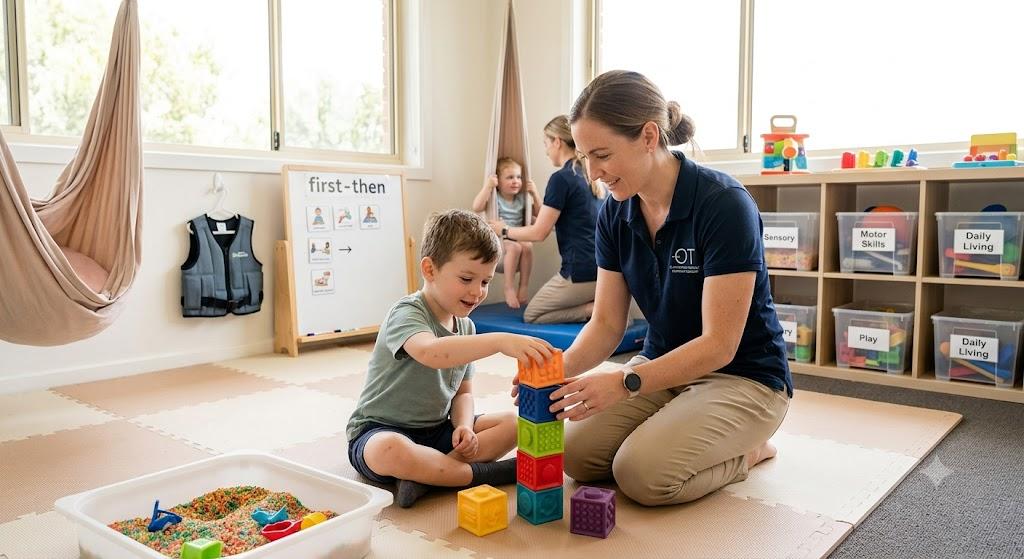
Occupational therapy can play an important role in supporting children with autism in everyday activities, communication, play, learning, and participation. Rather than focusing on one single skill, sessions are generally structured around the individual child's developmental needs, abilities, and daily routines. This personalised approach helps make therapy relevant to the child's experiences at home, school, and in other familiar environments.
What Is Occupational Therapy for Children With Autism?
Occupational therapy focuses on skills that children use to participate in everyday activities. For children with autism, this may include developing independence with daily routines, improving attention and motor coordination, supporting sensory regulation, and encouraging participation in play and learning activities.
An occupational therapy session is not necessarily the same for every child. The activities selected depend on the child's developmental profile and the areas that require support. An occupational therapist may first observe how the child responds to different activities before introducing exercises or structured tasks.
What Happens During a Typical Session?
A session may begin with simple activities that help the therapist understand the child's current abilities and level of engagement. Depending on the child's needs, the session can include activities involving movement, coordination, sensory experiences, play, or everyday tasks.
Sensory-based activities may be included when a child responds differently to certain sounds, textures, movements, or other sensory experiences. The therapist may use carefully selected activities to support the child's ability to participate comfortably in different situations.
Fine and gross motor activities can also form part of the session. These may involve hand coordination, balance, movement, or activities requiring controlled physical actions. Such tasks can be incorporated into play so that the child remains engaged while practising specific skills.
Supporting Everyday Independence
Occupational therapy can also address practical daily activities. Depending on the child's developmental stage, this may include routines related to dressing, eating, personal care, organising belongings, or completing simple tasks.
The therapist may break an activity into smaller steps and practise them gradually. Visual cues, repetition, demonstrations, and structured routines can be used when appropriate. The aim is to make everyday activities easier to understand and participate in according to the child's individual needs.
For parents looking into child occupational therapy for the first time, understanding the scope of the service can help them consider whether it matches their child's developmental requirements.
Play, Attention and Social Participation
Play is often an important part of occupational therapy for children. Activities can be selected to encourage attention, coordination, motor planning, turn-taking, and participation.
A therapist may introduce structured games, movement activities, construction tasks, drawing, or other age-appropriate activities. These can provide opportunities to practise skills while keeping the session meaningful and engaging for the child.
Occupational therapy may also support participation in school and community settings. Activities can be designed around skills such as following routines, remaining engaged with a task, managing transitions, and participating in age-appropriate activities.
How Assessments Guide Therapy
Before or during the therapy process, assessment can help identify areas that require attention. The therapist may consider motor skills, sensory responses, attention, daily living abilities, play, and participation.
This information helps inform an individualised plan. Progress is considered in relation to the child's starting abilities and the specific skills being addressed rather than through a one-size-fits-all programme.
Parents may also receive guidance on activities and routines that can be incorporated into everyday life. Consistency between therapy sessions and familiar routines can help children practise relevant skills in meaningful contexts.
Working With a Multidisciplinary Team
Children with developmental needs may benefit from support from different professionals. Occupational therapy can therefore form part of a broader multidisciplinary approach alongside services such as child guidance, speech therapy, clinical psychology, psychiatry, and assessment for neurodevelopmental disorders.
An occupational therapist may work within this wider framework, depending on the child's individual needs and the services involved in their care.
What Parents Can Expect From a Session
Every occupational therapy session can look different because activities are selected according to the child's age, developmental needs, interests, and areas requiring support. Some sessions may involve movement and sensory activities, while others may focus more heavily on motor coordination, play, attention, or daily routines.
The overall process is structured around practical skills and participation. Parents can discuss their child's developmental history, current needs, routines, and goals with the treating professionals so that therapy can be considered in the context of the child's everyday life.
Occupational therapy for children with autism is therefore not simply a collection of exercises. It is a structured, individualised service that can address sensory, motor, developmental, and everyday participation needs through meaningful activities.

 Arabic
 French
 Spanish
 Portuguese
 Deutsch
 Turkish
 Dutch
Dutch
 Italiano
 Russian
 Romaian
 Portuguese (Brazil)