
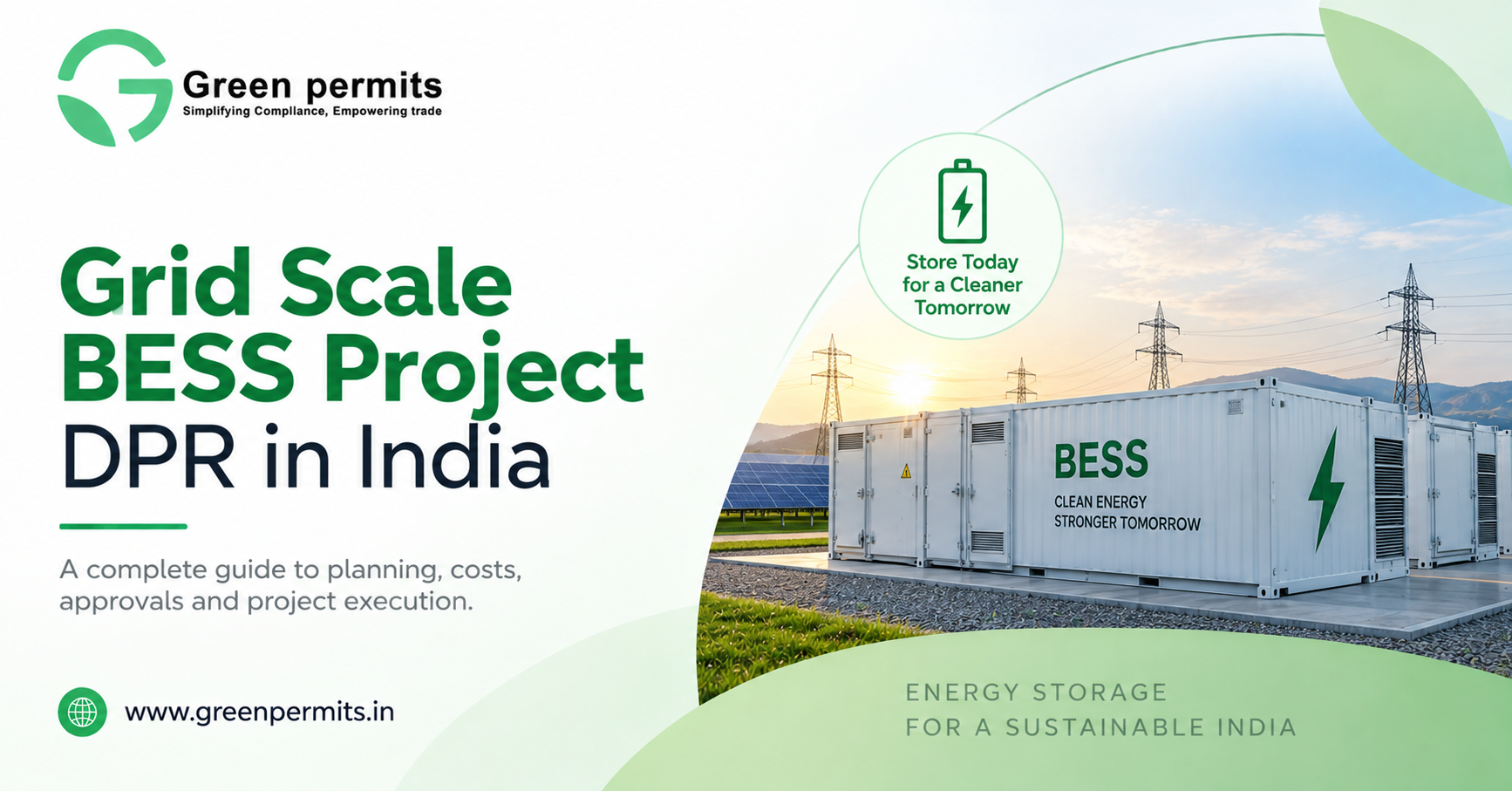
A Grid Scale BESS Project DPR helps investors, renewable-energy developers, utilities and industrial companies evaluate the technical design, battery capacity, grid connectivity, project cost, revenue model and financial feasibility of a Battery Energy Storage System before major investment.
Grid-scale BESS projects are increasingly being considered alongside solar and wind projects because battery storage can shift renewable electricity to higher-value hours, support peak demand, improve grid flexibility and help manage fluctuations in renewable generation.
However, a BESS project should not begin with a battery quotation alone. The developer first needs to understand why the battery is required, how many MW and MWh are needed, how often it will cycle, where it will connect to the grid and how the project will generate revenue.
Green Permits Consulting supports developers with BESS feasibility studies, Detailed Project Reports, site assessment, capacity planning, CAPEX and OPEX analysis, financial modelling and project finance documentation.
What is a Grid Scale BESS?
A Battery Energy Storage System stores electricity and supplies it back when required.
A typical grid-scale system includes battery containers or racks, Battery Management System, Power Conversion System, transformers, switchgear, HVAC, fire-safety systems, Energy Management System and grid interconnection equipment.
The basic power flow is:
Grid / Solar / Wind → PCS → Battery Storage → PCS → Transformer → Grid
Battery projects are usually described using both MW and MWh.
MW represents the maximum power the system can charge or discharge at one time, while MWh represents how much energy can be stored.
For example, a 100 MW / 200 MWh BESS can theoretically discharge at 100 MW for approximately two hours, subject to usable energy, operating limits and efficiency.
Why a DPR is Important for a BESS Project
A BESS DPR converts a storage concept into a technically and financially structured project.
It helps determine whether the proposed battery size matches the actual application.
A solar developer wanting to shift afternoon generation into evening hours may need a different storage duration from a project designed for peak shaving or grid services.
The DPR should therefore start with:
Application → Required Power → Storage Duration → Cycling Pattern → Battery Capacity
This is more reliable than deciding that the project will simply install a certain number of battery containers.
MW and MWh Sizing
Correct BESS sizing is one of the most important parts of the project.
Suppose a project needs to supply 50 MW for four hours.
The basic energy requirement would be around:
50 MW × 4 Hours = 200 MWh
But the installed battery capacity may need to be higher after considering usable depth of discharge, efficiency, degradation and operational reserve.
Therefore:
Required Delivered Energy ≠ Nameplate Battery Capacity
The DPR should calculate both beginning-of-life and end-of-life performance instead of sizing the project only for the first year.
Battery Technology Selection
Lithium-ion batteries are widely used for grid-scale storage, with LFP - Lithium Iron Phosphate being a common chemistry for stationary storage applications.
Technology selection should consider cycle life, thermal characteristics, energy density, warranty, degradation, operating temperature and supplier performance guarantees.
The lowest-priced battery should not automatically be selected.
For a project expected to operate for 15 or 20 years, degradation and replacement requirements can have a greater financial impact than a small difference in initial purchase price.
Battery Degradation and Augmentation
Battery capacity reduces over time as the system cycles and ages.
A project that begins with 100 MWh of usable capacity may not provide the same usable energy several years later.
Developers therefore need an augmentation strategy.
Additional battery capacity may be installed during the project life to maintain the contracted storage requirement.
The DPR should evaluate:
Initial Capacity → Annual Degradation → Required Performance → Augmentation
Ignoring degradation can result in a project that meets performance requirements initially but struggles later in the contract period.
Site Selection for Grid Scale BESS
A BESS project requires a site with suitable grid connectivity, enough land, safe access and adequate separation between battery equipment and other infrastructure.
The location should be evaluated for proximity to the substation, evacuation capacity, transmission requirements, road access, flooding risk and fire response.
A project located close to a suitable grid point may reduce transmission and interconnection costs.
For co-located renewable projects, the developer should also decide whether the BESS will share existing evacuation infrastructure or require additional capacity.
Standalone BESS vs Solar Plus Storage
A standalone BESS charges electricity from the grid and discharges it according to the commercial or grid requirement.
A solar plus BESS project stores electricity generated from the solar plant and supplies it later.
For example:
Solar Generation → BESS Charging → Evening Discharge
This can help shift renewable energy from low-demand or high-generation periods to hours when electricity is more valuable.
The DPR should model both charging cost and discharge revenue because stored electricity is not free simply because it comes from a renewable project.
Major BESS Equipment
The battery itself is only one part of the complete project.
A commercial system also requires the PCS, transformer, switchgear, Battery Management System, Energy Management System, HVAC, fire detection and suppression, SCADA, cabling and grid interconnection infrastructure.
Civil works, fencing, drainage, internal roads and control facilities may also be required.
Therefore, the project cost should be calculated as:
Battery System + PCS + Transformer + Electrical Balance of Plant + Civil Works + Grid Connection + Safety Systems
instead of using only the battery-container price.
Grid Scale BESS Project Cost
There is no single fixed cost per MWh that can be used for every BESS project.
CAPEX depends on battery chemistry, duration, supplier, warranty, container configuration, PCS design, interconnection voltage, site infrastructure and augmentation strategy.
A 100 MW / 100 MWh project and a 100 MW / 400 MWh project have the same power rating but very different battery requirements and economics.
The DPR should therefore prepare a project-specific cost model based on actual vendor quotations and system architecture.
Revenue Model for a BESS Project
A grid-scale battery can have different revenue models depending on the project structure.
Some projects may operate under long-term storage contracts or tenders. Others may be used for renewable-energy shifting, peak management, ancillary services or captive optimisation where permitted.
The financial model should clearly define:
How the Battery Charges → When it Discharges → Who Pays → Payment Structure
A project should not assume that having a battery automatically creates revenue.
The contractual or market mechanism must be identified before financial closure.
Round-Trip Efficiency
Not all electricity used to charge a battery is returned during discharge.
Losses occur through the battery, PCS, transformer, HVAC and other equipment.
This is represented through round-trip efficiency.
For example, if a system takes 100 units of electricity to charge but delivers only 88 units back to the grid, the energy loss affects operating economics.
The DPR should use supplier-backed efficiency assumptions and calculate losses over the entire project life.
Cycling Strategy
Battery economics are strongly affected by how often the system operates.
One cycle per day creates a different degradation profile from multiple daily cycles.
The DPR should therefore define the expected operating strategy before selecting the battery warranty.
A system designed for occasional peak support should not be evaluated using the same cycle assumptions as a battery expected to charge and discharge every day.
Fire and Safety Planning
Safety is a critical part of large BESS projects.
Battery containers should be designed with appropriate monitoring, ventilation or cooling, fire detection, emergency isolation and suppression systems according to the selected technology and applicable standards.
The site layout should also provide suitable separation, emergency access and operational controls.
Fire planning should be incorporated into the initial project design instead of being added after the battery system has already been ordered.
Environmental and Regulatory Planning
The exact approval requirement depends on the location, project structure, land and grid connection.
A BESS project may need to assess electrical approvals, fire-safety permissions, land and local approvals, grid connectivity requirements and environmental permissions where applicable.
If the BESS is part of a solar or industrial project, its approvals should be integrated with the larger facility.
End-of-life batteries and replacement modules should also be managed through the applicable battery-waste framework.
OPEX and Battery Replacement
BESS operating cost includes more than routine maintenance.
The financial model should consider auxiliary electricity for cooling, annual maintenance, insurance, software and EMS support, replacement parts, augmentation and eventual battery replacement.
For long-term projects, augmentation can become a significant lifecycle expense.
The DPR should therefore calculate both:
Initial CAPEX and Lifecycle Cost
A project with slightly higher initial investment may be financially stronger if degradation and augmentation requirements are lower.
Project Finance for Grid Scale BESS
Banks and investors need confidence that the project has predictable revenue and technically reliable equipment.
A lender will typically evaluate the storage contract or revenue model, battery supplier, warranty, degradation guarantees, EPC arrangement, grid connectivity and projected cash flow.
For contracted projects, the payment mechanism and performance obligations become particularly important.
The DPR should evaluate cash flow, debt servicing, project returns and downside scenarios before financing is finalised.
Financial Sensitivity Analysis
Battery projects can be sensitive to relatively small changes in assumptions.
The DPR should test scenarios such as higher battery replacement cost, lower efficiency, faster degradation, reduced availability or delayed commissioning.
For merchant or market-linked projects, changes in electricity price spreads may also affect revenue.
A strong model should therefore analyse:
Base Case → Downside Case → Cash Flow → Debt Repayment → Project Returns
rather than presenting only the most optimistic scenario.
Common Mistakes in BESS Project Planning
One common mistake is selecting battery capacity before defining the commercial use case.
Another is considering only the initial battery price while ignoring augmentation, grid infrastructure, auxiliary consumption and replacement cost.
Developers may also assume full battery capacity will remain available throughout the project life.
A better sequence is:
Use Case → Grid Study → MW/MWh Sizing → Technology → Site → DPR → Commercial Model → Project Finance
How Green Permits Helps with Grid Scale BESS Projects
Green Permits Consulting supports renewable-energy developers, investors and industrial companies with Grid Scale BESS feasibility studies, DPR preparation, battery sizing, technology evaluation, site assessment, CAPEX and OPEX modelling, financial analysis and project finance documentation.
The objective is to determine whether the proposed storage capacity, technology and commercial model are financially viable before major investment.
Learn More About Grid Scale BESS Project DPR
If you are planning a standalone BESS or solar-plus-storage project in India, the project should be evaluated for MW/MWh sizing, battery degradation, grid connectivity, CAPEX, augmentation, safety and revenue model before equipment is finalised.
Read more about project feasibility and DPR consulting services here:
👉 https://www.greenpermits.in/09/grid-scale-bess-dpr-in-india-cost-financials/
📞 Get Expert Assistance for Grid Scale BESS Project DPR
If you need help with a Grid Scale BESS Project DPR, feasibility study, battery sizing, CAPEX analysis, financial modelling or project finance, Green Permits Consulting can assist you.
🌐 Website: www.greenpermits.in
📞 Phone: +91 78350 06182
📧 Email: wecare@greenpermits.in

 Arabic
 French
 Spanish
 Portuguese
 Deutsch
 Turkish
 Dutch
Dutch
 Italiano
 Russian
 Romaian
 Portuguese (Brazil)