
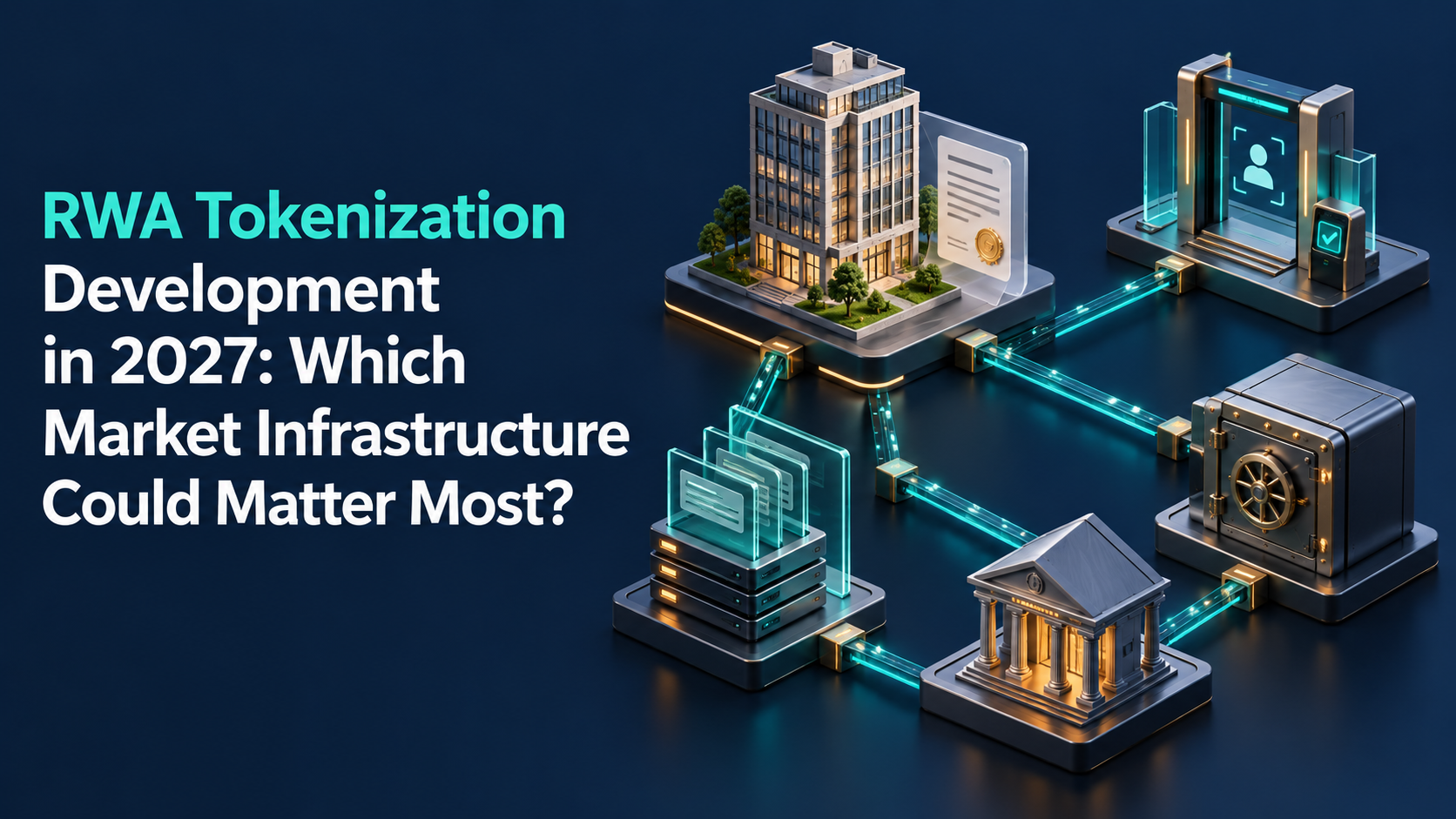
Real-world asset markets are moving toward a model where physical and financial assets can be represented through blockchain-based tokens. Real estate, private credit, government securities, commodities, funds, invoices, and other assets are being considered for tokenization as financial institutions look for new ways to issue, manage, settle, and transfer ownership records.
By 2027, the discussion around RWA tokenization development may move beyond the creation of asset tokens themselves. The surrounding market infrastructure could become just as important. Investor identity, custody, settlement, compliance systems, asset servicing, trading venues, valuation systems, payment rails, and data connections may determine whether tokenized assets can operate efficiently across different financial environments.
This means businesses entering the market may need to think about the complete infrastructure surrounding an asset token rather than treating token issuance as a standalone product. For an RWA tokenization company, this shift could create demand for platforms that connect several financial processes within one operating environment.
Why Market Infrastructure Could Matter More in 2027
Tokenization gives an asset a digital representation, but the token alone does not solve every operational requirement. A tokenized bond, for example, still needs investor verification, ownership records, settlement procedures, payment processing, reporting, custody arrangements, and compliance controls.
As more institutions participate in tokenized markets, these surrounding services could become increasingly important. A market may have thousands of tokenized assets, but their usefulness can remain limited if investors cannot move them between compatible systems or receive income through reliable payment mechanisms.
For businesses working on RWA tokenization platform development, this creates a wider product scope. The platform may need to connect asset issuers, investors, custodians, administrators, compliance teams, marketplaces, and financial service providers.
The question in 2027 may therefore become less about whether an asset can be tokenized and more about how efficiently the token can participate in a complete financial lifecycle.
1. Identity and Investor Verification Infrastructure
Investor identity is likely to remain an important part of tokenized markets. Unlike many permissionless digital assets, regulated real-world assets can involve investor eligibility rules, jurisdiction restrictions, accreditation requirements, sanctions screening, and other compliance checks.
A tokenization platform may therefore need identity systems that verify users before they gain access to particular assets. Instead of repeatedly submitting the same information across different platforms, investors could use verified identity credentials that interact with approved financial applications.
For an RWA tokenization development company, this can mean connecting identity verification, KYC procedures, AML checks, wallet addresses, and investor permissions within the platform architecture.
Method: Connect identity with asset permissions
A practical model is to associate verified investor status with wallet permissions. When an investor passes the required checks, the platform can record the relevant eligibility information and allow access to suitable tokenized assets.
Different assets can have different investor requirements. A private credit token might have one set of restrictions, while a government security or real estate investment could have another. The infrastructure needs to account for these differences rather than treating every investor and asset in the same way.
2. Custody and Wallet Infrastructure
Tokenized assets need secure methods for holding and transferring digital representations of ownership. This places custody and wallet infrastructure in an important position.
Institutional investors may not want to manage private keys in the same manner as individual crypto users. They may require custody providers, multi-signature controls, transaction approvals, policy management, audit records, and recovery procedures.
RWA tokenization platforms may therefore support different wallet models, including investor wallets, institutional custody wallets, smart contract wallets, and controlled wallets connected with regulated custodians.
Method: Support multiple custody models
An RWA tokenization platform development company can design custody functionality around the needs of different users. Individual investors may require a simpler wallet experience, while institutions may need approval workflows involving several authorized personnel.
The platform can also record transfers and ownership changes while applying the appropriate restrictions to each transaction.
3. Settlement and Payment Rails
Settlement could become one of the most important areas for tokenized financial markets in 2027. Asset transfers are only one side of a transaction. Buyers also need a reliable way to deliver payment while sellers need to receive funds.
Stablecoins, tokenized deposits, bank payment systems, and other digital payment mechanisms could potentially participate in this process, depending on the regulatory environment and market structure.
For example, a tokenized bond transaction could involve an asset token moving from a seller to a buyer while a digital payment instrument moves in the opposite direction. Smart contracts can coordinate these actions when the relevant conditions are satisfied.
Method: Connect asset movement with payment movement
RWA tokenization development can focus on transaction workflows where asset delivery and payment settlement are coordinated. This can reduce situations where one side of a transaction is completed while the other side remains pending.
The exact payment method will depend on the asset, jurisdiction, financial institutions involved, and regulatory framework. As a result, platforms may need several settlement options rather than relying on one payment mechanism.
4. Compliance Infrastructure
Compliance may become deeply connected with tokenized asset infrastructure. A token representing a regulated security cannot necessarily be transferred to every wallet or every investor.
Rules may apply based on investor location, holding period, investor category, asset type, offering structure, and other conditions.
An RWA tokenization company may therefore use smart contracts and off-chain compliance systems together. The blockchain can record ownership and transactions, while external compliance systems provide information needed to determine whether a transaction should proceed.
Method: Place compliance rules into transaction workflows
Instead of checking compliance only during onboarding, platforms can apply rules throughout the asset lifecycle. Before a transfer takes place, the system can check whether the sender and recipient meet the relevant requirements.
This approach can make compliance part of everyday asset operations rather than treating it as a separate administrative activity.
5. Asset Servicing Infrastructure
Issuing a token is only the beginning of an asset's lifecycle. Real-world assets often generate income, require reporting, undergo valuation changes, or experience corporate and administrative events.
A tokenized real estate asset, for example, may generate rental income. A private credit instrument may involve interest payments. A fund may distribute proceeds to investors. These events need to be reflected in investor records.
This creates demand for asset servicing infrastructure that can connect real-world financial activity with on-chain records.
Method: Connect off-chain events with token records
A platform can use data feeds and administrative systems to update token-related records when an asset generates income or experiences another financial event.
For example, rental income can be calculated off-chain, approved by the relevant administrator, and then distributed to eligible token holders through an automated payment workflow.
This could make asset servicing an important area for RWA token development in 2027.
6. Valuation and Data Infrastructure
Tokenized assets depend on reliable information about the assets they represent. Property tokens may require property valuations. Commodity tokens may depend on market prices. Private credit products may need borrower information and repayment data.
This makes data infrastructure another significant part of the tokenization ecosystem.
Blockchain networks generally do not know what is happening in the physical world without external data sources. Oracles and other data services can provide information that smart contracts need to process asset-related events.
Method: Combine several data sources
An RWA tokenization platform development company can connect valuation providers, market data services, asset administrators, accounting systems, and other approved data sources.
Using several sources can also help platforms compare information and identify differences that require human review.
The quality of the underlying data matters because inaccurate information can affect distributions, valuations, investor reporting, and trading decisions.
7. Secondary Trading Infrastructure
Primary issuance may attract investors, but secondary markets can influence how useful tokenized assets become after issuance.
A token holder may eventually want to sell an asset position rather than waiting until maturity or another liquidity event. This creates a requirement for trading venues that understand the restrictions associated with tokenized assets.
Unlike unrestricted crypto tokens, many tokenized securities may only be transferable between approved participants.
Method: Create permission-aware trading systems
Secondary marketplaces can connect order management, investor verification, asset restrictions, settlement, and custody into one trading process.
A trading platform may first check the buyer's eligibility, confirm that the seller can transfer the asset, execute the trade, and then coordinate settlement.
This type of infrastructure could become particularly relevant as more tokenized financial products reach the market.
8. Interoperability Between Networks
The tokenization market may involve several blockchain networks rather than one universal network. Different financial institutions, asset issuers, and marketplaces could select networks according to their technical and regulatory requirements.
This raises an interoperability challenge.
An investor holding a token on one network may eventually need access to services operating on another network. Without suitable communication between systems, tokenized markets could remain divided into separate environments.
Method: Use compatible standards and transfer systems
RWA tokenization development can include support for recognized token standards, messaging protocols, custody integrations, and controlled transfer mechanisms.
Interoperability does not necessarily mean every asset should move freely across every network. Regulated assets may require carefully controlled transfers where investor permissions and asset restrictions remain intact.
The goal is to allow different financial systems to communicate while retaining the rules attached to the asset.
9. Reporting and Audit Infrastructure
Institutional participation also brings reporting requirements. Asset issuers, fund managers, custodians, administrators, and investors may need records covering ownership, transactions, income, valuations, and compliance events.
Blockchain records can provide a history of token transactions, but organizations may still require reports that combine on-chain and off-chain information.
Method: Combine blockchain records with financial reporting
Platforms can provide dashboards and reporting systems that connect wallet activity with financial records. Administrators can then review ownership, distributions, transactions, and asset information from a single operational environment.
This can also help organizations prepare information for audits, regulatory reporting, and investor communications.
10. Institutional Integration Could Become a Major Requirement
By 2027, tokenization platforms may increasingly need to connect with existing financial infrastructure rather than operating as isolated blockchain applications.
Banks, asset managers, broker-dealers, custodians, payment providers, fund administrators, and compliance vendors already use established systems for their daily operations. Tokenization platforms that can communicate with these systems may have a wider range of potential applications.
For a Real-world asset tokenization company, this means API connections, data synchronization, permission management, custody integrations, and settlement connectivity can become important parts of platform planning.
Method: Treat blockchain as part of a wider financial system
Instead of creating a token platform that operates independently, businesses can design infrastructure around connections with existing financial services.
This approach allows blockchain records to participate in established processes for onboarding, settlement, accounting, reporting, custody, and asset management.
What Could RWA Platforms Look Like in 2027?
The RWA tokenization market could become more infrastructure-focused as asset categories expand. A platform may include token issuance, investor onboarding, compliance, wallets, custody, asset servicing, payments, reporting, valuation data, and secondary trading within a connected environment.
However, the exact structure will depend on the asset category and jurisdiction. A tokenized treasury product may require different infrastructure from tokenized real estate or private credit. Regulatory requirements can also differ significantly between markets.
This means businesses planning RWA tokenization should begin with the asset lifecycle rather than simply selecting blockchain technology. The asset, investor group, legal structure, payment model, custody arrangement, compliance requirements, and expected trading environment can all influence the technology architecture.
How Businesses Can Prepare for 2027
Businesses planning RWA tokenization development can start by identifying the asset category and the financial processes surrounding it. The next stage can involve defining investor requirements, ownership rules, custody arrangements, payment methods, data sources, and reporting needs.
The blockchain network can then be selected according to these requirements. Smart contracts can manage token issuance, transfers, distributions, and other programmed actions, while external systems can handle information that does not naturally exist on-chain.
For an RWA tokenization platform development company, this approach can also support gradual product expansion. A first release might focus on issuance and investor onboarding, followed by custody, servicing, secondary trading, and additional integrations.
Conclusion
RWA tokenization development in 2027 could place greater attention on the infrastructure surrounding tokenized assets rather than token creation alone. Identity, compliance, custody, settlement, payments, valuation data, asset servicing, secondary trading, interoperability, and reporting could all influence how tokenized markets operate. Businesses considering RWA tokenization may therefore need platforms that connect blockchain-based ownership with the wider financial processes required throughout an asset's lifecycle. As institutions and investors participate in more tokenized markets, the ability to coordinate these services could become an important part of platform planning. Blockchain App Factory provides RWA tokenization development services.
FAQs
1. What is RWA tokenization development?
RWA tokenization development refers to creating blockchain-based systems that represent ownership or economic rights connected with real-world assets such as real estate, securities, commodities, funds, and private credit.
2. Which infrastructure could matter most for RWA markets in 2027?
Several areas could be important, including identity verification, compliance, custody, payment settlement, asset servicing, valuation data, secondary trading, interoperability, and financial reporting.
3. Why is compliance important for tokenized assets?
Many real-world assets are subject to financial regulations and investor restrictions. Compliance systems can help determine who can access, hold, or transfer particular tokenized assets.
4. What role can smart contracts play in RWA tokenization?
Smart contracts can manage functions such as token issuance, transfer conditions, investor permissions, income distributions, and settlement workflows according to the rules programmed into the system.
5. Can tokenized assets have secondary markets?
Yes. Tokenized assets can potentially trade on secondary marketplaces when the asset structure, applicable regulations, investor eligibility requirements, and marketplace infrastructure support such transactions.
6. Why does custody matter for RWA tokenization?
Custody provides methods for securely holding and managing tokenized assets. Institutional participants may require controlled wallets, transaction approvals, multi-party authorization, and other custody arrangements.
7. What does RWA token development involve?
RWA token development can involve token standards, smart contracts, ownership rules, wallet integration, investor permissions, compliance mechanisms, asset data connections, and distribution functions.
8. What should businesses consider before choosing an RWA tokenization platform?
Businesses can assess the asset category, legal structure, target investors, jurisdiction, custody model, compliance requirements, payment method, blockchain network, asset servicing needs, and potential secondary market requirements before selecting a platform approach.
9. Can different blockchain networks support RWA tokenization?
Yes. Different networks can be used for tokenized assets depending on technical requirements, transaction models, ecosystem support, institutional preferences, and regulatory considerations.
10. Why could asset servicing become important for tokenized markets?
Tokenized assets can generate income and experience financial events after issuance. Asset servicing infrastructure can connect activities such as rental income, interest payments, fund distributions, valuations, and reporting with token ownership records.

 Arabic
 French
 Spanish
 Portuguese
 Deutsch
 Turkish
 Dutch
Dutch
 Italiano
 Russian
 Romaian
 Portuguese (Brazil)