
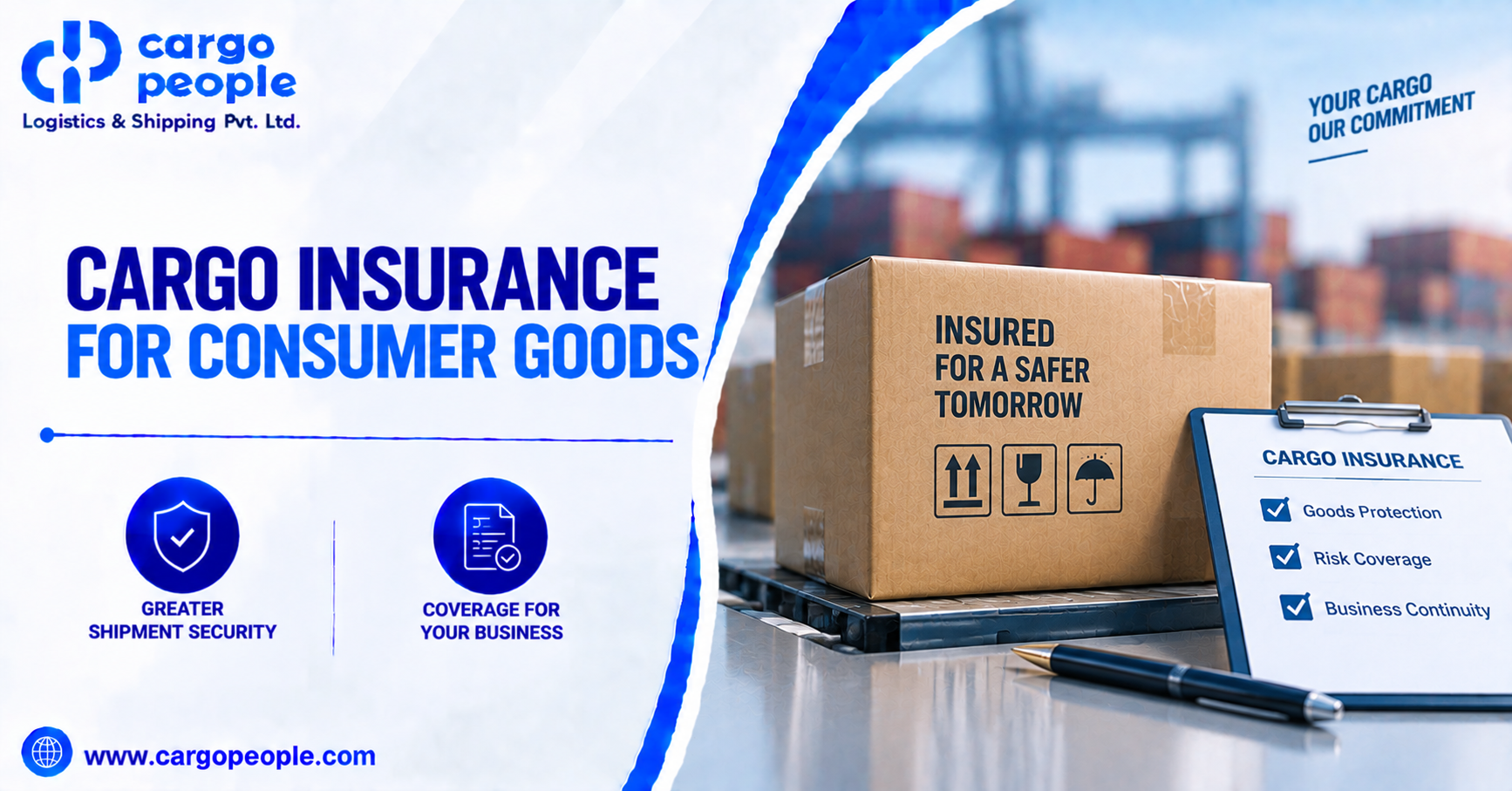
Consumer goods may travel thousands of kilometres before reaching the final buyer, and every stage of that journey creates some level of risk.
Products can be damaged during loading, container movement, sea transit, air transport, customs handling, warehousing, or final delivery.
Cargo Insurance for Consumer Goods helps importers and exporters protect the financial value of their shipment against covered transit risks.
For businesses dealing in electronics, household products, cosmetics, personal care products, packaged foods, retail goods, appliances, and other commercial products, insurance should be considered as part of the logistics plan rather than after a problem occurs.
Cargo People Logistics & Shipping Pvt. Ltd. supports businesses with international freight, customs clearance, warehousing, cargo insurance coordination, and door-to-door delivery.
What is Cargo Insurance?
Cargo insurance provides financial protection for goods moving from one location to another.
Depending on the policy and coverage selected, it may cover certain risks related to loss or physical damage during transportation.
A shipment may move through several stages, including supplier pickup, warehouse handling, port movement, international freight, customs clearance, and final delivery.
Insurance can help reduce the financial impact if insured goods are lost or damaged during covered stages of the journey.
Why Consumer Goods Need Cargo Insurance
Consumer goods are often high in quantity and commercial value.
For example, a shipment may contain 10,000 units of electronics, cosmetics, household products, or retail merchandise.
Even if only part of the cargo is damaged, the financial loss can be significant.
Some products are also more sensitive to moisture, breakage, crushing, leakage, theft, or rough handling.
Cargo insurance can therefore be important for businesses that want to protect inventory value during transportation.
Common Risks During International Shipping
Consumer goods can be exposed to several risks during transit.
These may include:
- Physical damage
- Water or moisture damage
- Theft or pilferage
- Fire
- Handling accidents
- Container damage
- Breakage
- Loss during transportation
The actual coverage depends on the insurance policy, terms, exclusions, and cargo type.
Businesses should review the policy carefully rather than assuming every transit risk is automatically covered.
Cargo Insurance for Sea Freight
Sea freight is commonly used for larger consumer goods shipments.
FCL and LCL cargo may remain in transit for several days or weeks depending on the route.
During this period, the shipment may pass through container yards, ports, vessels, warehouses, and transportation vehicles.
For products sensitive to moisture, movement, or physical damage, proper packaging and cargo insurance can work together to reduce financial risk.
Insurance should ideally be arranged before the shipment begins its journey.
Cargo Insurance for LCL Shipments
LCL cargo usually experiences more handling than FCL cargo.
The shipment may be moved during origin consolidation, container loading, destination deconsolidation, customs examination, and final delivery.
This additional handling can increase the possibility of carton damage or package movement.
Importers shipping smaller quantities of consumer goods through LCL should therefore review both packaging quality and insurance coverage before dispatch.
Cargo Insurance for FCL Shipments
FCL shipments generally involve less cargo handling because the container is dedicated to one shipper.
However, this does not mean the shipment is risk-free.
Containers can still be exposed to accidents, water ingress, heavy movement, theft, or handling damage during transportation.
For a full container carrying high-value consumer goods, the total inventory exposure can be substantial.
Businesses should compare the cargo value with the cost of suitable insurance protection.
High-Value Consumer Goods
Some products require greater attention because a relatively small shipment can carry a high commercial value.
Examples may include:
- Consumer electronics
- Mobile accessories
- Premium cosmetics
- Smart devices
- Electrical equipment
- Branded retail products
- Small appliances
A shipment occupying only a few CBM may still be worth several lakh rupees.
Insurance decisions should therefore be based on cargo value and risk rather than shipment size alone.
Packaging and Cargo Insurance
Cargo insurance does not replace proper packaging.
Insurers may expect goods to be packed appropriately for the transportation method being used.
Weak cartons, poor palletisation, inadequate moisture protection, or unsuitable packaging can increase the chance of damage.
Businesses should use export-quality packaging appropriate for the product and route.
Fragile goods, liquids, electronics, and high-value products may require additional protective measures.
Cargo Value and Insurance Planning
Before arranging cargo insurance, businesses should calculate the commercial value of the shipment accurately.
The value may include the cost of goods and other components depending on the insurance arrangement.
For example, an importer bringing consumer products worth ₹25 lakh should understand how much financial exposure exists if the shipment is damaged or lost.
The insurance coverage should be selected according to the shipment value, commodity, route, and terms agreed with the insurer.
Documents Required for Cargo Insurance
The documents required can vary according to the insurer and shipment.
Common documents may include:
- Commercial Invoice
- Packing List
- Bill of Lading or Air Waybill
- Cargo description
- Shipment value
- Origin and destination
- Transport mode
- Packaging details
Accurate information is important because differences between the declared cargo and actual shipment can create complications during a claim.
Cargo Insurance Claims
If cargo arrives damaged, businesses should document the condition immediately.
Photographs, delivery records, survey reports, packing details, shipping documents, and written notifications may be required depending on the claim.
Damaged packaging should not be discarded before the claim requirements are understood.
Businesses should also report damage promptly according to the policy conditions.
Maintaining complete shipping records can make the claim process easier.
Common Cargo Insurance Mistakes
One common mistake is assuming that the shipping line or freight forwarder automatically covers the full value of the cargo.
Carrier liability and cargo insurance are different.
Another mistake is purchasing insurance without checking exclusions or coverage conditions.
Businesses may also fail to declare the correct cargo type or value.
The insurance policy should therefore be reviewed before shipment rather than only after damage occurs.
How to Reduce Cargo Risk
Insurance is only one part of cargo risk management.
Businesses should also review:
- Packaging quality
- Cargo securing
- Palletisation
- Route selection
- Handling requirements
- Warehouse conditions
- Product sensitivity
- Shipment tracking
Good logistics planning can reduce the chances of damage while insurance helps protect against covered financial losses.
Why Choose Cargo People for Consumer Goods Logistics?
Cargo People Logistics & Shipping Pvt. Ltd. supports importers, exporters, manufacturers, distributors, traders, SMEs, and corporate businesses with international freight and cargo movement.
Our services include sea freight, air freight, FCL and LCL shipping, customs clearance, warehousing, cargo insurance coordination, container handling, and door-to-door delivery.
Cargo People can coordinate the shipment from the overseas supplier through Indian customs clearance and onward to the warehouse, distributor, or final customer.
Our focus is to connect freight, customs, storage, insurance coordination, and delivery through one logistics process.
Learn More About Cargo Insurance for Consumer Goods
Planning to import or export consumer goods and want to reduce the financial risk of international transportation?
The process should begin with cargo valuation, packaging review, freight planning, insurance selection, customs documentation, and final delivery arrangements.
Cargo People Logistics & Shipping Pvt. Ltd. can support businesses with cargo insurance coordination, sea freight, air freight, customs clearance, warehousing, and complete international logistics.
👉 https://cargopeople.com/blog/cargo-insurance-for-consumer-goods/
📞 Get Expert Assistance for Cargo Insurance and Logistics
If you need support with Cargo Insurance for Consumer Goods along with sea freight, air freight, FCL or LCL shipping, customs clearance, warehousing, or door-to-door delivery, Cargo People Logistics & Shipping Pvt. Ltd. can help coordinate the complete shipment.
🌐 Website: https://www.cargopeople.com/
📞 Phone: +91 97174 65454
📧 Email: wecare@cargopeople.com
Contact Cargo People for cargo insurance coordination and complete consumer goods logistics support.

 Arabic
 French
 Spanish
 Portuguese
 Deutsch
 Turkish
 Dutch
Dutch
 Italiano
 Russian
 Romaian
 Portuguese (Brazil)