
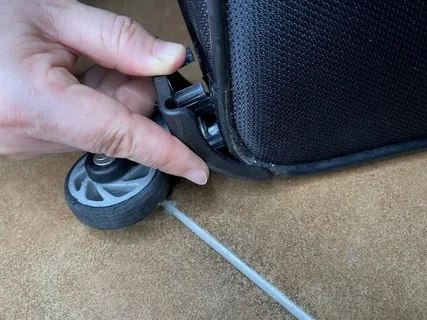
Searching for luggage repair near me often means your suitcase has developed a problem at an inconvenient time. A broken wheel, damaged zipper, loose handle, or torn section can make an otherwise usable bag difficult to travel with.
Before replacing the entire suitcase, inspect the damage carefully. In many cases, one faulty component can be repaired without replacing the whole bag.
Start With a Complete Inspection
Do not check only the part that has stopped working.
Place the suitcase on a flat surface and inspect the outside from top to bottom. Check the wheels, handles, zippers, corners, shell, stitching, and frame.
Then open the luggage and inspect the interior.
Look for:
- Torn lining
- Loose stitching
- Broken zipper sections
- Damaged compartments
- Cracked internal supports
- Signs of moisture or other damage
A complete inspection can reveal additional problems before the suitcase is repaired.
Check the Wheels First
Wheels experience considerable wear during travel.
Airport floors may be smooth, but luggage can also be dragged across sidewalks, roads, stairs, and other uneven surfaces.
Look for wheels that:
- Do not rotate properly
- Wobble while moving
- Make unusual sounds
- Have visible cracks
- Become stuck
- Have worn-down surfaces
If the suitcase body and wheel housing are still sound, replacing the damaged wheel may be enough.
Test the Telescopic Handle
Pull the handle up and down several times without forcing it.
It should extend smoothly and lock into position.
If it feels loose, gets stuck, or drops unexpectedly, the internal mechanism may need attention.
Do not repeatedly force a handle that has become jammed. Excessive pressure can damage the rails or surrounding suitcase structure.
Inspect the Zipper
A zipper can fail in several ways.
The slider may become difficult to move, the teeth may separate, or the surrounding fabric may start to tear.
If the zipper is simply stuck, avoid pulling it aggressively.
A damaged slider may sometimes be replaced, while a badly damaged zipper may require more extensive repair.
Addressing the issue early can prevent the contents of the suitcase from becoming exposed during travel.
Look for Shell Cracks
Hard-shell luggage should be checked carefully after a fall or rough handling.
Not every scratch requires attention, but a deep crack can become larger with continued use.
Pay particular attention to corners, edges, and areas around handles and wheels.
If the shell has major structural damage, ask whether repair is practical before relying on the suitcase for another journey.
Check Soft Luggage for Tears
Fabric suitcases and travel bags can develop tears around corners, handles, seams, and pockets.
Small areas of fraying may become larger when the bag is packed heavily.
Inspect the stitching around handles and straps as well.
If a handle is pulling away from the fabric, repairing it early may prevent the problem from getting worse.
Decide Whether Repair Makes Sense
A suitcase does not automatically need replacing because one component has failed.
Repair may be practical when the main structure remains in good condition.
For example, a suitcase with good wheels, a sound shell, and a working zipper may only need a handle repair.
Replacement may make more sense when several major components have failed or the frame and shell are severely damaged.
Consider the overall condition rather than focusing on one faulty part.
Get Repairs Done Before Traveling
Timing matters.
If your flight is approaching, do not wait until the last minute to deal with a damaged suitcase.
A repair may require replacement components or additional inspection.
Arranging a luggage repair service in Dubai ahead of time gives you an opportunity to address the problem before the bag is packed and ready to leave.
After the repair, test the wheels, handles, zippers, and other affected components before traveling.
Check Other Equipment Before a Trip
Travel preparation often involves more than luggage.
If you are also preparing outdoor equipment, inspect items that may have been stored for a long time.
For example, if a backyard trampoline needs to be assembled or checked before use, a trampoline assembly service can help with the setup.
Keeping separate maintenance tasks organized can make preparation easier and reduce last-minute problems.
Ask What Will Actually Be Repaired
Before approving luggage work, ask what the repair includes.
A wheel problem could involve replacing the wheel, fixing the mounting point, or addressing the surrounding housing.
Similarly, a handle repair may involve the telescopic mechanism rather than the handle grip itself.
Understanding the proposed work helps you know what to expect from the finished repair.
When Should You Replace the Suitcase?
Replacement may be worth considering when:
- The frame is badly bent
- The shell has major structural cracks
- Several important components have failed
- The repair cost is close to buying suitable new luggage
- The suitcase has extensive internal damage
- The bag has already reached the end of its useful life
A professional assessment can help you compare the condition of the luggage with the likely repair requirements.
Final Thoughts
A damaged suitcase does not always need to be replaced. Wheels, handles, zippers, stitching, and other components can often be assessed individually.
If you are searching for luggage repair near me, first identify the damaged parts and check the overall condition of the bag.
Repairing the specific problem may be enough to make the suitcase ready for another trip. If the damage affects the main structure or several major components, replacement may be more practical.

 English
 Arabic
 French
 Spanish
 Portuguese
 Deutsch
 Turkish
 Italiano
 Russian
 Romaian
 Portuguese (Brazil)