
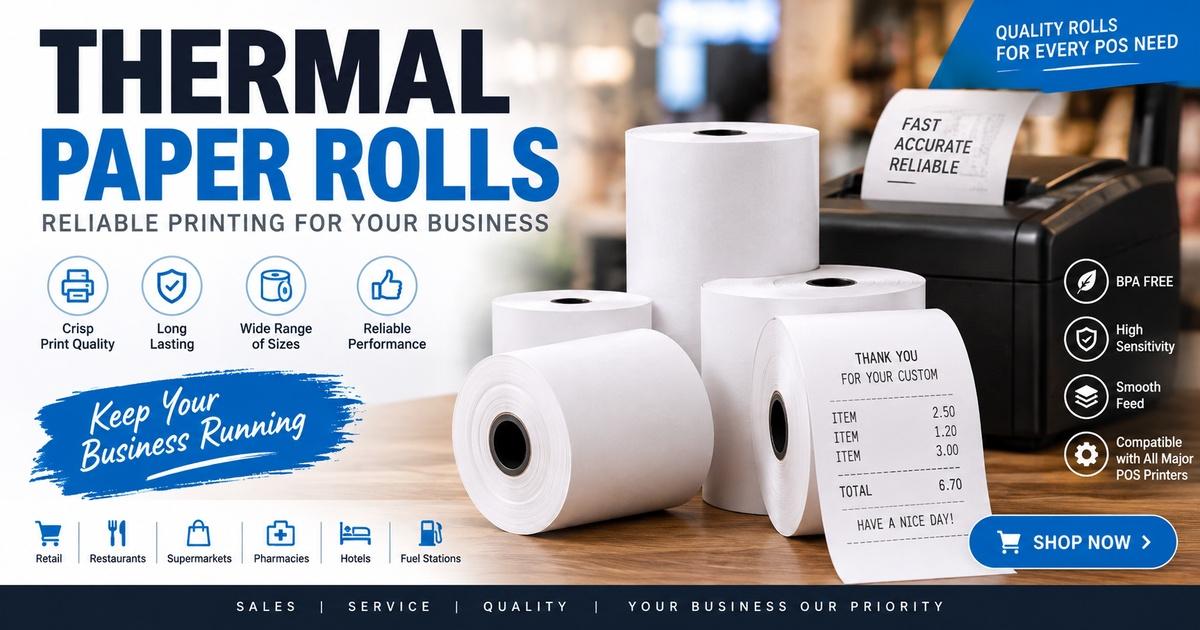
Common Thermal Paper Myths That Just Aren't True
Ask ten people what they think they know about thermal paper and at least half will repeat something that hasn't been true for years, or was never quite accurate to begin with. Between outdated safety concerns around heat-sensitive coated paper, assumptions carried over from older receipt roll technology, and simple misunderstanding of how thermal printing and POS paper rolls actually work, this heat-reactive printing material has picked up more misinformation than a product this ordinary really deserves.
Myth: All Thermal Paper Contains Harmful Chemicals
This belief traces back to genuine early concerns over Bisphenol A (BPA), once the standard colour developer used in most thermal coatings. It's outdated for most of today's market — the majority of manufacturers shifted to BPA-free formulations years ago, commonly using Bisphenol S instead, and a growing share have moved to phenol-free coatings that skip that chemical family entirely. Assuming every roll still uses the older formulation ignores how much the industry has already changed.
Myth: Thermal Paper Needs a Special, Expensive Printer
People sometimes assume thermal printing requires costly, specialised hardware compared to a regular office printer. In reality, thermal printers are typically cheaper to buy and run than ink or laser alternatives, precisely because they skip cartridges, ribbons, and the maintenance that comes with them. The printer itself is usually the less expensive part of the whole setup.
Myth: A Receipt Will Stay Readable Indefinitely
This one causes real problems for anyone relying on a printed receipt for warranty claims or expense records months later. Thermal prints fade over time as the same heat-reactive coating continues responding to ambient heat, light, and friction long after printing. A receipt tucked into a hot glovebox or a sun-exposed dashboard can become illegible within weeks, not years.
Myth: Any Roll Fits Any Thermal Printer
Because thermal rolls look broadly similar at a glance, buyers often assume they're interchangeable across machines.Width, diameter, and core size all need to match a specific printer's holder and feed mechanism exactly, so thermal paper rolls that are even a couple of millimetres off in any dimension usually won't feed correctly.
| Myth | Reality |
| All thermal paper is BPA-based and harmful | Most current stock is BPA-free or phenol-free |
| Thermal printers cost more to run | They're generally cheaper, with no ink or ribbon needed |
| Receipts stay readable forever | Prints fade over time, faster with heat and sunlight |
| Any roll fits any printer | Width, diameter, and core size must match exactly |
| Thermal paper can't be recycled at all | Some facilities accept it; recyclability varies regionally |
Myth: Thermal Paper Can Never Be Recycled
The truth sits somewhere in between rather than at either extreme. The coating layer can complicate standard paper-recycling processes, and some facilities explicitly exclude thermal receipts as a result. Other regions and recycling programmes accept it without issue, particularly with newer, more recyclable coating formulations entering the market. Blanket claims in either direction — always recyclable or never recyclable — both oversimplify a genuinely regional situation.
How the Same Technology Serves Very Different Industries
Beyond the retail till most people picture, thermal paper's role shifts considerably depending on the setting it's used in:
-
Healthcare settings print diagnostic readouts like ECG traces, which need a more fade-resistant coating since they're kept in patient records for years
-
Logistics and courier operations rely on it for shipping labels, prioritising barcode clarity over long-term fade resistance
-
Hospitality and retail favour speed and low running cost above almost everything else, since volume is high and individual receipts are short-lived
-
Transit and ticketing systems need a balance of speed and moderate durability, since a ticket might need to stay legible for a full journey
Each of these settings is technically using the same core technology, just with the coating formulation tuned toward whichever property matters most for that specific use case.
Why These Misconceptions Persist
Most of these myths trace back to outdated information that was accurate at some earlier point and simply never got updated in most people's heads. BPA concerns were legitimate a decade ago; recyclability limitations were more absolute before facilities adapted; the "any roll fits any printer" assumption made more sense when fewer competing formats existed. None of that makes the current myths harmless, though, since they still lead to real buying mistakes and unnecessary confusion.
If you want to read more related blogs , post and other content click here
Frequently Asked Questions
Is thermal paper still made with BPA?
Some are, but most manufacturers have shifted to BPA-free or phenol-free coatings over recent years, so assuming every roll still contains BPA is outdated for most of the current market.
Are thermal printers more expensive to run than regular printers?
No, generally the opposite — thermal printers skip ink and toner cartridges entirely, which usually makes them cheaper to operate over time than ink or laser printers.
Will a thermal receipt stay legible forever if I keep it?
No. The heat-reactive coating keeps reacting to light, heat, and friction after printing, so receipts fade over time, especially if stored somewhere warm or sun-exposed.
Can any thermal paper roll be used in any thermal printer?
No. Width, diameter, and core size all need to match the specific printer's holder and feed mechanism, or the roll won't fit or feed correctly.
Is thermal paper actually recyclable?
It depends on the facility. Some recycling programmes accept it, while others exclude it due to the coating layer, so checking local guidance is more reliable than assuming either way.

 Arabic
 French
 Spanish
 Portuguese
 Deutsch
 Turkish
 Dutch
Dutch
 Italiano
 Russian
 Romaian
 Portuguese (Brazil)