
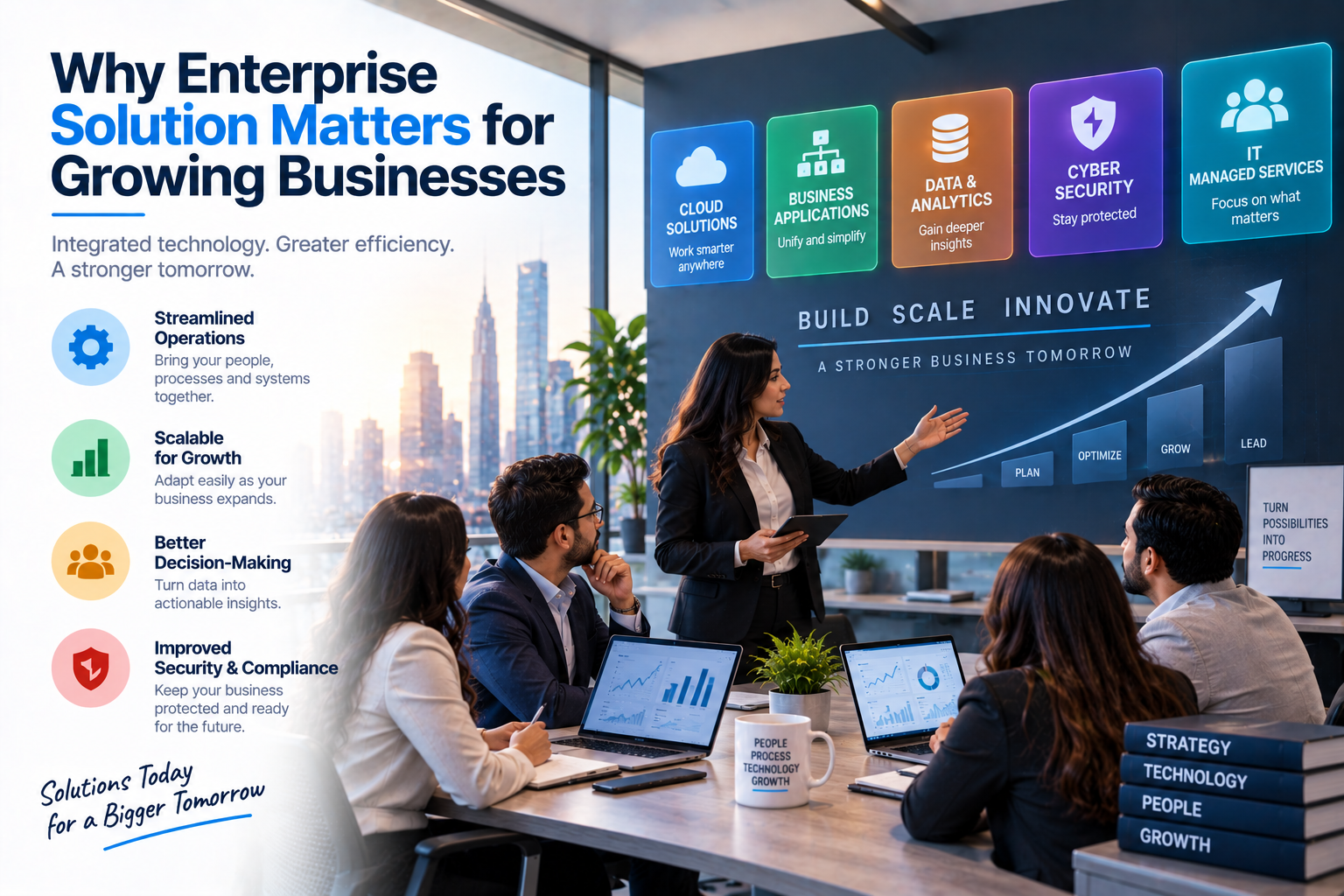
Growing a business is exciting, but it also brings new challenges. What worked when a company had ten employees may not work when the team reaches one hundred. Data increases, customers expect faster service, and different departments need to work together without constant confusion. This is where an enterprise solution becomes valuable.
An enterprise solution helps businesses connect their people, processes, data, and technology through a more organized digital environment. Instead of relying on disconnected applications and manual processes, companies can build systems that support daily operations and future growth. It is not only about using advanced technology. It is about making the business easier to manage.
What Is an Enterprise Solution?
An enterprise solution is a technology platform or collection of integrated systems designed to solve complex business needs. These solutions can support areas such as customer relationship management, finance, human resources, supply chain operations, data management, and business analytics.
For a growing company, having everything connected can make a big difference. Employees spend less time searching for information or entering the same data into multiple systems. Managers can also get a clearer view of business performance and make decisions with better information.
Modern enterprise IT solutions are often designed around the specific requirements of an organization. That matters because every growing business has different workflows, customers, and operational challenges.
Why Growing Businesses Need Enterprise Technology
Growth usually creates complexity. Imagine a company that starts with a simple spreadsheet for customer records. At first, it feels perfectly fine. Then the customer base grows, several employees begin editing different files, and important information gets lost or duplicated.
This is a common problem. Technology that was suitable for a small operation can become a limitation later.
An enterprise solution provides a more structured way to manage business information. Teams can access the data they need, processes can be automated, and leadership can monitor important activities from a central environment. Things become smoother.
Better Business Efficiency
One of the biggest advantages of enterprise systems is improved efficiency. Repetitive tasks can consume hours every week. Employees may manually transfer information between applications, prepare reports, or follow up on routine processes.
Enterprise platforms can automate many of these activities. For example, information entered into one system can be made available to another connected department. Notifications, approvals, reporting, and workflow management can also be streamlined.
This allows employees to focus on more valuable work instead of spending the whole day on administrative tasks.
Improved Data Management and Decision-Making
Business decisions are only as good as the information behind them. When data is scattered across spreadsheets, emails, and separate applications, getting an accurate picture becomes difficult.
Enterprise IT solutions can bring important information together and make it easier to analyze. Business leaders can monitor sales, customer activity, operational performance, and other key metrics without depending entirely on manually prepared reports.
This is particularly useful for companies that are expanding into new markets. Better visibility means management can identify problems earlier and respond before small issues become expensive ones.
Stronger Customer Experience
Customers notice when a business is disorganized. Delayed responses, incorrect information, repeated questions, and poor communication can quickly damage trust.
An enterprise solution can connect customer-facing operations with internal systems. Customer service teams may have access to relevant account information, while sales and support departments can work from a shared source of data.
The result is a more consistent customer journey. It feels simple from the customer's side, even though sophisticated technology may be working behind the scenes.
Supporting Business Growth
Scalability is another important reason businesses invest in enterprise technology. A company should not need to replace its entire technology infrastructure every time it grows.
A well-designed enterprise solution can support additional employees, customers, locations, and business processes as requirements change. Cloud platforms are especially useful because resources can often be expanded without investing heavily in physical infrastructure.
This is where related technologies also become important. Businesses may combine enterprise platforms with cloud computing, cybersecurity, data analytics, and DevOps services in Lahore to create a stronger technology environment.
Better Collaboration Between Teams
As companies grow, departments can sometimes start working like separate businesses. Marketing has one set of information. Sales has another. Finance uses different processes. IT has its own systems.
This creates communication gaps.
Enterprise systems help connect departments and establish shared workflows. Employees can work with more consistent information and understand how their work affects other parts of the organization.
It does not remove every communication problem, of course. People are still people. But good technology can remove many unnecessary barriers.
Enterprise Solutions and Security
Security becomes more important as a business collects more customer and operational data. A growing organization can become an attractive target for cyber threats, especially when multiple applications and users are involved.
Enterprise technology can include access controls, authentication, monitoring, data protection, backups, and other security measures. Businesses can also integrate their systems with dedicated cybersecurity solutions to reduce potential risks.
Security should not be treated as something added at the end. It needs to be considered while designing the technology environment.
How to Choose the Right Enterprise Solution
Choosing an enterprise platform should start with business requirements rather than technology trends. A company should first understand which processes are causing problems and where employees are losing time.
The solution should then be evaluated based on scalability, integration capabilities, security, usability, support, and total cost. A platform may have hundreds of features, but if employees find it difficult to use, its real value will be limited.
Implementation also matters. Even a digital transformation agencies system can fail when employees are not properly trained or when the transition is poorly managed. Businesses should therefore consider planning, customization, migration, testing, and ongoing support before making a final decision.
The Long-Term Value of Enterprise IT Solutions
Enterprise technology is not simply an investment in software. It is an investment in how a business operates.
When systems are properly integrated, companies can reduce operational friction, improve visibility, strengthen customer relationships, and prepare for future expansion. The biggest benefit may not be immediately visible. Over time, better systems allow teams to work faster and management to focus more on strategy.
For growing organizations, that flexibility can become a genuine competitive advantage.
Conclusion
A growing business needs more than good products and hardworking employees. It needs technology that can keep pace with changing demands. An enterprise solution can help connect departments, improve efficiency, organize data, strengthen security, and create a better customer experience.
The right enterprise IT solutions should support today's operations while preparing the company for tomorrow's challenges. Businesses in Pakistan and beyond can use modern digital infrastructure, cloud platforms, analytics, automation, and professional IT services to build that foundation.
For companies looking to strengthen their technology strategy, Chromeis can play an important role in developing and supporting practical enterprise technology solutions that align with real business requirements. Growth becomes easier when the technology behind the business is ready for it.
Frequently Asked Questions
What is an enterprise solution?
An enterprise solution is a technology system or integrated group of systems designed to manage complex business processes. It can help organizations handle areas such as operations, customer management, finance, data, human resources, and reporting from a more connected environment.
Why are enterprise IT solutions important for growing businesses?
Enterprise IT solutions help growing companies manage increasing amounts of data, employees, customers, and business activities. They can improve efficiency, automate repetitive processes, support collaboration, and provide better information for business decisions.
Can small businesses use enterprise solutions?
Yes. Small and medium-sized businesses can use scalable enterprise technologies when their operations become more complex. Cloud-based platforms can be particularly useful because businesses can expand their technology resources as they grow.
How do enterprise solutions improve customer experience?
Connected systems can give employees faster access to customer information and help different departments coordinate their work. This can reduce delays, improve communication, and provide customers with a more consistent experience.
What should businesses consider before choosing an enterprise solution?
Businesses should consider their current processes, future growth, integration requirements, security, scalability, usability, implementation costs, and ongoing support. Choosing a system based only on its features can create problems if it does not fit the organization's actual needs.

 Arabic
 French
 Spanish
 Portuguese
 Deutsch
 Turkish
 Dutch
Dutch
 Italiano
 Russian
 Romaian
 Portuguese (Brazil)