
Introduction
If you sell online in Pakistan — on Daraz, through an Instagram page, from a Shopify or WooCommerce store, or via a WhatsApp catalogue — the money reaching your bank account is no longer the money your customer paid. Somewhere between the buyer's wallet and your account, a bank, a payment gateway or a courier rider has already deducted tax and sent it to the Federal Board of Revenue under your name. That is the single most important thing to understand about the e-commerce tax regime that started on 1 July 2025, and at BACO Consultants we have found it is also the thing most online sellers discover only when their first settlement report looks short. This guide walks through every rate, every section, every deadline and every trap, and if you want the mechanics handled for you rather than explained to you, our corporate, tax and legal services cover the full e-commerce compliance cycle from registration to return.
The regime is not a small tweak. It introduced a brand-new charging section into the Income Tax Ordinance, 2001, converted banks and couriers into withholding agents, barred marketplaces from onboarding unregistered sellers, and — from Tax Year 2027 — quietly changed whether the tax you have already suffered is a full stop or a credit. Getting this wrong costs money in two directions: overpaying because you did not claim an adjustment you were entitled to, or underpaying and inviting a notice. You can check where you currently stand using our withholding tax calculator before reading further.
What Is E-Commerce Tax in Pakistan?
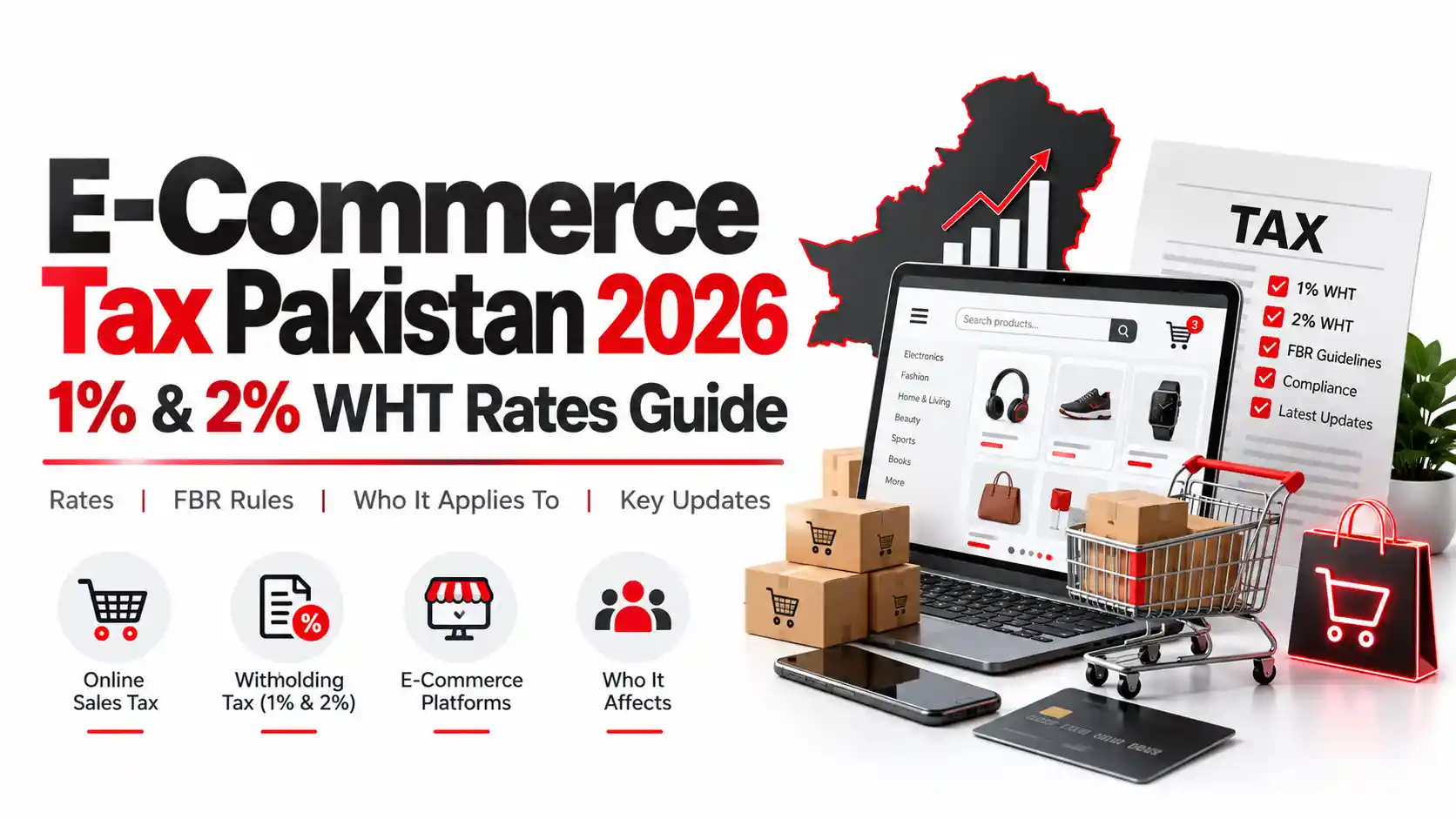
Direct answer: E-commerce tax in Pakistan is a withholding-based income tax on payments received for digitally ordered goods and services supplied from within Pakistan, charged under Section 6A of the Income Tax Ordinance, 2001 and collected at source by payment intermediaries at 1% and by courier services at 2%, together with a separate 2% sales tax on digitally ordered taxable goods under the Sales Tax Act, 1990.
The phrase "e-commerce tax" is slightly misleading, because it is not one tax. It is a package of three moving parts: a charging provision that creates the liability, a collection provision that appoints who deducts it, and a reporting provision that forces the deductors to tell the Federal Board of Revenue (FBR) exactly who they deducted it from. Before July 2025, an online seller was taxed like any other business — you declared your income, you paid on your profit. Now the tax arrives before the profit does. If you are still unsure how withholding differs from the tax you pay with your return, our explainer on Pakistan's withholding tax rate chart for 2026-27 sets out the full landscape.
What makes this regime distinctive is that the withholding agent is not your customer. In classic Section 153 withholding, a company buying goods from you deducts tax and pays you net. Here, the buyer is an ordinary consumer with no withholding duty at all. Instead, the law reaches sideways and grabs the infrastructure of the transaction — the bank, the gateway, the courier — and makes it responsible. That design choice is what allows the FBR to tax millions of small, undocumented sellers without ever auditing a single one of them individually, and it is also why so many sellers who consider themselves "too small to be taxed" are now firmly inside the net. If you have never registered at all, start with our guide to NTN registration in Pakistan step by step.
Why Pakistan Introduced an E-Commerce Tax Regime
Direct answer: The FBR introduced the e-commerce regime because a large population of online sellers operated informally without registration, and taxing them individually was administratively impossible; shifting collection onto banks, gateways, couriers and marketplaces created a workable point of collection and a documentation trail for the digital economy.
Pakistan's retail sector has long been the hardest part of the economy to document. Successive attempts — the CNIC condition on sales, the Tajir Dost Scheme, tax through electricity bills, amnesty schemes — produced limited results. E-commerce compounded the problem, because an Instagram seller shipping COD parcels through a courier leaves almost no institutional footprint. The FBR's stated rationale for this framework is precisely that: a large number of sellers connected to online marketplaces or running e-stores were unregistered and operating informally, so the answer was to register them through a simplified process and collect a contribution on every digitally ordered transaction through a workable withholding mechanism. The wider documentation drive is covered in our summary of the top 10 tax changes in Pakistan's 2026-27 budget.
There is a second, quieter policy goal embedded in the rate structure. The 1% digital rate versus the 2% COD rate is not an accident — the FBR has explained that the differential exists to push transactions toward digital payment channels in support of the national move toward a cashless economy. In other words, the 100 basis points between the two rates is a deliberately priced incentive. A seller who converts a meaningful share of COD orders to prepaid digital orders is not just improving cash flow and reducing return-to-origin losses; they are cutting their withholding burden in half on those orders. This is one of the cleanest, most actionable tax-planning levers available to Pakistani online sellers today, and it sits alongside the broader techniques we set out in tax planning strategies for businesses.
Key Definitions You Must Get Right
Direct answer: The regime turns on four defined terms — digitally ordered goods or services, online marketplace, payment intermediary, and courier service. Whether you are inside or outside the net, and whether 1% or 2% applies, depends entirely on which definition your transaction falls within.
1. Digitally Ordered Goods or Services
This covers goods or services ordered through a digital channel — an online marketplace, a website, or a mobile application — and delivered from within Pakistan. The order, not the payment, is the trigger. A customer who browses your Instagram catalogue, messages you, and then pays cash at the door has still placed a digitally ordered transaction. This surprises a great many sellers who assumed cash meant invisible. If you sell services rather than goods and export them, read our note on income tax returns for freelancers in Pakistan, because the export regime under Sections 154 and 154A works differently.
2. Online Marketplace (OMP)
An online marketplace is a platform that connects third-party sellers to buyers and facilitates the transaction — Daraz being the obvious Pakistani example, alongside app-based and social commerce channels. Critically, an OMP is not a withholding agent for income tax in its own right; its duty is reporting, through the monthly statement under Section 165C(2). Many marketplace sellers wrongly assume the platform "handles the tax" — the platform reports, the bank or courier deducts, and you carry the liability. Where a marketplace also operates its own courier arm, it wears both hats and files both sets of statements. If you are building a marketplace or a platform business, our private limited company registration service is the usual starting point for getting the corporate vehicle right before the compliance load arrives. Book a Free E-Commerce Structuring Consultation
3. Payment Intermediary
A payment intermediary means a banking company, a financial institution (including a licensed exchange company), or a payment gateway that facilitates the transfer of funds or payment instructions between two or more persons. In practice, where a vendor uses an e-store or mobile application and takes online payment, the acquiring bank typically sits in the payment intermediary role and carries the collection duty. This is why your settlement from a gateway arrives net of 1% even though you never authorised any deduction. Understanding which of your banking relationships is the collection point matters for reconciliation, and our business NTN registration service ensures the account is correctly mapped to your registered profile from day one. Talk to a BACO Tax Advisor Today
4. Courier Service
A courier service is a person providing delivery services for goods — expressly including logistics and ride-hailing services — and collecting cash on behalf of a seller. That inclusion of ride-hailing and logistics is broader than most sellers expect, and it means quick-commerce and food-delivery style models can fall inside the definition. Where the courier collects COD, the courier deducts 2% before remitting your sale proceeds. For businesses juggling several couriers with different remittance cycles, the reconciliation discipline in our monthly tax compliance checklist for businesses in Pakistan is the practical control to put in place.
The 1% and 2% Rates — Complete Rate Chart
Direct answer: For sellers on the Active Taxpayer List, tax is collected at 1% of the gross amount on digital or banking-channel payments and 2% on cash-on-delivery payments. For sellers not on the Active Taxpayer List, the Tenth Schedule increases these by 100%, producing effective rates of 2% and 4% respectively.
Three Rate Details That Change Your Numbers
The base is gross, not net. The collection is made on the gross amount payable including sales tax, if any — not on your margin, not on your net settlement after platform commission, and not exclusive of GST. On a Rs. 11,800 order comprising Rs. 10,000 goods value and Rs. 1,800 sales tax, the 1% is charged on Rs. 11,800, not Rs. 10,000. That is Rs. 118, not Rs. 100 — an 18% difference that compounds across thousands of orders. Model the effect on your own numbers with our net profit margin calculator before you set your pricing for the next season.
ATL status is worth exactly half your withholding. Appearing on the Active Taxpayer List halves the rate in both channels. There is no middle ground anymore: the Finance Act, 2026 removed the late-filer relief that previously existed under Rule 1A of the Tenth Schedule, so the gap between being on the list and off it is now binary and unforgiving. Check your status now through our guide on how to check the Active Taxpayer List in Pakistan, and read late filer vs non-filer vs active filer for the wider cost of slipping off.
Double deduction risk under Section 153(1). Where a prescribed person buys from you online, there has been a recognised technical concern that tax could be deducted both under Section 153(2A) by the intermediary and again under Section 153(1) by the payer, because the exclusion that would prevent this was not carried into the final legislation. If you sell B2B online, this is a live reconciliation item — raise it early rather than discovering it in a tax assessment appeal.
Registration Requirements and Documents
Direct answer: Every e-commerce seller must be registered for income tax with a National Tax Number, and online marketplaces and courier services are barred from providing their services to unregistered sellers. Sales tax registration is separately required for e-commerce vendors supplying taxable goods.
This is the enforcement teeth of the regime. Registration is no longer something the FBR chases you for — it is a precondition of doing business at all, because your marketplace and your courier are legally prevented from onboarding you without it.
Documents Required — Company
Companies additionally need the SECP incorporation certificate, Memorandum and Articles of Association, Form-A/Form-II or the equivalent, CNICs of all directors, and a board resolution authorising the principal officer. Our company NTN registration service handles this end to end, and if the company does not exist yet, start with SECP company registration. Get Registered This Week — Start With BACO
Choosing the Right Legal Form
The regime applies identically to a sole proprietor and a private limited company, so the choice of vehicle should be driven by liability, credibility with marketplaces, access to payment gateways and the ability to raise capital — not by any hope of escaping withholding. Our comparison of sole proprietor vs company in Pakistan lays out the trade-offs, and the cost side is covered in company registration cost in Pakistan.
Common Mistakes E-Commerce Sellers Make
Direct answer: The five costliest mistakes are treating all bank credits as sales, ignoring ATL status, failing to collect deduction certificates, confusing income tax and sales tax withholding, and defaulting into the final tax regime without modelling the alternative.
- Treating every bank credit as e-commerce revenue. Capital contributions, refunds to customers, own-account transfers, personal transfers and export proceeds all get swept in, inflating declared turnover and, in the worst case, pushing you over the Rs. 200 million threshold artificially. Split them at source.
- Letting ATL status lapse. Doubling is automatic and silent. You will not get a warning; your settlements will simply arrive lighter. Check active filer status quarterly, not annually.
- Not collecting withholding certificates. Sellers frequently know the tax was deducted but cannot prove it when claiming the credit. Collect certificates monthly while the counterparty relationship is warm.
- Confusing the income tax 2% with the sales tax 2%. They are different taxes under different statutes with different treatments. Registered sellers who fail to adjust the sales tax withholding against output tax are simply donating money. Our sales tax filing checklist prevents this.
- Accepting the final tax regime by default. From TY2027 it is a choice for sellers up to Rs. 200 million turnover. Making it passively, without modelling, is the most expensive form of inaction available to a low-margin seller.
- Assuming the marketplace "handles the tax." Marketplaces report; banks and couriers deduct; you are the taxpayer. The liability never leaves you.
- Ignoring the wealth statement. A business that grows from Rs. 2 million to Rs. 20 million in a year with no corresponding wealth reconciliation is a Section 111 enquiry waiting to happen. See the wealth statement guide.
- Not filing because "the tax is already deducted." Filing is what keeps you on the ATL, which is what keeps your rate at 1% and 2%. Non-filing costs you twice.
Expert Tips and Best Practices
Direct answer: Shift your payment mix toward digital channels, protect ATL status as a financial asset, reconcile monthly rather than annually, keep export and local receipts strictly segregated, and model the regime election before every filing.
Price the tax into your listings. The levy is on gross value including sales tax. If it is not in your price, it is in your margin.
Incentivise prepaid checkout. A 2% prepayment discount costs you the same as the COD tax differential while improving cash conversion and cutting return-to-origin losses. Test it on one category first. See tax planning strategies for businesses.
Treat ATL status as a balance-sheet item. At Rs. 50 million of COD sales, ATL status is worth Rs. 1 million a year in avoided withholding. Diarise the filing date.
Reconcile monthly, close quarterly. Build an orders-to-settlement-to-bank bridge every month while the data is fresh. Annual reconstruction is where errors and lost credits come from.
Segregate exports rigorously. Section 6A does not touch receipts already withheld under Sections 154 and 154A. Mixing them creates both overpayment and audit risk.
Keep your IRIS profile current. Business activity codes, addresses and bank accounts are the fields the FBR matches against marketplace and courier statements. Stale data produces false mismatches. Our FBR IRIS 2.0 guide covers the current portal.
Pay online and keep the PSID trail. See how to generate and pay tax online through PSID.
Get an opinion in writing before you elect. The regime election is a commercial decision with a several-lakh consequence for many sellers. Treat it accordingly — our startup tax consultancy service exists for exactly this. Get a Written Opinion on Your E-Commerce Tax Position
Why Choose BACO Consultants for E-Commerce Tax Compliance in Pakistan
Direct answer: BACO Consultants combines chartered accountancy, legal practice and hands-on FBR representation in a single team, which is what e-commerce tax work actually requires — because the questions it raises are simultaneously accounting questions, statutory interpretation questions and enforcement questions.
E-commerce tax is a genuinely cross-disciplinary problem. Working out whether a courier remittance was correctly withheld is an accounting reconciliation. Working out whether Section 153(1) can be applied on top of Section 153(2A) is statutory interpretation. Working out how to answer a Section 161 show-cause notice is advocacy. Most advisory firms are strong in one of those three and improvise the other two. Our practice is built around all three, and our team reflects that.
What working with us looks like in practice:
- Full-cycle e-commerce compliance. Registration, sales tax registration where required, monthly reconciliation, statutory statements, and annual filing — see our complete service catalogue.
- Regime modelling before you file. We compute your position under both the final and adjustable routes and give you a written recommendation, rather than defaulting you into whichever is easier to file.
- Withholding-agent support. If you operate a marketplace, gateway or courier business, we handle quarterly withholding statements and monthly sales tax returns.
- Notice and appeal representation. From first response through to appellate proceedings — see the tax appeal process in Pakistan.
- Cross-border capability. For Pakistani sellers using US entities to access international marketplaces, our USA company formation and tax filing services sit alongside the local work.
- Free diagnostic tools. Our calculator suite is publicly available, because we would rather you arrive with informed questions.
Clients across Islamabad, Rawalpindi, Lahore and Karachi work with us on exactly this brief — see best tax consultant in Islamabad for how we approach engagements. Book Your E-Commerce Tax Consultation With BACO Consultants
Frequently Asked Questions
Q1. What is the e-commerce tax rate in Pakistan in 2026?
For sellers on the Active Taxpayer List, tax is collected at 1% of the gross amount on payments made through digital or banking channels, and 2% on cash-on-delivery payments, under Section 153(2A) of the Income Tax Ordinance, 2001. Sellers not on the ATL face 2% and 4% respectively.
Q2. Who deducts the 1% and 2% e-commerce withholding tax?
The payment intermediary — a banking company, financial institution, licensed exchange company or payment gateway — deducts 1% on digital payments. The courier services, including logistics and ride-hailing operators collecting cash, deducts 2% on cash-on-delivery payments. Online marketplaces report but do not deduct income tax.
Q3. Is the e-commerce tax final or adjustable?
For Tax Year 2026 it was a final tax. From Tax Year 2027, the Finance Act, 2026 made it adjustable where turnover exceeds Rs. 200 million, and allows persons with turnover up to Rs. 200 million to opt out of the final tax regime when filing their return.
Q4. Is the 1% calculated on my profit or on the total order value?
On the gross amount payable, including sales tax if any. It is not calculated on profit, and it is not reduced by platform commission, shipping charges or payment-gateway fees.
Q5. Do I still have to file an income tax return if tax was already deducted?
Yes. Filing is what keeps you on the Active Taxpayer List, and ATL status is what keeps your withholding rate at 1% and 2% instead of 2% and 4%. Not filing effectively doubles your tax.
Q6. Can an online marketplace or courier ship for me if I have no NTN?
No. Online marketplaces and courier services are barred from providing services to unregistered sellers, so registration is now a commercial precondition of trading online, not just a legal duty.
Q7. Does this apply to freelancers and IT exporters?
Not to their export receipts. Proceeds already subject to withholding under Sections 154 and 154A of the Income Tax Ordinance, 2001 fall outside the Section 6A e-commerce regime. Local e-commerce sales by the same person are covered.
Q8. What is the difference between the 2% income tax and the 2% sales tax?
They are separate taxes. The 2% income tax applies to cash-on-delivery payments under Section 153(2A) of the Income Tax Ordinance, 2001. The 2% sales tax applies to the gross value of digitally ordered taxable goods under Serial 8 of the Eleventh Schedule to the Sales Tax Act, 1990. Both can apply to the same order.
Q9. How can I reduce my e-commerce withholding tax legally?
Stay on the Active Taxpayer List to halve the rate, shift your payment mix from cash on delivery to prepaid digital payments to move from 2% to 1%, register for sales tax where that makes the 2% sales tax withholding adjustable, and from Tax Year 2027 evaluate the opt-out from the final tax regime if your margins are thin.
Q10. What happens if a courier or bank fails to deduct the tax?
The withholding agent becomes liable. Under the Income Tax Ordinance, recovery typically proceeds under Section 161 read with Section 205 together with default surcharge; under the Sales Tax Act, Section 11F allows recovery of the amount that should have been withheld plus default surcharge and penalty.
Conclusion
Pakistan's e-commerce tax regime is no longer new, and it is no longer avoidable. Section 6A creates the charge, Section 153(2A) collects it at 1% on digital payments and 2% on cash on delivery, the Tenth Schedule doubles both for anyone off the Active Taxpayer List, Section 165C makes sure the FBR sees every transaction, and a separate 2% sales tax sits on top for digitally ordered taxable goods. The Finance Act, 2026 then added the piece most sellers have not yet acted on: from Tax Year 2027, the tax is adjustable above Rs. 200 million turnover, and everyone below that threshold can opt out of the final regime at filing.
Our single key recommendation: stop treating this as a deduction that happens to you, and start treating it as a variable you manage. Get on the ATL and stay there — it is worth half your withholding. Move your payment mix toward prepaid — it is worth the other half on those orders. Reconcile monthly so your credits survive. And before you file, model the final-versus-adjustable choice properly, because for a seller on a single-digit margin it is often the difference between a meaningful tax bill and none at all. Read benefits of becoming a tax filer in Pakistan if you are still deciding.
Your logical next step is a twenty-minute review of your own numbers: your gross online sales, your payment split, your ATL status and your true net margin. Put those four figures in front of a qualified adviser and the right regime choice becomes obvious. If you would like us to do that with you, we are one click away. Book Your Free E-Commerce Tax Review With BACO Consultants
Disclaimer
This article is for general informational purposes only and does not constitute professional tax, legal, or financial advice. Tax rates, thresholds, deadlines and procedures in Pakistan change with each Finance Act and are subject to subsequent statutory rules, SROs, circulars and judicial interpretation. Figures flagged must be confirmed against the operative text on the official Federal Board of Revenue portal before being relied upon. Nothing here guarantees any particular assessment, approval or outcome. Consult a qualified BACO Consultants advisor for guidance specific to your situation.

 Arabic
 French
 Spanish
 Portuguese
 Deutsch
 Turkish
 Dutch
Dutch
 Italiano
 Russian
 Romaian
 Portuguese (Brazil)