
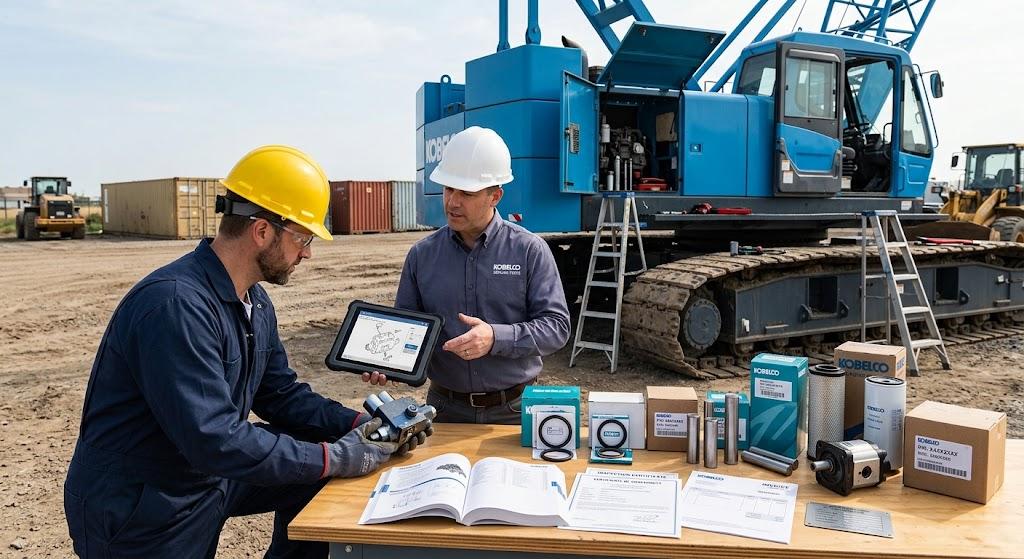
There's a particular sinking feeling that comes with watching a Kobelco crane sit motionless on a job site. The crew waits. The schedule compresses. And the only thing standing between you and getting back to work is a single failed component.
Maybe the swing motor on your CKE series has seized. Maybe the boom cylinder seals on a rough-terrain unit have deteriorated past the point of temporary repair. Regardless, the pressure to source a replacement quickly is intense.
In that pressure, mistakes happen. Operators rush to order from the first listing they find, trusting the part number alone. But heavy-equipment components aren't interchangeable the way consumer goods are. A single wrong specification can turn a routine repair into a multi-day ordeal involving secondary damage, return shipping, and rework.
Before you place that order, pause. Ask five targeted questions. The conversation takes minutes and can spare you from consequences that take days or weeks to resolve.
1. "Who Actually Manufactured This Component?"
The distinction between OEM and aftermarket isn't a simple good-versus-bad comparison. Aftermarket Kobelco parts can deliver reliable performance at a lower cost. The problem isn't the category — it's not knowing the specifics within it.
Listings that describe items as "OEM equivalent" or "direct replacement" are intentionally broad. Find out the manufacturer. Is the brand identifiable and reputable, or is it an unknown entity operating behind a generic label? A transparent crane parts supplier will answer these questions without prompting or deflection.
For components operating under extreme mechanical stress — wire ropes, swing bearings, hydraulic pumps, boom pins — stick with OEM or a manufacturer with a proven track record in the industry. For items like seals, gaskets, and filters, a quality aftermarket alternative from a recognized brand is often perfectly adequate. Making that distinction intentionally, rather than by accident, protects your investment.
2. "Have You Verified Compatibility with My Machine's Serial Number?"
Production history matters enormously with Kobelco equipment. The CK, CKE, RK, and SL product lines span many years, and each generation carries engineering revisions that alter part fitment. A component designed for a 2014 CKE2500G may not physically or functionally match a 2019 CKE2500G-2, even if the base part number appears identical.
Hand the seller your complete machine details: model designation, serial number, and year of manufacture. Demand verification against the parts catalog, not just a surface-level number match. The accuracy of sourcing Kobelco parts depends entirely on this step.
The stakes increase significantly with hydraulic and electrical components. Two solenoid valves may share identical dimensions yet differ in operating voltage, coil resistance, or connector pinout between model revisions. Without serial-number-level confirmation, you're gambling on compatibility. That gamble has consequences well beyond the cost of the part itself.
3. "Is This Item Physically Available in Your Facility Today?"
Inventory language varies wildly across the industry. "In stock" might mean the item is boxed on a shelf waiting for pickup. It might also mean the seller intends to order it from a third-party distributor and call that "in-stock availability." These are fundamentally different scenarios.
Ask directly whether the part sits in their warehouse or whether it's being sourced elsewhere. If it's sourced, clarify the origin — domestic facility versus overseas supplier — and what the realistic delivery window looks like to your location.
Time-sensitive repairs demand precision, not generalized estimates about typical shipping times. A competent crane parts supplier should be able to confirm inventory status, warehouse location, and expected ship date within minutes. Also address freight logistics for larger Kobelco parts like boom sections, counterweights, or complete hydraulic assemblies. These items require specialized handling and carrier arrangements that not every seller can manage efficiently.
4. "What Are Your Warranty Terms and Return Conditions?"
Standing behind a product is easy to claim. Defining what that commitment looks like in practice — in writing — is what separates dependable sellers from everyone else.
Request specific details: warranty duration, coverage scope, and whether the policy extends beyond manufacturing defects to include premature wear under normal operating conditions. Clarify who bears the cost of return shipping for defective items. A responsible crane parts supplier provides documented answers rather than verbal assurances that evaporate when problems arise.
For aftermarket components, confirm whether a fitment guarantee exists. If a pump valued in the thousands arrives with an incompatible flange pattern despite the seller's earlier verification, the question of who absorbs restocking fees and return freight needs answering before the transaction occurs. Establishing these terms upfront prevents adversarial situations after money has changed hands.
5. "Can You Supply Test Certificates, Material Specifications, or Traceability Records?"
Documentation distinguishes established suppliers from casual intermediaries. This is particularly true for load-bearing and safety-critical Kobelco parts — wire ropes, hooks, sheaves, structural pins, and hydraulic cylinders.
Material test reports, load certificates, and verification against applicable ISO or JIS standards should accompany these components as standard practice. In regulated environments or projects with compliance requirements, missing paperwork creates real liability for your operation.
Even for lower-risk items, a seller capable of providing spec sheets and datasheets demonstrates genuine product knowledge rather than surface-level catalog browsing. Ask directly whether documentation will ship with the part. If the response involves checking with a third party or promising to follow up later, note that. It signals where that seller's actual expertise begins and ends.
The Broader Value of Asking
None of these questions are designed to create friction or test the seller's patience. They represent the same kind of methodical thinking you apply during daily operations — walking the machine, checking wear points, verifying that everything meets standard before you commit to the work.
A reputable crane parts supplier will recognize informed questioning as a positive signal. It establishes a foundation for an ongoing working relationship. That relationship becomes invaluable during genuine emergencies — early-morning failures, weekend breakdowns, situations where someone needs to pick up the phone and act immediately.
Sellers who resist these questions, provide evasive answers, or rush toward closing the transaction are communicating something about how they operate beyond the initial sale. Your Kobelco equipment has earned its place through consistent hard work. It deserves components that match the original specifications, arrive with proper documentation, and are supplied by someone who takes accountability for what they sell. Five questions and a few minutes of conversation are all that stand between a smart purchase and an expensive mistake.

 Arabic
 French
 Spanish
 Portuguese
 Deutsch
 Turkish
 Dutch
Dutch
 Italiano
 Russian
 Romaian
 Portuguese (Brazil)