
Importers bringing large quantities of machinery, electronics, industrial components, raw materials, or finished goods into India often face a working-capital challenge because customs duty can become payable before goods are released for domestic use.
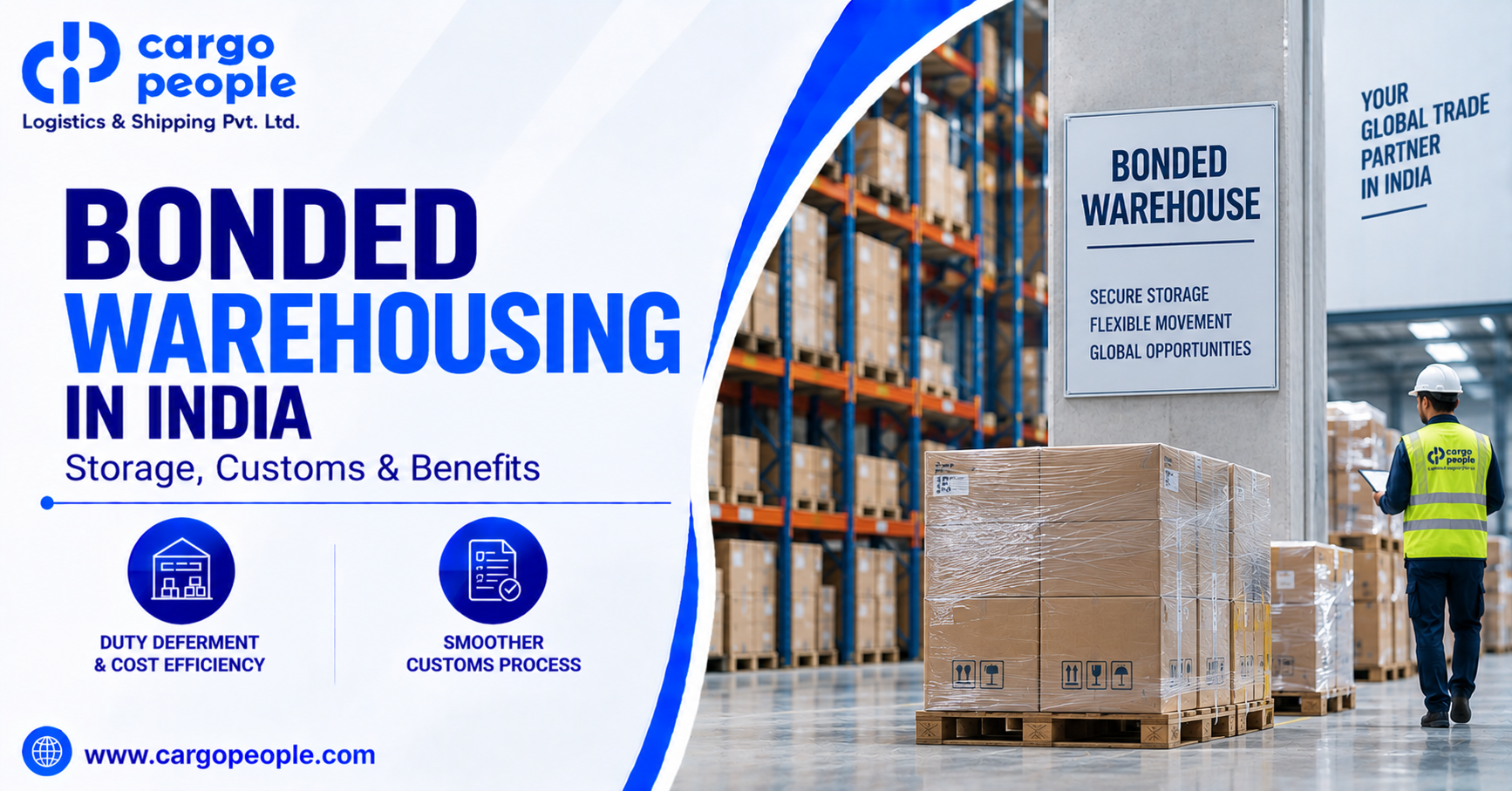
Bonded Warehousing in India allows eligible imported goods to be stored in an approved customs bonded warehouse under customs control before final domestic clearance. This can help businesses manage inventory more efficiently and defer applicable customs duty until the goods are cleared for home consumption.
The biggest advantage is flexibility. Instead of clearing the entire shipment at once, an importer may be able to clear goods according to actual business demand while the remaining eligible inventory continues to stay under bond.
Cargo People Logistics & Shipping Pvt. Ltd. supports importers, manufacturers, distributors, and trading businesses with bonded warehousing coordination, customs clearance, sea freight, air freight, container handling, warehousing, and door-to-door logistics.
What is Bonded Warehousing?
A bonded warehouse is an approved facility where imported goods can be stored under customs control before applicable duties are paid for domestic clearance.
Unlike a normal warehouse, goods in a bonded warehouse have not yet completed the full customs clearance process for domestic use.
For example, an importer may bring 1,000 units of industrial equipment into India but require only 300 units immediately. Instead of clearing the full quantity at once, the business may plan clearance according to actual demand while the remaining stock continues in bonded storage.
Why Importers Use Bonded Warehousing
Bonded warehousing is mainly used to improve inventory and cash-flow planning.
Suppose a company imports goods worth ₹1 crore but expects to sell the stock over the next 4 months. Paying customs duty on the complete shipment immediately can block working capital even though much of the stock may remain unused.
Before choosing bonded warehousing, businesses should review:
- Import value
- Expected customs duty
- Monthly inventory requirement
- Storage period
- Domestic sales plan
- Possible re-export requirement
This helps determine whether bonded storage provides a real commercial benefit.
How Bonded Warehousing Works
The process generally begins when imported cargo reaches an Indian airport or seaport and the importer chooses the applicable warehousing procedure instead of immediately clearing the entire shipment for domestic consumption.
After the required customs documentation is completed, eligible goods can be moved to an approved bonded warehouse. The warehouse maintains inventory records while the goods remain under customs control.
When the importer needs part or all of the stock, the applicable customs clearance and duty payment process is completed for that quantity.
This allows businesses to connect duty payment more closely with actual inventory movement.
Bonded Warehousing for Machinery
Machinery imports can involve high-value shipments and significant customs-duty exposure.
A manufacturer may import several machines together, but installation may take place in different phases. Some equipment may be needed immediately while other machines may be required after 2 or 3 months.
Bonded warehousing can provide temporary storage while the business prepares factory space, civil work, utilities, installation teams, or project schedules.
For heavy machinery, the warehouse should also have suitable flooring, loading access, lifting equipment, and safe handling arrangements.
Bonded Warehousing for Electronics
Electronics often have high commercial value even when they occupy relatively little space.
Typical products may include servers, telecom equipment, networking devices, industrial electronics, sensors, control systems, computer components, and electrical assemblies.
These goods may require additional attention to security, moisture, handling, inventory tracking, and product segregation.
For sensitive electronics, businesses should also check whether any manufacturer-recommended storage conditions are required.
Bonded Warehousing for FCL Shipments
Large imports often arrive as FCL cargo.
A typical FCL bonded movement may involve container arrival, customs warehousing formalities, transportation to the approved warehouse, container destuffing, cargo verification, and inventory receiving.
These steps should ideally be planned before the vessel reaches India.
If the warehouse, transporter, customs documents, or unloading arrangements are not ready, the importer may face additional container detention or storage costs.
Bonded Warehousing for LCL Cargo
Smaller shipments may arrive as LCL cargo.
LCL shipments normally pass through consolidation and deconsolidation facilities, so the cargo may experience additional handling before reaching the bonded warehouse.
If bonded storage is required, the customs and logistics teams should coordinate the movement from the arrival facility to the approved warehouse according to the applicable procedure.
Because LCL cargo is handled more frequently, strong packaging and accurate package identification become especially important.
Customs Documentation for Bonded Warehousing
Accurate customs documentation is important because bonded cargo must remain clearly traceable.
The customs file may include the Commercial Invoice, Packing List, Bill of Lading or Air Waybill, IEC details, HS Code, product description, country-of-origin details, and applicable regulatory documents.
For machinery, electronics, or regulated products, technical catalogues or product compliance documents may also be required.
The customs team should review the documentation before cargo arrival so that missing information can be corrected early.
Inventory Control in a Bonded Warehouse
Inventory control is one of the most important parts of bonded warehousing.
The warehouse and importer should be able to identify what goods entered the facility, what quantity remains in bond, and what quantity has been cleared or moved under the applicable customs procedure.
For businesses managing several products or models, inventory may need to be tracked by product, SKU, model, quantity, import document, and storage location.
Good inventory control helps reduce differences between physical stock and customs records.
Partial Clearance of Imported Goods
One of the practical advantages of bonded warehousing is the ability to plan phased clearance where permitted.
For example, a distributor imports 10,000 units of a product but expects monthly sales of around 2,000 units.
Instead of immediately clearing all 10,000 units, the company may plan customs clearance according to actual demand while the remaining eligible goods stay under bond.
This can reduce upfront cash-flow pressure and help businesses manage inventory more efficiently.
Bonded Warehousing and Re-Export
Some companies import goods into India but may later need to supply part of the stock to another international market.
Regional distributors, spare-parts businesses, project suppliers, and international trading companies may therefore consider bonded warehousing when re-export is a possible requirement.
Goods remaining under the appropriate bonded procedure may provide more flexibility for such movements compared with goods already cleared for domestic consumption.
The re-export plan should be discussed with the customs and logistics team before cargo movement.
Importance of Warehouse Location
Warehouse location can significantly affect the total logistics cost.
An importer should consider the distance between the warehouse and the seaport, airport, ICD, factory, customers, and major distribution markets.
For example, a warehouse with a lower monthly rent may not actually be cheaper if it adds significant transportation cost for every delivery.
The best warehouse should therefore be selected on total logistics cost rather than storage rent alone.
Bonded Warehousing Cost in India
There is no fixed bonded warehousing cost in India.
The final cost depends on cargo type, storage period, number of pallets, cargo weight, warehouse location, handling frequency, loading and unloading, and transportation requirements.
For example, heavy industrial machinery may require specialized lifting and floor capacity, while electronics may require higher security and more controlled handling.
This is why businesses should ask for a complete cost structure before selecting a bonded warehouse.
Common Bonded Warehousing Mistakes
Many problems happen because bonded warehousing is considered only after cargo has already reached India.
At that stage, the importer may have limited time to arrange customs documentation, warehouse space, transportation, and inventory controls.
Other common mistakes include poor stock records, choosing an unsuitable warehouse, ignoring handling costs, and failing to plan when inventory will actually be cleared.
Bonded warehousing works best when it is planned before shipment rather than used as emergency storage.
How to Reduce Bonded Warehousing Delays
The best way to reduce delays is to prepare the customs and warehouse plan before cargo arrives.
A practical checklist includes:
- Confirm cargo details and HS Code
- Review customs documentation
- Select the bonded warehouse
- Plan FCL or LCL movement
- Arrange transportation
- Prepare unloading requirements
- Set up inventory tracking
- Plan phased domestic clearance
This gives the importer, customs team, transporter, and warehouse more control over the shipment.
Bonded Warehousing and Freight Forwarding
Bonded warehousing is closely connected with international freight and customs clearance.
A typical shipment may begin with supplier pickup overseas, followed by air or sea freight, arrival in India, customs warehousing formalities, bonded transportation, warehouse receiving, storage, phased customs clearance, and final domestic delivery.
If these stages are handled separately, the importer may need to coordinate between multiple service providers.
A freight forwarder with customs and warehousing capabilities can help manage the complete process more efficiently.
Why Choose Cargo People for Bonded Warehousing in India?
Cargo People Logistics & Shipping Pvt. Ltd. supports importers, manufacturers, distributors, traders, SMEs, and corporate businesses with bonded cargo and international logistics planning.
Our support includes bonded warehousing coordination, air freight, sea freight, FCL and LCL shipping, customs clearance, container handling, container destuffing, warehousing, cargo insurance coordination, and final delivery.
Cargo People can coordinate the movement from the overseas supplier through the Indian port or airport and onward to the bonded warehouse or final destination.
Our focus is to manage freight, customs clearance, storage, inventory movement, and domestic delivery through one coordinated logistics process.
Learn More About Bonded Warehousing in India
Planning to import a large shipment but do not need the complete inventory immediately?
The process should begin with customs planning, warehouse selection, inventory controls, cargo movement, storage requirements, and a clear strategy for phased domestic clearance or re-export.
Cargo People Logistics & Shipping Pvt. Ltd. can support businesses with bonded warehousing, customs clearance, sea freight, air freight, container handling, and door-to-door logistics.
📞 Get Expert Assistance for Bonded Warehousing in India
If you are looking for Bonded Warehousing in India or need support with import customs clearance, FCL or LCL shipping, sea freight, air freight, container destuffing, warehousing, or door-to-door logistics, Cargo People Logistics & Shipping Pvt. Ltd. can help coordinate the process.
🌐 Website: https://www.cargopeople.com/
📞 Phone: +91 97174 65454
📧 Email: wecare@cargopeople.com
Contact Cargo People for bonded warehousing and complete import logistics support in India.

 Arabic
 French
 Spanish
 Portuguese
 Deutsch
 Turkish
 Dutch
Dutch
 Italiano
 Russian
 Romaian
 Portuguese (Brazil)